Cheat
yq YAML processor
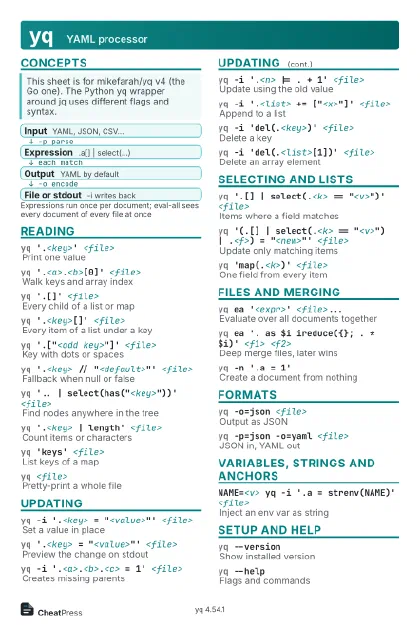 Light · Postcard
102 × 152 mm · PDF
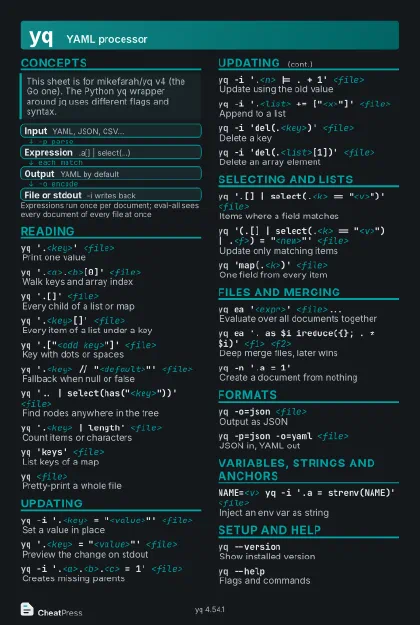 Dark · Postcard
102 × 152 mm · PDF
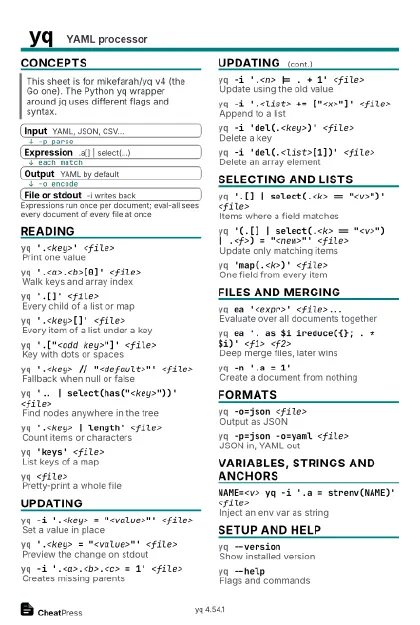 Ink saver · Postcard
102 × 152 mm · PDF
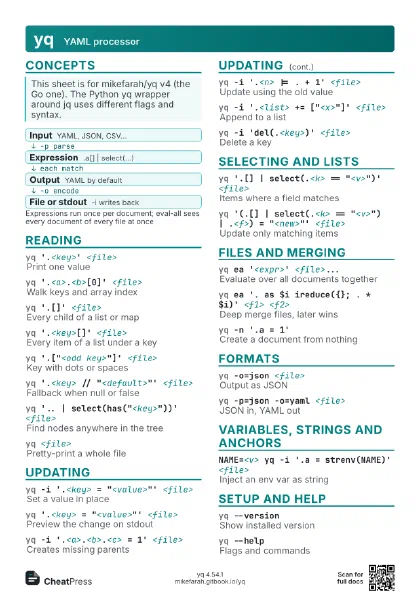
 Light · A4 landscape
297 × 210 mm · PDF
 Dark · A4 landscape
297 × 210 mm · PDF
 Ink saver · A4 landscape
297 × 210 mm · PDF
 Light · A3 landscape
420 × 297 mm · PDF
 Dark · A3 landscape
420 × 297 mm · PDF
 Ink saver · A3 landscape
420 × 297 mm · PDF
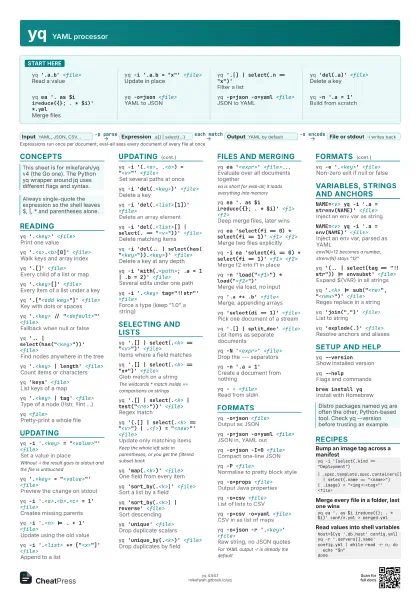
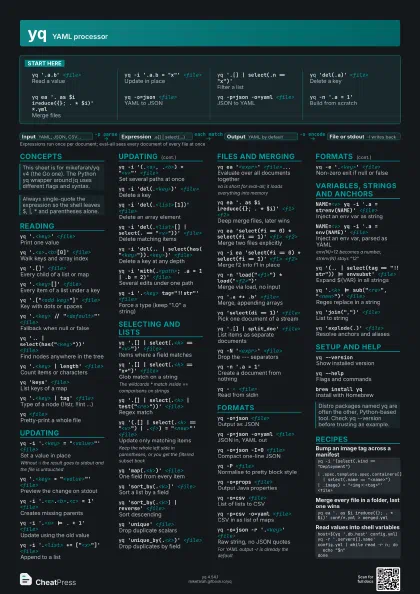
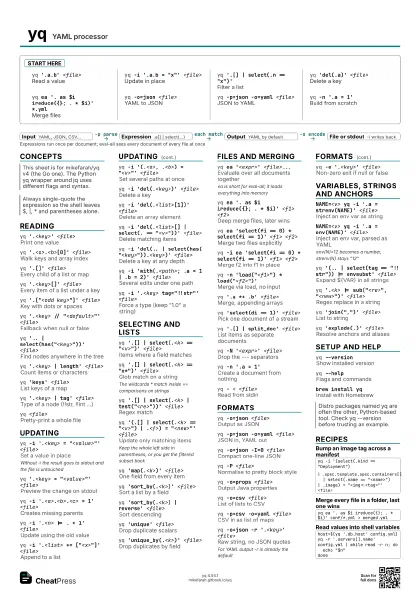
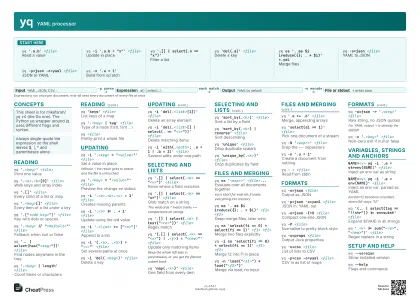
Start here
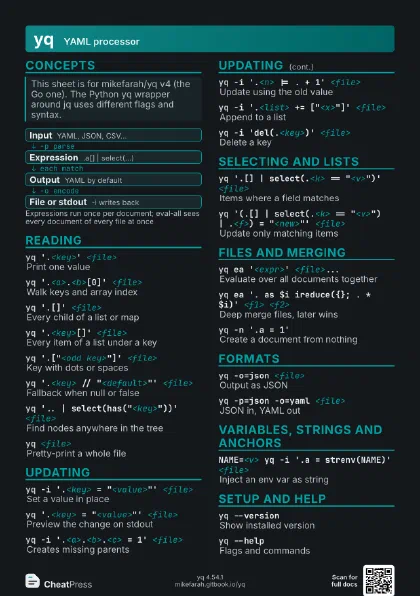
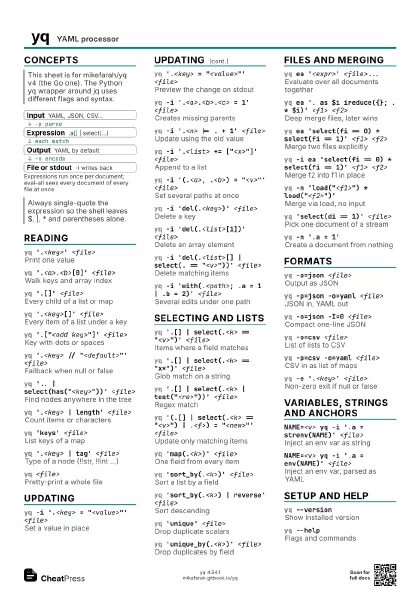
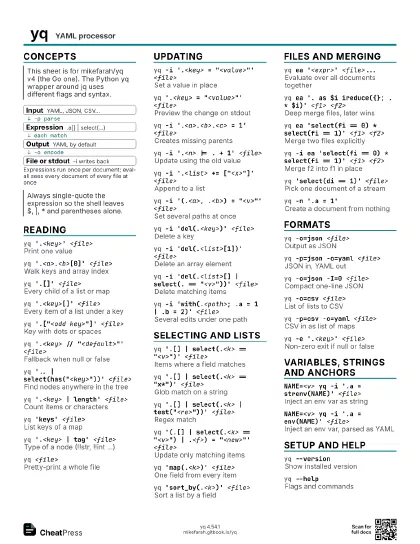
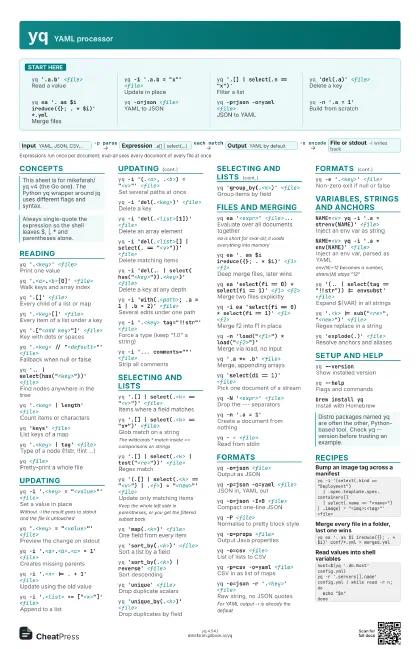
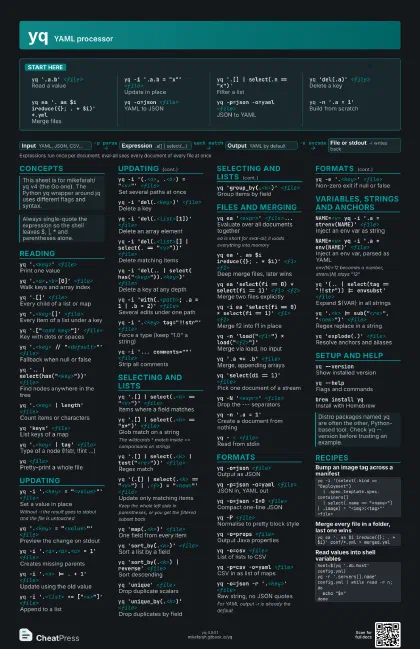
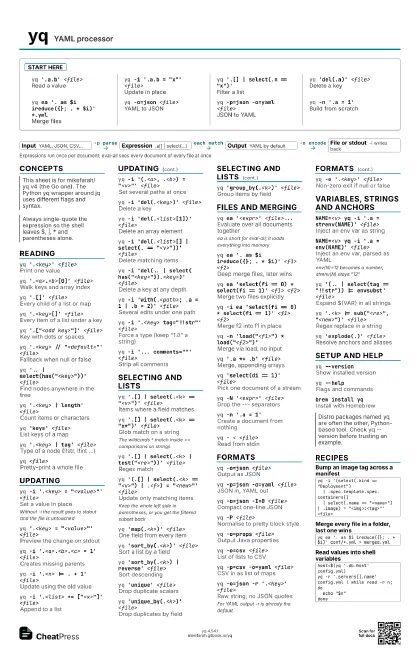
yq '.a.b' <file>
Read a value
yq -i '.a.b = "x"' <file>
Update in place
yq '.[] | select(.n == "x")'
Filter a list
yq 'del(.a)' <file>
Delete a key
yq ea '. as $i ireduce({}; . * $i)' *.yml
Merge files
yq -o=json <file>
YAML to JSON
yq -p=json -o=yaml <file>
JSON to YAML
yq -n '.a = 1'
Build from scratch
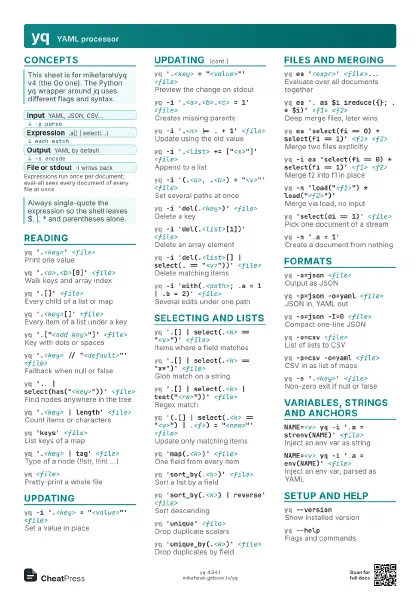
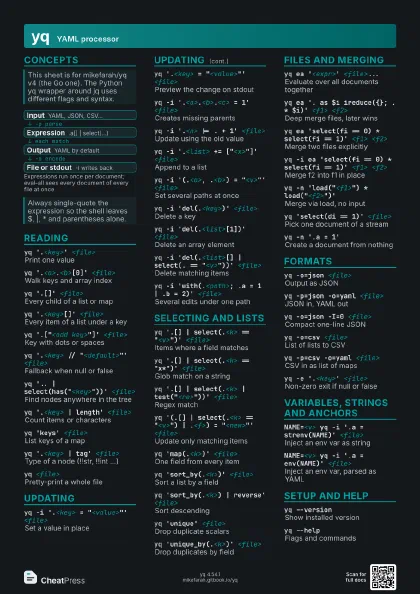
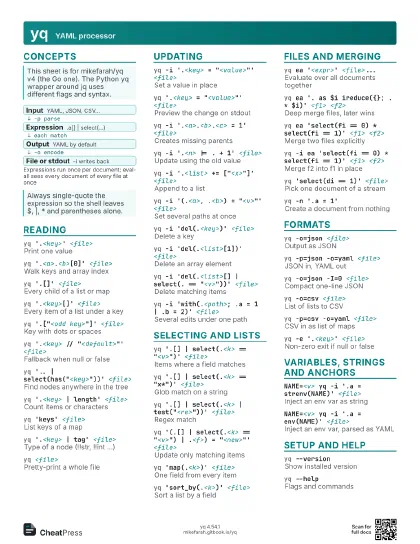
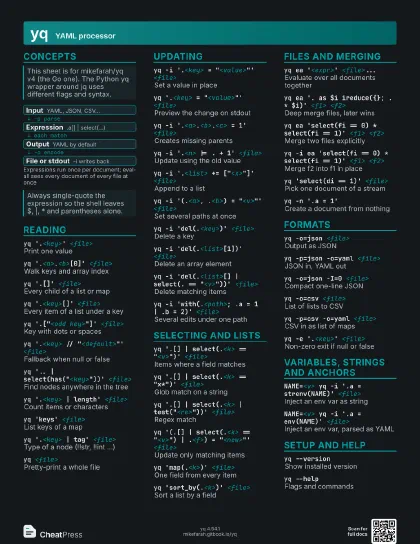
Concepts
- Input YAML, JSON, CSV...
- Expression .a[] | select(...)
- Output YAML by default
- File or stdout -i writes back
Reading
yq '.<key>' <file>
Print one value
yq '.<a>.<b>[0]' <file>
Walk keys and array index
yq '.[]' <file>
Every child of a list or map
yq '.<key>[]' <file>
Every item of a list under a key
yq '.["<odd key>"]'
                    <file>
Key with dots or spaces
yq '.<key> // "<default>"'
                    <file>
Fallback when null or false
yq '.. | select(has("<key>"))'
                    <file>
Find nodes anywhere in the tree
yq '.<key> | length' <file>
Count items or characters
yq 'keys' <file>
List keys of a map
yq '.<key> | tag' <file>
Type of a node (!!str, !!int ...)
yq <file>Pretty-print a whole file
Updating
yq -i '.<key> = "<value>"'
                    <file>
Set a value in place
Without -i the result goes to stdout and the file is untouched
yq '.<key> = "<value>"'
                    <file>
Preview the change on stdout
yq -i '.<a>.<b>.<c> = 1'
                    <file>
Creates missing parents
yq -i '.<n> |= . + 1' <file>
Update using the old value
yq -i '.<list> += ["<x>"]'
                    <file>
Append to a list
yq -i '(.<a>, .<b>) =
                    "<v>"' <file>
Set several paths at once
yq -i 'del(.<key>)' <file>
Delete a key
yq -i 'del(.<list>[1])' <file>
Delete an array element
yq -i 'del(.<list>[] | select(. ==
                    "<v>"))' <file>
Delete matching items
yq -i 'del(.. |
                    select(has("<key>")).<key>)'
                    <file>
Delete a key at any depth
yq -i 'with(.<path>; .a = 1 | .b = 2)'
                    <file>
Several edits under one path
yq -i '.<key> tag="!!str"'
                    <file>
Force a type (keep "1.0" a string)
yq -i '... comments=""' <file>
Strip all comments
Selecting and lists
yq '.[] | select(.<k> ==
                    "<v>")' <file>
Items where a field matches
yq '.[] | select(.<k> == "x*")'
                    <file>
Glob match on a string
The wildcards * match inside == comparisons on strings
yq '.[] | select(.<k> |
                    test("<re>"))' <file>
Regex match
yq '(.[] | select(.<k> == "<v>") |
                    .<f>) = "<new>"' <file>
Update only matching items
Keep the whole left side in parentheses, or you get the
filtered subset back
yq 'map(.<k>)' <file>
One field from every item
yq 'sort_by(.<k>)' <file>
Sort a list by a field
yq 'sort_by(.<k>) | reverse'
                    <file>
Sort descending
yq 'unique' <file>
Drop duplicate scalars
yq 'unique_by(.<k>)' <file>
Drop duplicates by field
yq 'group_by(.<k>)' <file>
Group items by field
yq 'pick(["<a>",
                    "<b>"])' <file>
Keep only some keys
yq 'to_entries' <file>
Map to list of key/value pairs
yq 'with_entries(.key |= "<pre>" +
                    .)' <file>
Rename every key
yq 'sort_keys(..)' <file>
Sort keys recursively
Files and merging
yq ea '<expr>' <file>...
Evaluate over all documents together
ea is short for eval-all; it loads everything into memory
yq ea '. as $i ireduce({}; . * $i)' <f1>
                    <f2>
Deep merge files, later wins
yq ea 'select(fi == 0) * select(fi == 1)'
                    <f1> <f2>
Merge two files explicitly
yq -i ea 'select(fi == 0) * select(fi == 1)'
                    <f1> <f2>
Merge f2 into f1 in place
yq -n 'load("<f1>") *
                    load("<f2>")'
Merge via load, no input
yq '.a *+ .b' <file>
Merge, appending arrays
yq 'select(di == 1)' <file>
Pick one document of a stream
yq '.[] | split_doc' <file>
List items as separate documents
yq -N '<expr>' <file>
Drop the --- separators
yq -n '.a = 1'
Create a document from nothing
yq - < <file>
Read from stdin
Formats
yq -o=json <file>
Output as JSON
yq -p=json -o=yaml <file>
JSON in, YAML out
yq -o=json -I=0 <file>
Compact one-line JSON
yq -P <file>
Normalise to pretty block style
yq -o=props <file>
Output Java properties
yq -o=csv <file>
List of lists to CSV
yq -p=csv -o=yaml <file>
CSV in as list of maps
yq -o=shell <file>
Emit shell variable assignments
yq -p=xml -o=yaml <file>
XML to YAML
yq -o=json -r '.<key>' <file>
Raw string, no JSON quotes
For YAML output -r is already the default
yq -e '.<key>' <file>
Non-zero exit if null or false
Variables, strings and anchors
NAME=<v> yq -i '.a = strenv(NAME)'
                    <file>
Inject an env var as string
NAME=<v> yq -i '.a = env(NAME)'
                    <file>
Inject an env var, parsed as YAML
env(N)=12 becomes a number, strenv(N) stays "12"
yq '(.. | select(tag == "!!str")) |=
                    envsubst' <file>
Expand ${VAR} in all strings
yq '.<k> |= sub("<re>",
                    "<new>")' <file>
Regex replace in a string
yq 'join(",")' <file>
List to string
yq '.<k> | @base64' <file>
Base64 encode
yq '.<k> | @base64d' <file>
Base64 decode
yq 'explode(.)' <file>
Resolve anchors and aliases
yq --yaml-fix-merge-anchor-to-spec=true
                    '<expr>' <file>
Spec-correct << merge keys
Explicit keys beat << values; default is still false in
4.54 and warns
Setup and help
yq --versionShow installed version
yq --helpFlags and commands
brew install yqInstall with Homebrew
docker run --rm -v "${PWD}":/workdir mikefarah/yq
                    '<expr>' <file>
Run from the container image
Recipes
yq -i '(select(.kind == "Deployment") | .spec.template.spec.containers[] | select(.name == "<name>") | .image) = "<img>:<tag>"' <file>yq ea '. as $i ireduce({}; . * $i)' conf/*.yml > merged.ymlhost=$(yq '.db.host' config.yml)yq -r '.servers[].name' config.yml | while read -r n; do echo "$n"doneyq -o=csv '[["name", "count"]] + [.[] | [.name, .count]]' <file>diff <(yq -P 'sort_keys(..)' a.yml) <(yq -P 'sort_keys(..)' b.yml)