Cheat
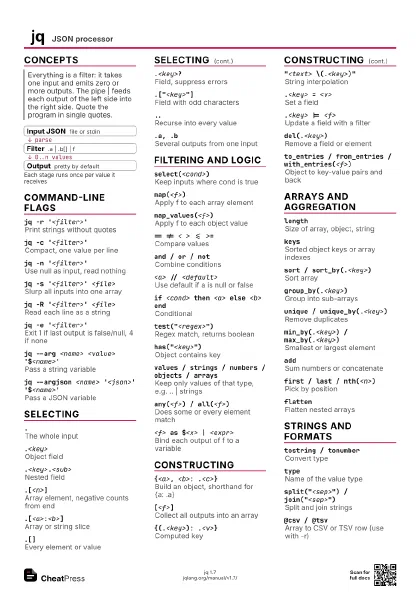
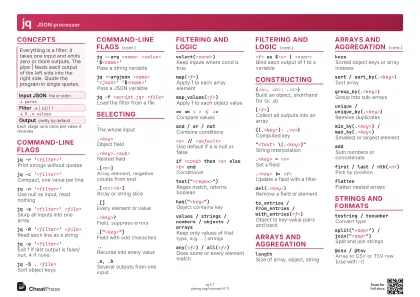
jq JSON processor
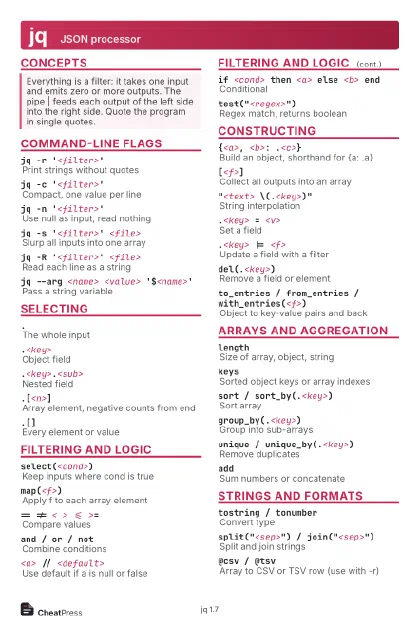 Light · Postcard
102 × 152 mm · PDF
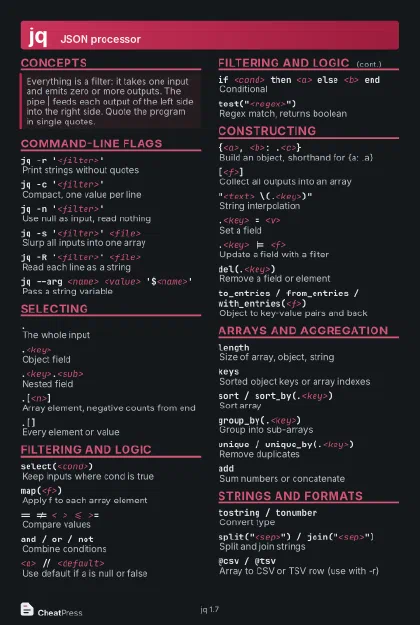 Dark · Postcard
102 × 152 mm · PDF
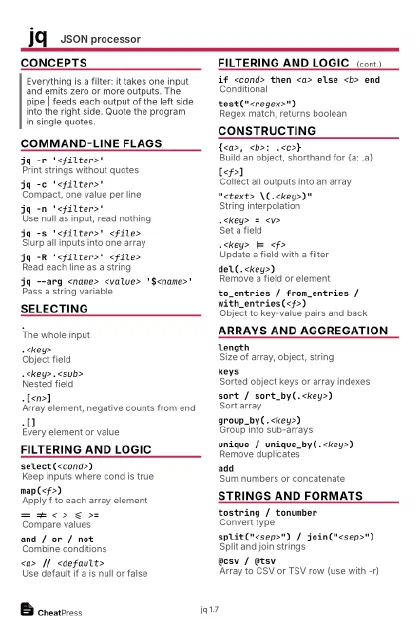 Ink saver · Postcard
102 × 152 mm · PDF
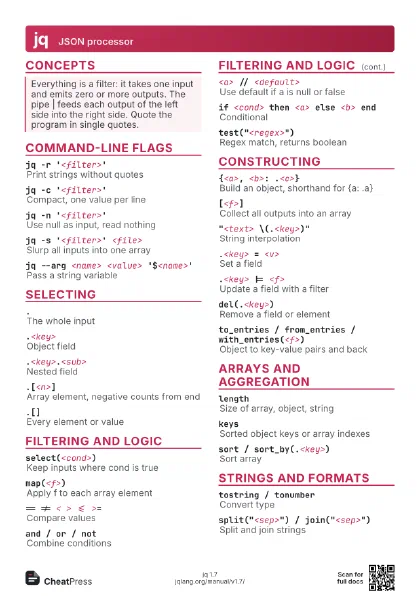
 Light · A4 landscape
297 × 210 mm · PDF
 Dark · A4 landscape
297 × 210 mm · PDF
 Ink saver · A4 landscape
297 × 210 mm · PDF
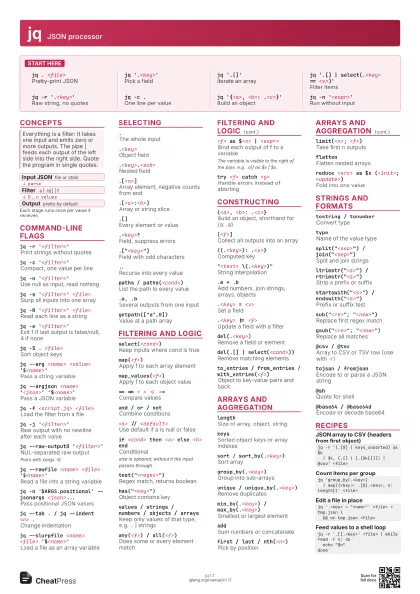
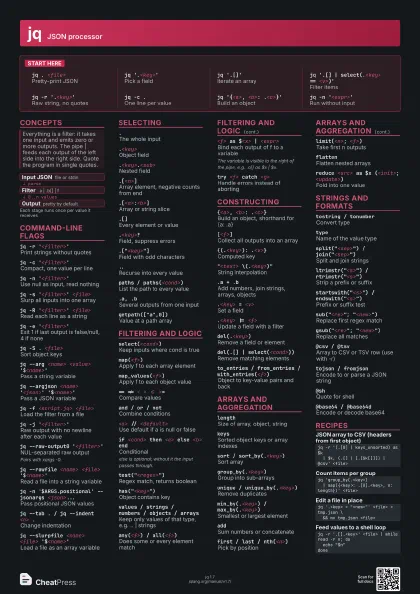
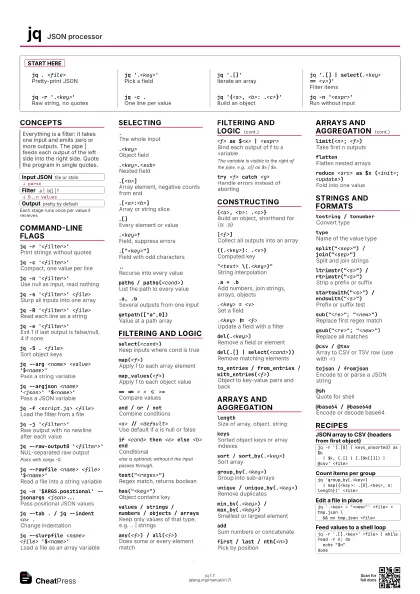
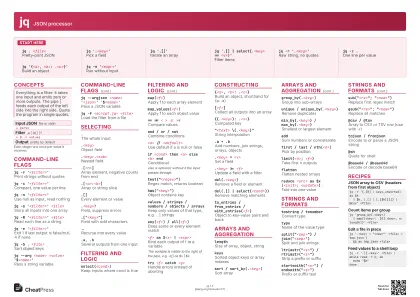 Light · A3 landscape
420 × 297 mm · PDF
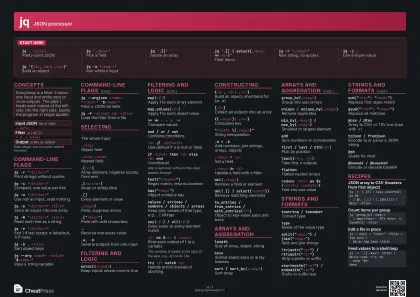 Dark · A3 landscape
420 × 297 mm · PDF
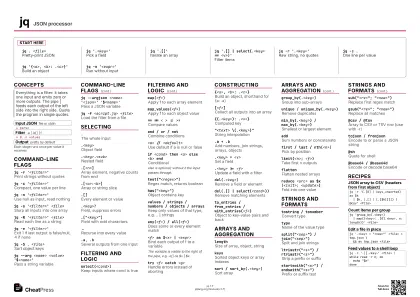 Ink saver · A3 landscape
420 × 297 mm · PDF
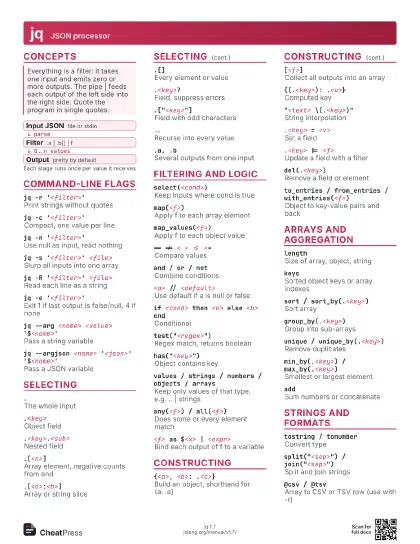
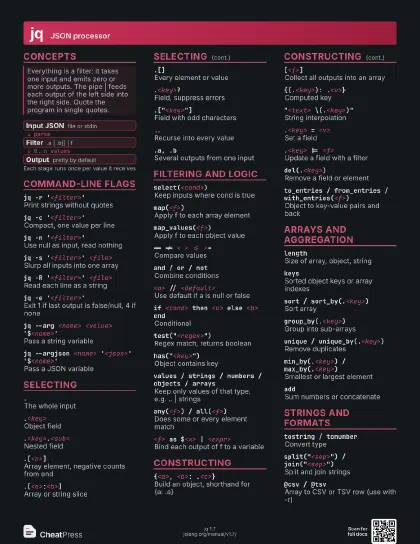
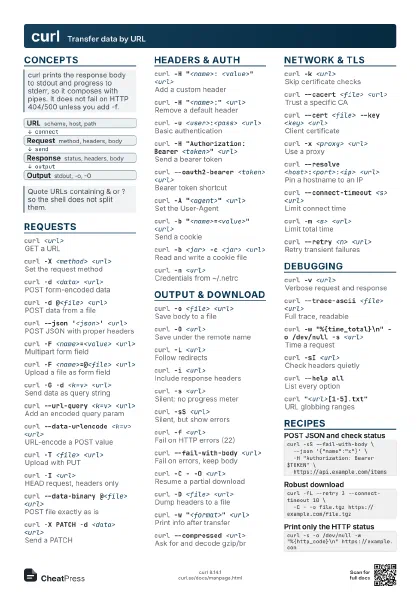
Start here
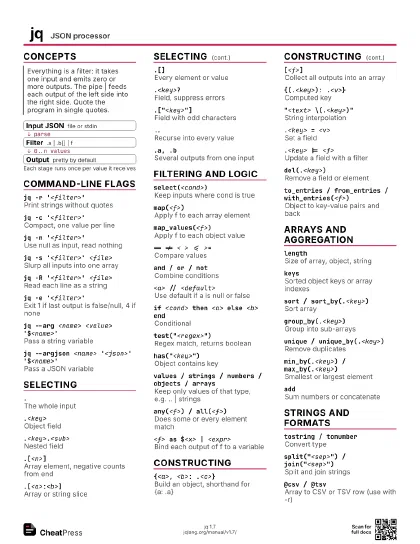
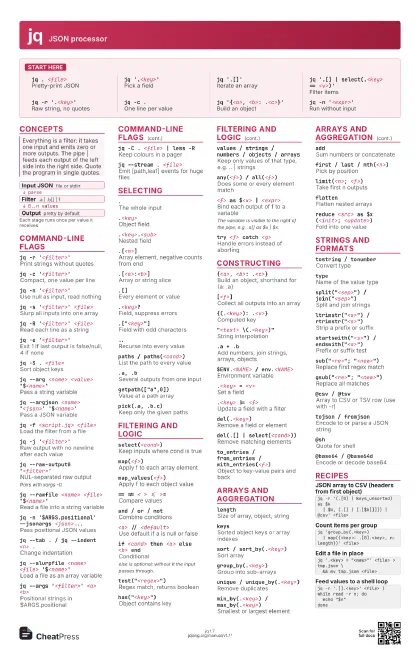
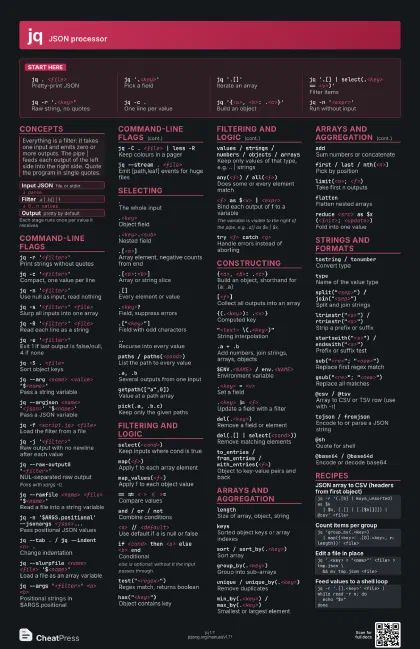
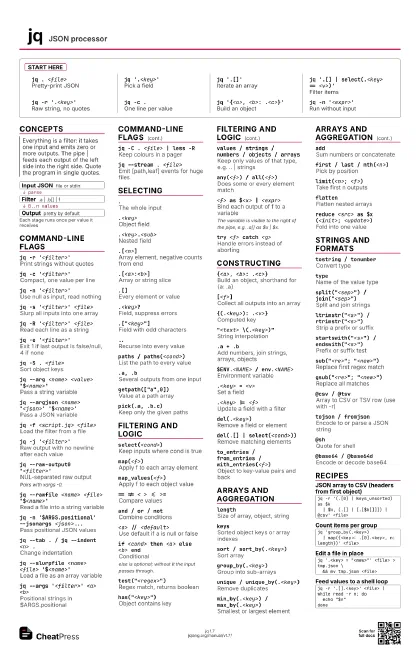
jq . <file>
Pretty-print JSON
jq '.<key>'
Pick a field
jq '.[]'
Iterate an array
jq '.[] | select(.<key> == <v>)'
Filter items
jq -r '.<key>'
Raw string, no quotes
jq -c .One line per value
jq '{<a>, <b>: .<c>}'
Build an object
jq -n '<expr>'
Run without input
Concepts
- Input JSON file or stdin
- Filter .a | .b[] | f
- Output pretty by default
Command-line flags
jq -r '<filter>'
Print strings without quotes
jq -c '<filter>'
Compact, one value per line
jq -n '<filter>'
Use null as input, read nothing
jq -s '<filter>' <file>
Slurp all inputs into one array
jq -R '<filter>' <file>
Read each line as a string
jq -e '<filter>'
Exit 1 if last output is false/null, 4 if none
jq -S . <file>
Sort object keys
jq --arg <name> <value>
                    '$<name>'
Pass a string variable
jq --argjson <name> '<json>'
                    '$<name>'
Pass a JSON variable
jq -f <script.jq> <file>
Load the filter from a file
jq -j '<filter>'
Raw output with no newline after each value
jq --raw-output0 '<filter>'
NUL-separated raw output
Pairs with xargs -0.
jq --rawfile <name> <file>
                    '$<name>'
Read a file into a string variable
jq -n '$ARGS.positional' --jsonargs
                    <json>...
Pass positional JSON values
jq --tab . / jq --indent <n> .
Change indentation
jq --slurpfile <name> <file>
                    '$<name>'
Load a file as an array variable
jq --args '<filter>' <a>
                    <b>
Positional strings in $ARGS.positional
jq -C . <file> | less -R
Keep colours in a pager
jq --stream . <file>
Emit [path,leaf] events for huge files
Selecting
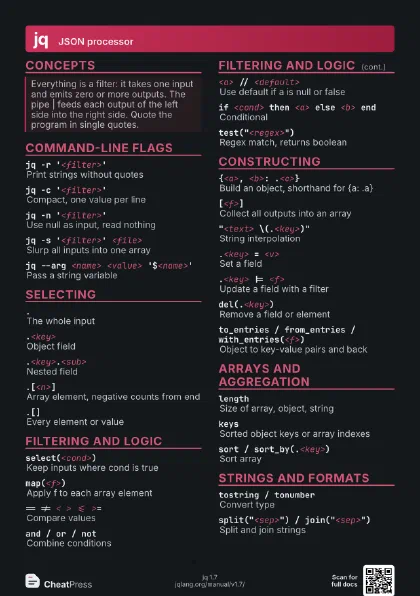
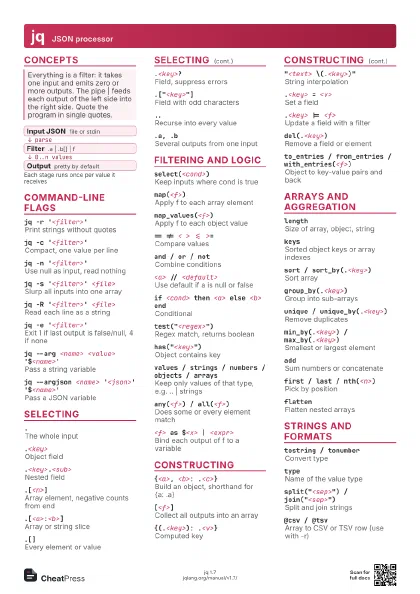
.The whole input
.<key>Object field
.<key>.<sub>
Nested field
.[<n>]Array element, negative counts from end
.[<a>:<b>]
Array or string slice
.[]Every element or value
.<key>?Field, suppress errors
.["<key>"]
Field with odd characters
..Recurse into every value
paths / paths(<cond>)
List the path to every value
.a, .bSeveral outputs from one input
getpath(["a",0])
Value at a path array
pick(.a, .b.c)Keep only the given paths
Filtering and logic
select(<cond>)
Keep inputs where cond is true
map(<f>)Apply f to each array element
map_values(<f>)
Apply f to each object value
== != < > <= >=
Compare values
and / or / notCombine conditions
<a> // <default>
Use default if a is null or false
if <cond> then <a> else <b> end
Conditional
else is optional; without it the input passes through.
test("<regex>")
Regex match, returns boolean
has("<key>")
Object contains key
values / strings / numbers / objects / arrays
Keep only values of that type, e.g. .. | strings
contains(<x>) / inside(<x>)
Substring or subset test
any(<f>) / all(<f>)
Does some or every element match
<f> as $<x> | <expr>
Bind each output of f to a variable
The variable is visible to the right of the pipe, e.g. .a[] as
$x | $x.
inputsRead all remaining inputs (use with -n)
jq -n '[inputs]' a.json b.json collects every value.
try <f> catch <g>
Handle errors instead of aborting
emptyOutput nothing, drops the value
error("<msg>")
Raise an error
Constructing
{<a>, <b>: .<c>}
Build an object, shorthand for {a: .a}
[<f>]Collect all outputs into an array
{(.<key>): .<v>}
Computed key
"<text> \(.<key>)"
String interpolation
.a + .b
Add numbers, join strings, arrays, objects
.a * .bMultiply, or deep-merge objects
$ENV.<NAME> / env.<NAME>
Environment variable
.<key> = <v>
Set a field
.<key> |= <f>
Update a field with a filter
.<key> += <n>
Arithmetic update
del(.<key>)
Remove a field or element
del(.[] | select(<cond>))
Remove matching elements
to_entries / from_entries / with_entries(<f>)
Object to key-value pairs and back
walk(<f>)Apply f to every value bottom-up
Arrays and aggregation
lengthSize of array, object, string
keysSorted object keys or array indexes
keys_unsortedObject keys in original order
sort / sort_by(.<key>)
Sort array
group_by(.<key>)
Group into sub-arrays
unique / unique_by(.<key>)
Remove duplicates
min_by(.<key>) / max_by(.<key>)
Smallest or largest element
addSum numbers or concatenate
first / last / nth(<n>)
Pick by position
limit(<n>; <f>)
Take first n outputs
flattenFlatten nested arrays
reverseReverse an array
Strings: explode | reverse | implode.
index(<x>) / indices(<x>)
Find position(s)
range(<n>)
Count from 0 to n-1
reduce <src> as $x (<init>;
                    <update>)
Fold into one value
transposeSwap rows and columns
Strings and formats
tostring / tonumber
Convert type
typeName of the value type
split("<sep>") /
                    join("<sep>")
Split and join strings
ascii_downcase / ascii_upcase
Change case
ltrimstr("<s>") /
                    rtrimstr("<s>")
Strip a prefix or suffix
startswith("<s>") /
                    endswith("<s>")
Prefix or suffix test
sub("<re>"; "<new>")
Replace first regex match
gsub("<re>"; "<new>")
Replace all matches
capture("(?<name>...)")
Named groups to object
@csv / @tsvArray to CSV or TSV row (use with -r)
tojson / fromjson
Encode to or parse a JSON string
@json / @textEncode as JSON or plain string
@shQuote for shell
@uriPercent-encode
@base64 / @base64d
Encode or decode base64
@htmlEscape HTML
todate / fromdate
Epoch seconds and ISO 8601
fromdate needs YYYY-MM-DDTHH:MM:SSZ, no fractions or offsets.
nowCurrent epoch time
debug / debug("<msg>")
Print to stderr, pass the value on
Recipes
jq -r '(.[0] | keys_unsorted) as $k | $k, (.[] | [.[$k[]]]) | @csv' <file>jq 'group_by(.<key>) | map({<key>: .[0].<key>, n: length})' <file>jq '.<key> = "<new>"' <file> > tmp.json \ && mv tmp.json <file>jq -r '.[].<key>' <file> | while read -r n; do echo "$n"done