Cheat
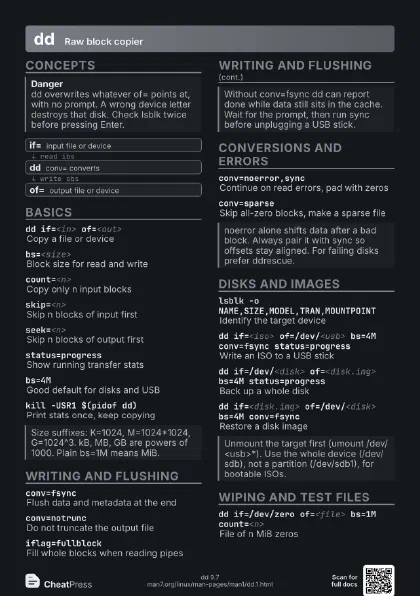
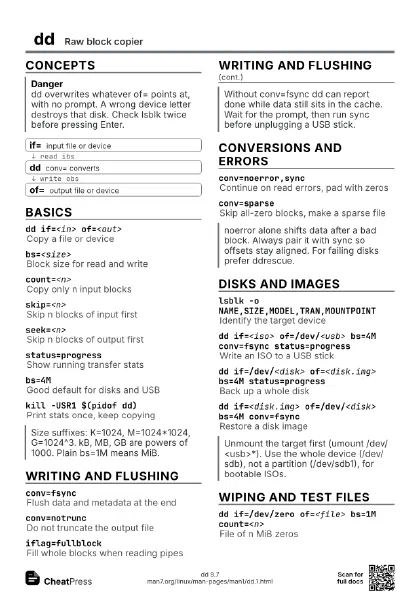
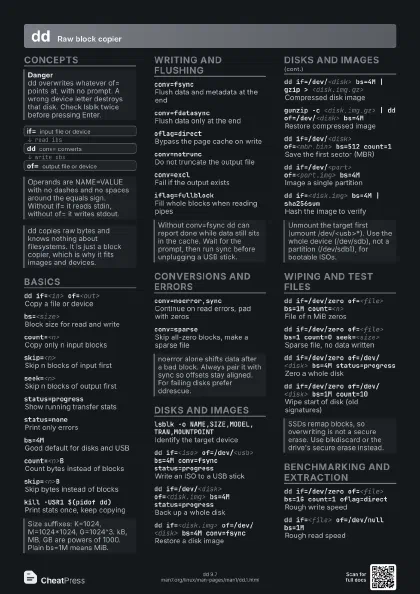
dd Raw block copier
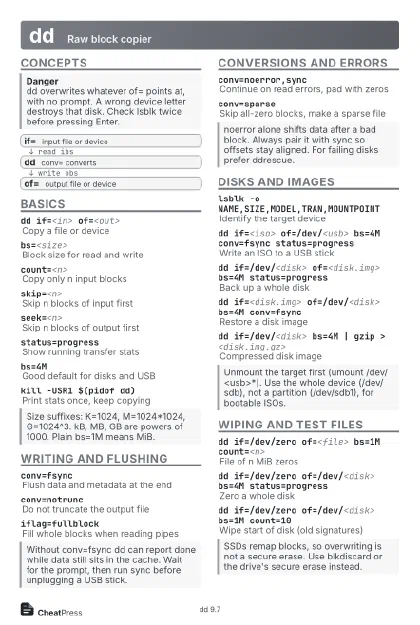 Light · Postcard
102 × 152 mm · PDF
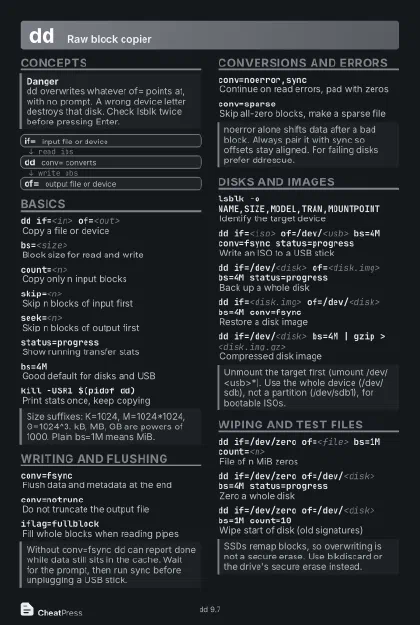 Dark · Postcard
102 × 152 mm · PDF
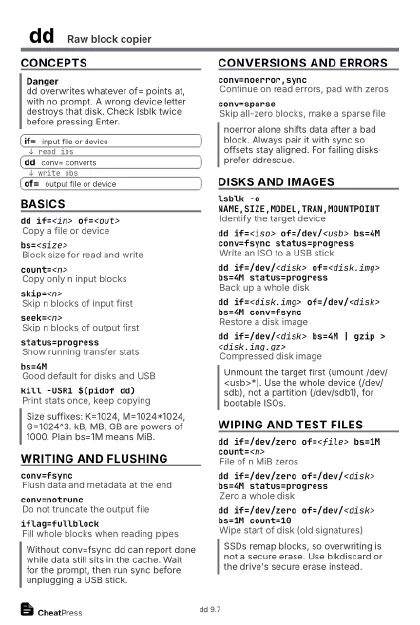 Ink saver · Postcard
102 × 152 mm · PDF
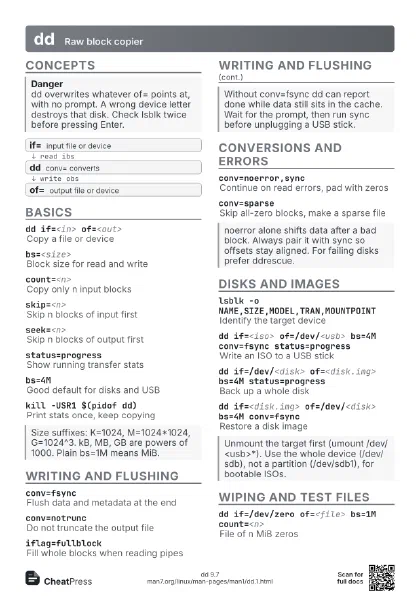
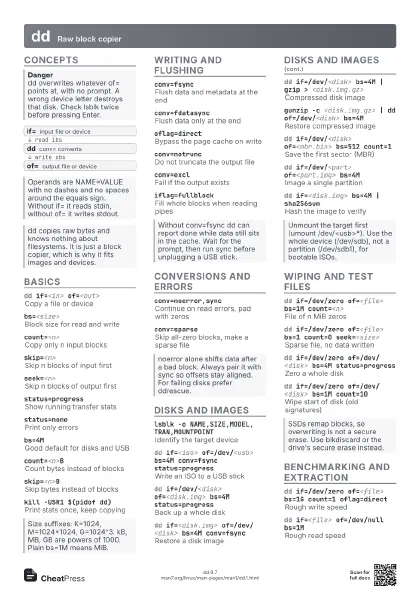
 Light · A4 landscape
297 × 210 mm · PDF
 Dark · A4 landscape
297 × 210 mm · PDF
 Ink saver · A4 landscape
297 × 210 mm · PDF
 Light · A3 landscape
420 × 297 mm · PDF
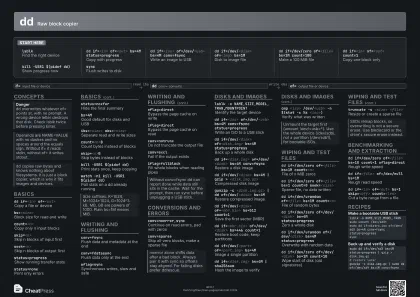 Dark · A3 landscape
420 × 297 mm · PDF
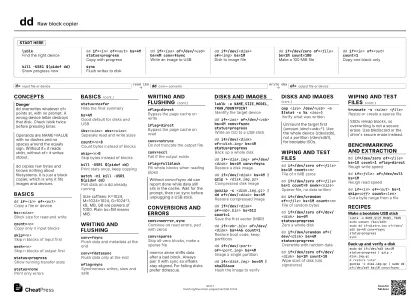 Ink saver · A3 landscape
420 × 297 mm · PDF
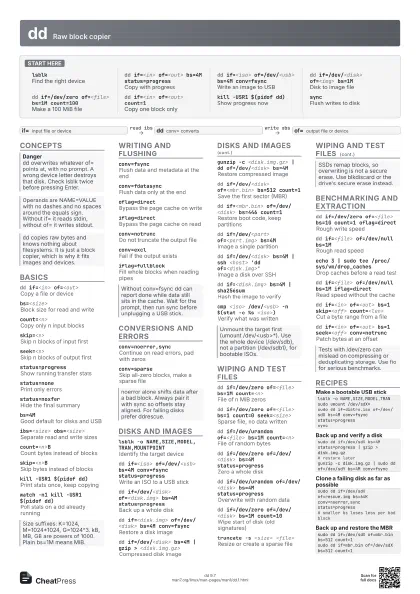
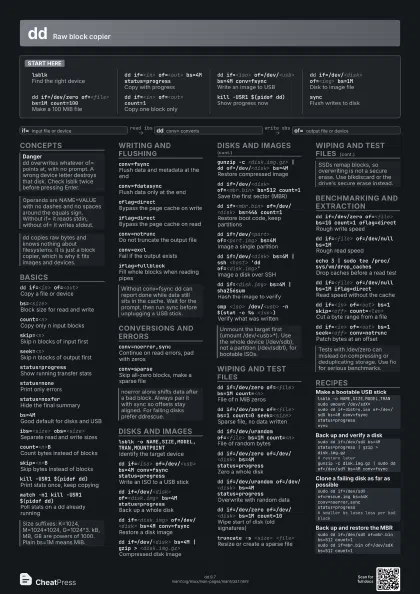
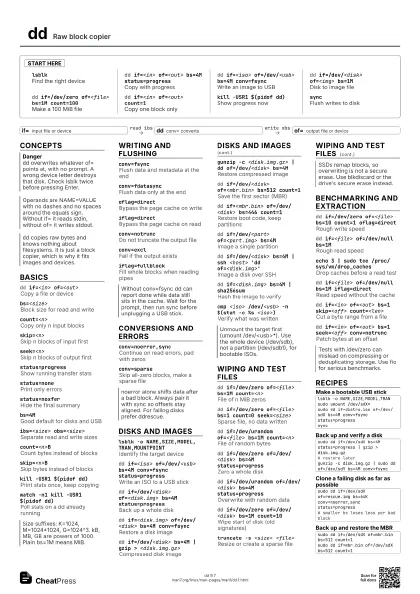
Start here
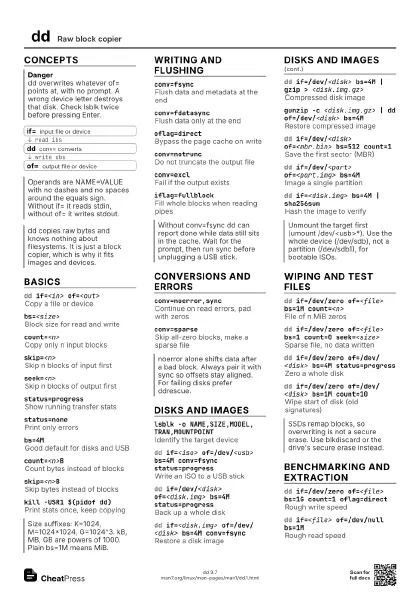
lsblkFind the right device
dd if=<in> of=<out> bs=4M status=progress
Copy with progress
dd if=<iso> of=/dev/<usb> bs=4M
                    conv=fsync
Write an image to USB
dd if=/dev/<disk> of=<img> bs=1M
Disk to image file
dd if=/dev/zero of=<file> bs=1M count=100
Make a 100 MiB file
dd if=<in> of=<out> count=1
Copy one block only
kill -USR1 $(pidof dd)
Show progress now
syncFlush writes to disk
Concepts
- if= input file or device
- dd conv= converts
- of= output file or device
Basics
dd if=<in> of=<out>
Copy a file or device
bs=<size>Block size for read and write
count=<n>Copy only n input blocks
skip=<n>Skip n blocks of input first
seek=<n>Skip n blocks of output first
status=progressShow running transfer stats
status=nonePrint only errors
status=noxferHide the final summary
bs=4MGood default for disks and USB
ibs=<size> obs=<size>
Separate read and write sizes
count=<n>B
Count bytes instead of blocks
skip=<n>BSkip bytes instead of blocks
kill -USR1 $(pidof dd)
Print stats once, keep copying
watch -n1 kill -USR1 $(pidof dd)
Poll stats on a dd already running
Writing and flushing
conv=fsyncFlush data and metadata at the end
conv=fdatasyncFlush data only at the end
oflag=syncSynchronous writes, slow and safe
oflag=directBypass the page cache on write
iflag=directBypass the page cache on read
conv=notruncDo not truncate the output file
conv=exclFail if the output exists
conv=nocreatFail if the output is missing
oflag=append conv=notrunc
Append to the output
iflag=fullblockFill whole blocks when reading pipes
iflag=nocache oflag=nocache
Drop cached pages after use
Conversions and errors
conv=noerror,sync
Continue on read errors, pad with zeros
conv=sparseSkip all-zero blocks, make a sparse file
conv=swabSwap every pair of bytes
conv=ucaseUpper-case the text
conv=lcaseLower-case the text
conv=asciiEBCDIC to ASCII
conv=ebcdicASCII to EBCDIC
conv=block cbs=<n>
Pad lines to fixed-width records
conv=unblock cbs=<n>
Trim fixed-width records to lines
iflag=skip_bytes
Read skip= as a byte count
Disks and images
lsblk -o NAME,SIZE,MODEL,TRAN,MOUNTPOINT
Identify the target device
dd if=<iso> of=/dev/<usb> bs=4M conv=fsync
                    status=progress
Write an ISO to a USB stick
dd if=/dev/<disk> of=<disk.img> bs=4M
                    status=progress
Back up a whole disk
dd if=<disk.img> of=/dev/<disk> bs=4M
                    conv=fsync
Restore a disk image
dd if=/dev/<disk> bs=4M | gzip >
                    <disk.img.gz>
Compressed disk image
gunzip -c <disk.img.gz> | dd of=/dev/<disk>
                    bs=4M
Restore compressed image
dd if=/dev/<disk> of=<mbr.bin> bs=512
                    count=1
Save the first sector (MBR)
dd if=<mbr.bin> of=/dev/<disk> bs=446
                    count=1
Restore boot code, keep partitions
dd if=/dev/<part> of=<part.img> bs=4M
Image a single partition
dd if=/dev/<disk> bs=4M | ssh <host> 'dd
                    of=<disk.img>'
Image a disk over SSH
dd if=<in> bs=4M | pv | dd of=<out> bs=4M
Progress bar through pv
dd if=<disk.img> bs=4M | sha256sum
Hash the image to verify
cmp <iso> /dev/<usb> -n $(stat -c %s
                    <iso>)
Verify what was written
blockdev --getsize64 /dev/<disk>
Device size in bytes
Wiping and test files
dd if=/dev/zero of=<file> bs=1M count=<n>
File of n MiB zeros
dd if=/dev/zero of=<file> bs=1 count=0
                    seek=<size>
Sparse file, no data written
dd if=/dev/urandom of=<file> bs=1M
                    count=<n>
File of random bytes
dd if=/dev/zero of=/dev/<disk> bs=4M
                    status=progress
Zero a whole disk
dd if=/dev/urandom of=/dev/<disk> bs=4M
                    status=progress
Overwrite with random data
dd if=/dev/zero of=/dev/<disk> bs=1M count=10
Wipe start of disk (old signatures)
dd if=/dev/zero of=/dev/<disk> bs=1M seek=$((
                    <MiB> - 10 ))
Wipe the end of the disk
truncate -s <size> <file>
Resize or create a sparse file
Benchmarking and extraction
dd if=/dev/zero of=<file> bs=1G count=1
                    oflag=direct
Rough write speed
dd if=<file> of=/dev/null bs=1M
Rough read speed
echo 3 | sudo tee /proc/sys/vm/drop_caches
Drop caches before a read test
dd if=<file> of=/dev/null bs=1M iflag=direct
Read speed without the cache
dd if=<in> of=<out> bs=1 skip=<off>
                    count=<len>
Cut a byte range from a file
dd if=<in> of=<out> bs=<n> skip=1
Drop the first n bytes
dd if=<in> of=<out> bs=1 seek=<off>
                    conv=notrunc
Patch bytes at an offset
Recipes
lsblk -o NAME,SIZE,MODEL,TRANsudo umount /dev/sdX*sudo dd if=distro.iso of=/dev/sdX bs=4M conv=fsync status=progresssyncsudo dd if=/dev/sdX bs=4M status=progress | gzip > disk.img.gz# restore latergunzip -c disk.img.gz | sudo dd of=/dev/sdY bs=4M conv=fsyncsudo dd if=/dev/sdX of=rescue.img bs=64K conv=noerror,sync status=progress# smaller bs loses less per bad blocksudo dd if=/dev/sdX of=mbr.bin bs=512 count=1sudo dd if=mbr.bin of=/dev/sdX bs=512 count=1