Cheat
Celery Python task queue
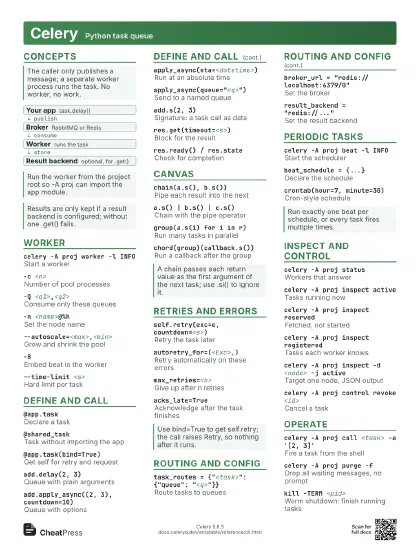
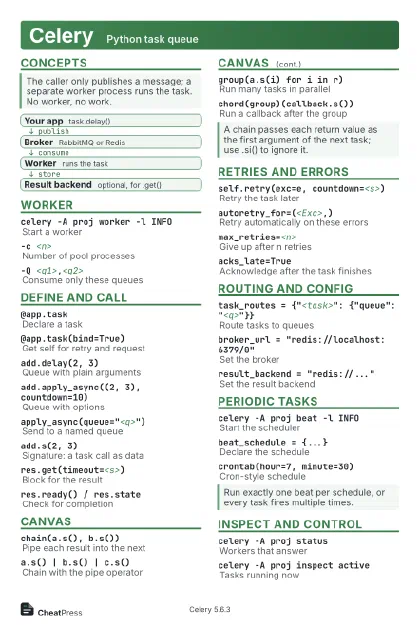 Light · Postcard
102 × 152 mm · PDF
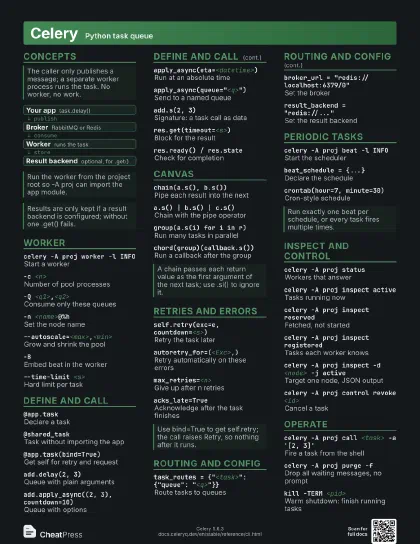
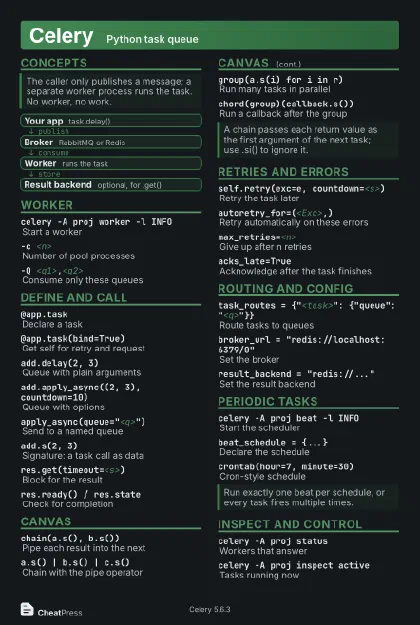 Dark · Postcard
102 × 152 mm · PDF
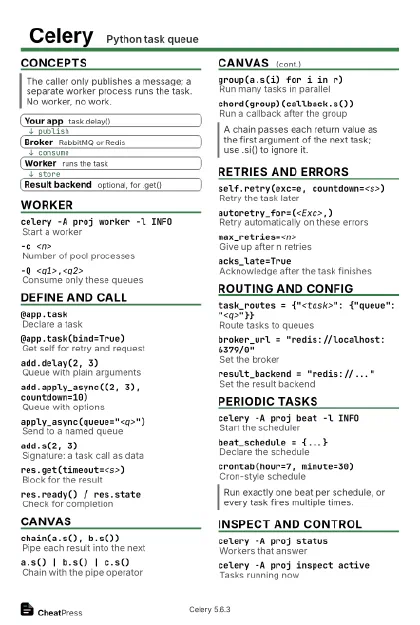 Ink saver · Postcard
102 × 152 mm · PDF
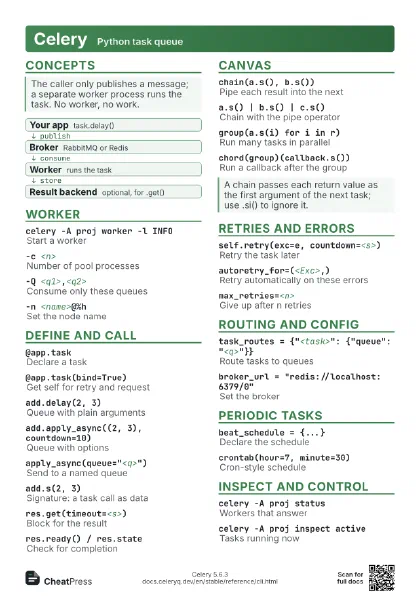
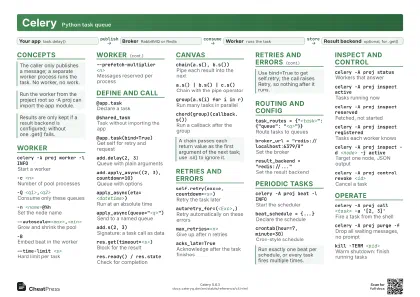 Light · A4 landscape
297 × 210 mm · PDF
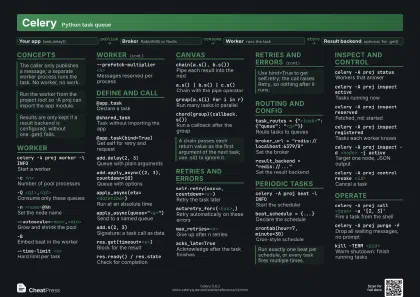 Dark · A4 landscape
297 × 210 mm · PDF
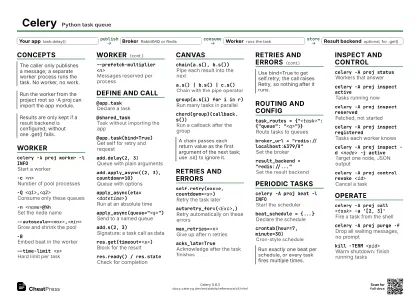 Ink saver · A4 landscape
297 × 210 mm · PDF
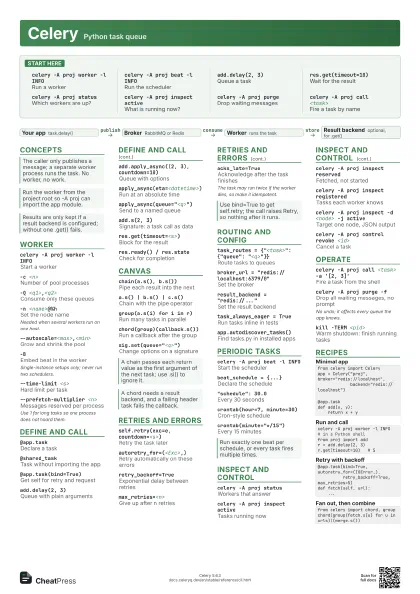
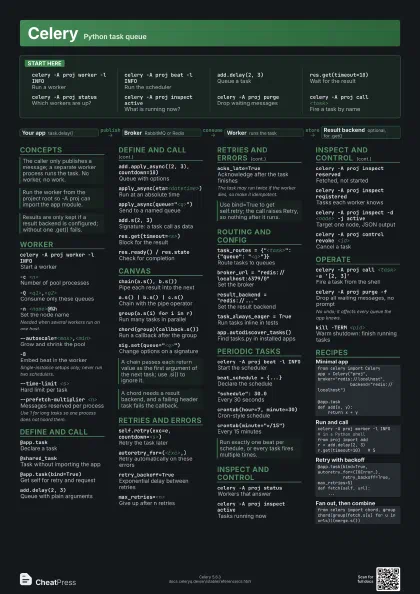
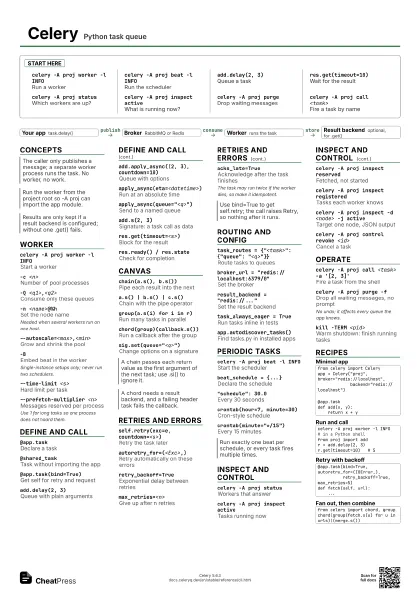
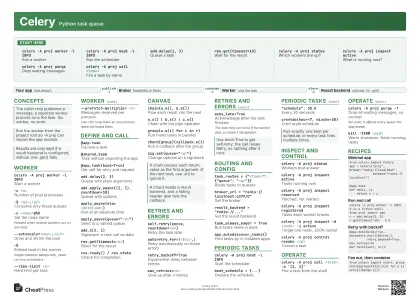 Light · A3 landscape
420 × 297 mm · PDF
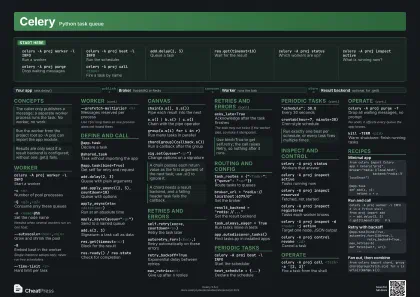 Dark · A3 landscape
420 × 297 mm · PDF
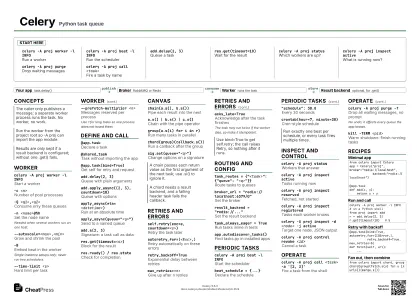 Ink saver · A3 landscape
420 × 297 mm · PDF
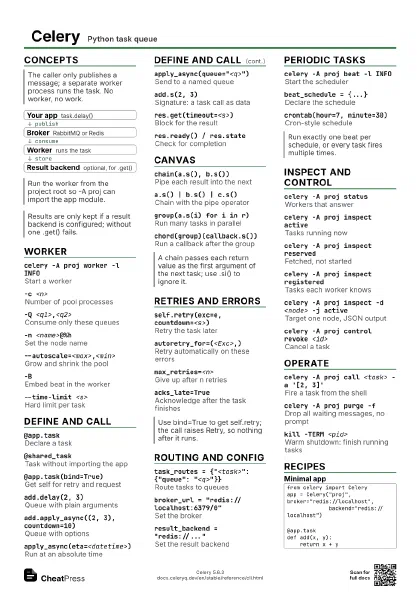
Start here
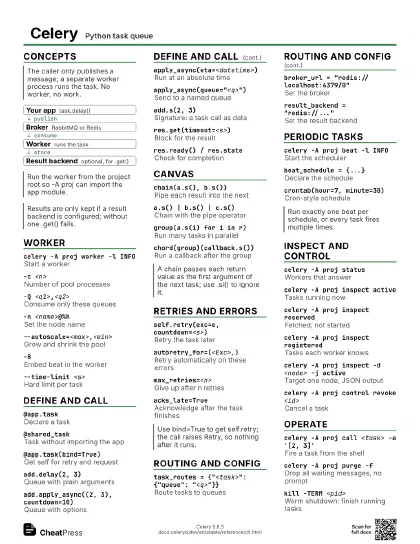
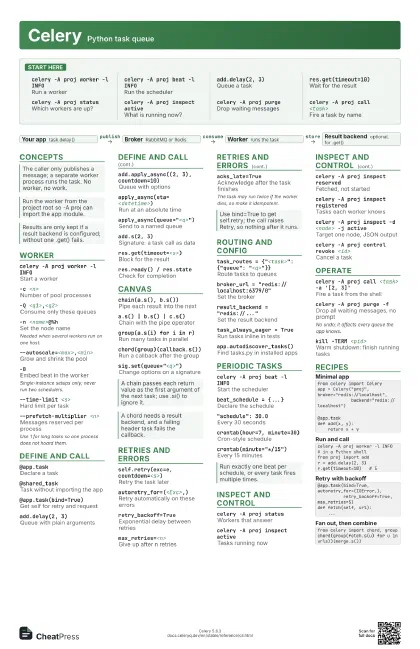
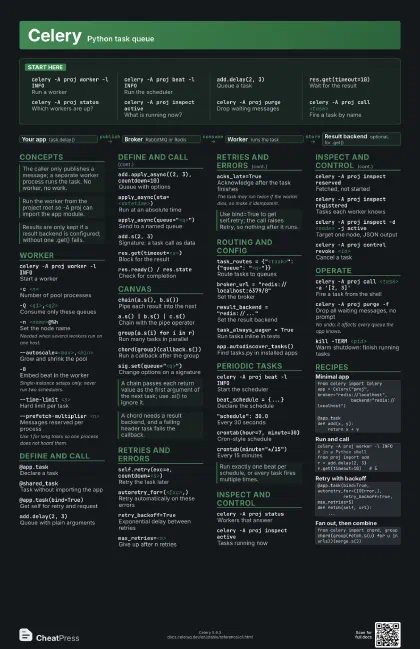
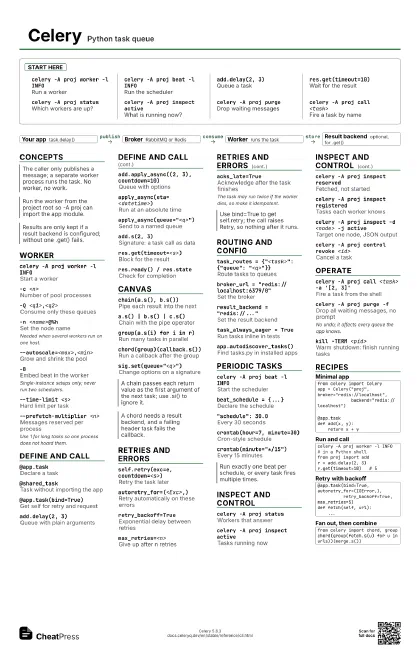
celery -A proj worker -l INFO
Run a worker
celery -A proj beat -l INFO
Run the scheduler
add.delay(2, 3)Queue a task
res.get(timeout=10)
Wait for the result
celery -A proj status
Which workers are up?
celery -A proj inspect active
What is running now?
celery -A proj purge
Drop waiting messages
celery -A proj call <task>
Fire a task by name
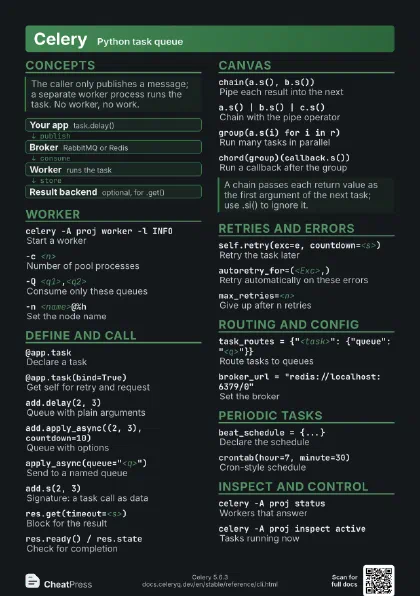
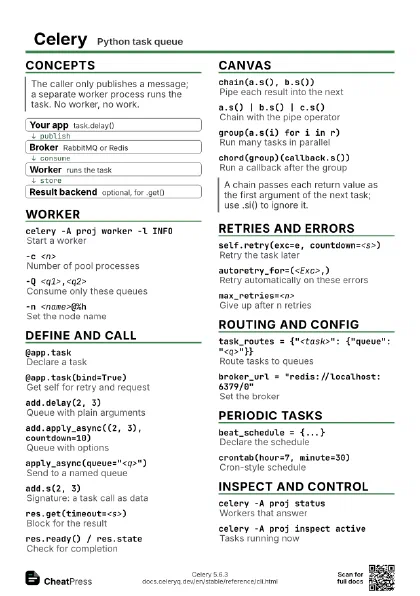
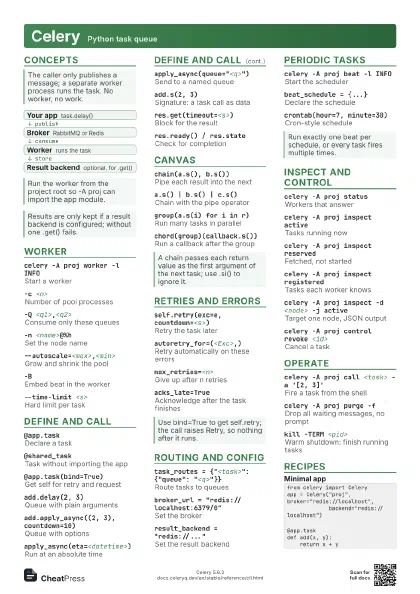
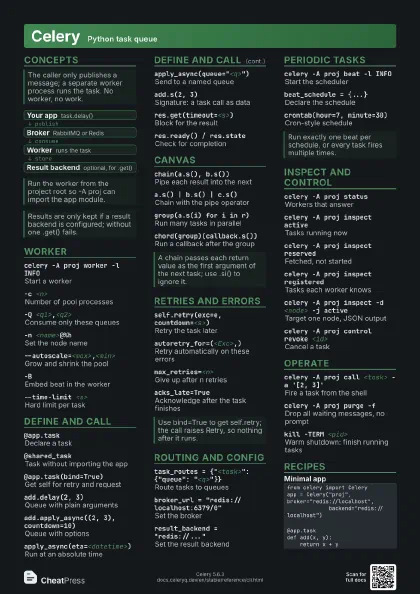
Concepts
- Your app task.delay()
- Broker RabbitMQ or Redis
- Worker runs the task
- Result backend optional, for .get()
Worker
celery -A proj worker -l INFO
Start a worker
-c <n>Number of pool processes
-Q <q1>,<q2>
Consume only these queues
-n <name>@%h
Set the node name
Needed when several workers run on one host.
--autoscale=<max>,<min>
Grow and shrink the pool
-BEmbed beat in the worker
Single-instance setups only; never run two schedulers.
--time-limit <s>
Hard limit per task
--prefetch-multiplier <n>
Messages reserved per process
Use 1 for long tasks so one process does not hoard them.
Define and call
@app.taskDeclare a task
@shared_taskTask without importing the app
@app.task(bind=True)
Get self for retry and request
add.delay(2, 3)Queue with plain arguments
add.apply_async((2, 3), countdown=10)
Queue with options
apply_async(eta=<datetime>)
Run at an absolute time
apply_async(queue="<q>")
Send to a named queue
add.s(2, 3)Signature: a task call as data
res.get(timeout=<s>)
Block for the result
res.ready() / res.state
Check for completion
Canvas
chain(a.s(), b.s())
Pipe each result into the next
a.s() | b.s() | c.s()
Chain with the pipe operator
group(a.s(i) for i in r)
Run many tasks in parallel
chord(group)(callback.s())
Run a callback after the group
sig.set(queue="<q>")
Change options on a signature
Retries and errors
self.retry(exc=e, countdown=<s>)
Retry the task later
autoretry_for=(<Exc>,)
Retry automatically on these errors
retry_backoff=True
Exponential delay between retries
max_retries=<n>
Give up after n retries
acks_late=TrueAcknowledge after the task finishes
The task may run twice if the worker dies, so make it
idempotent.
Routing and config
task_routes = {"<task>": {"queue":
                    "<q>"}}
Route tasks to queues
broker_url = "redis://localhost:6379/0"
Set the broker
result_backend = "redis://..."
Set the result backend
task_always_eager = True
Run tasks inline in tests
app.autodiscover_tasks()
Find tasks.py in installed apps
Periodic tasks
celery -A proj beat -l INFO
Start the scheduler
beat_schedule = {...}
Declare the schedule
"schedule": 30.0
Every 30 seconds
crontab(hour=7, minute=30)
Cron-style schedule
crontab(minute="*/15")
Every 15 minutes
Inspect and control
celery -A proj status
Workers that answer
celery -A proj inspect active
Tasks running now
celery -A proj inspect reserved
Fetched, not started
celery -A proj inspect registered
Tasks each worker knows
celery -A proj inspect -d <node> -j active
Target one node, JSON output
celery -A proj control revoke <id>
Cancel a task
Operate
celery -A proj call <task> -a '[2, 3]'
Fire a task from the shell
celery -A proj purge -f
Drop all waiting messages, no prompt
No undo; it affects every queue the app knows.
kill -TERM <pid>
Warm shutdown: finish running tasks
Recipes
from celery import Celeryapp = Celery("proj", broker="redis://localhost", backend="redis://localhost")@app.taskdef add(x, y): return x + ycelery -A proj worker -l INFO# in a Python shellfrom proj import addr = add.delay(2, 3)r.get(timeout=10) # 5@app.task(bind=True, autoretry_for=(IOError,), retry_backoff=True, max_retries=5)def fetch(self, url): ...from celery import chord, groupchord(group(fetch.s(u) for u in urls))(merge.s())