Cheat
Flask Python micro web framework
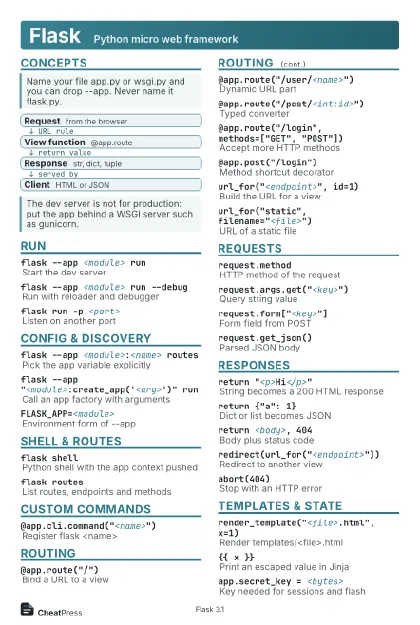 Light · Postcard
102 × 152 mm · PDF
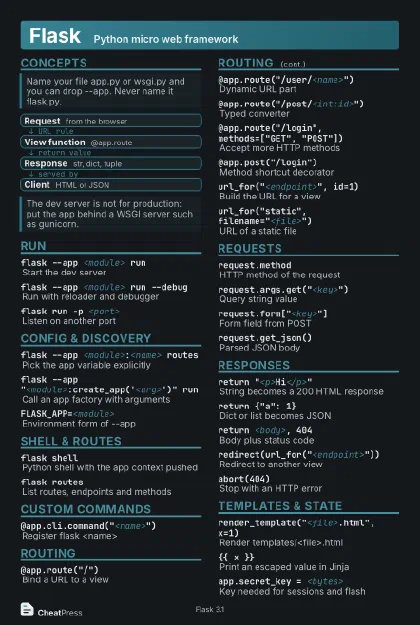 Dark · Postcard
102 × 152 mm · PDF
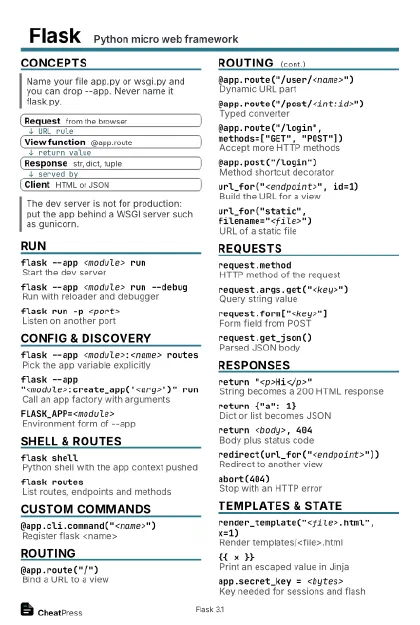 Ink saver · Postcard
102 × 152 mm · PDF
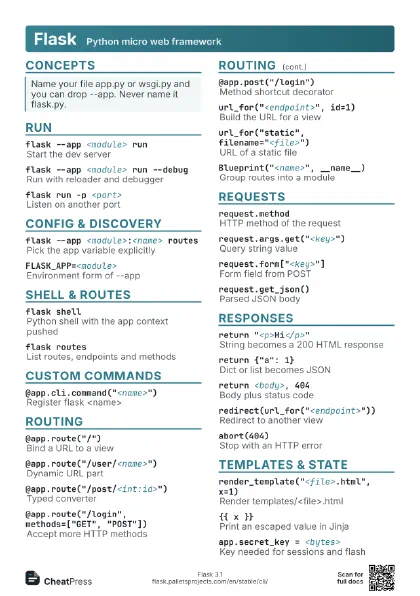
 Light · A4 landscape
297 × 210 mm · PDF
 Dark · A4 landscape
297 × 210 mm · PDF
 Ink saver · A4 landscape
297 × 210 mm · PDF
 Light · A3 landscape
420 × 297 mm · PDF
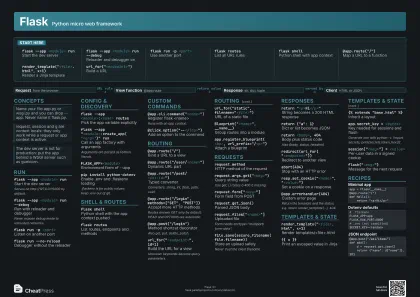 Dark · A3 landscape
420 × 297 mm · PDF
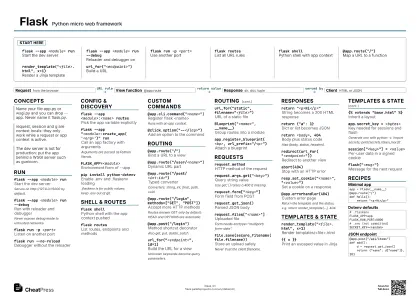 Ink saver · A3 landscape
420 × 297 mm · PDF
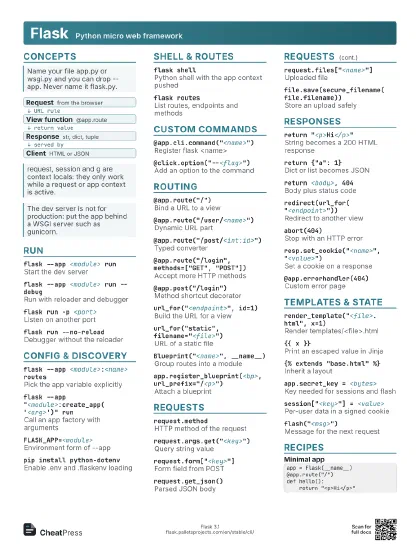
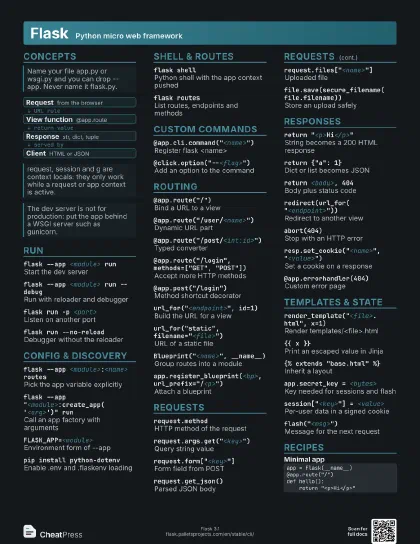
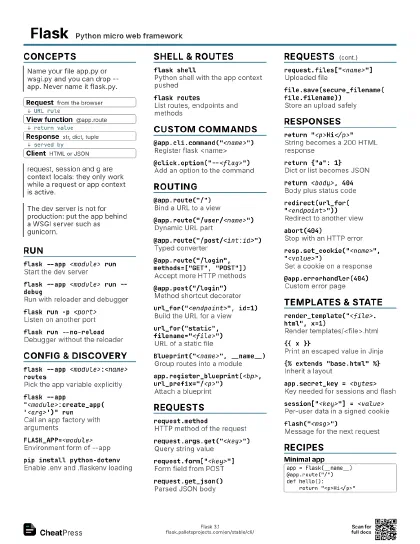
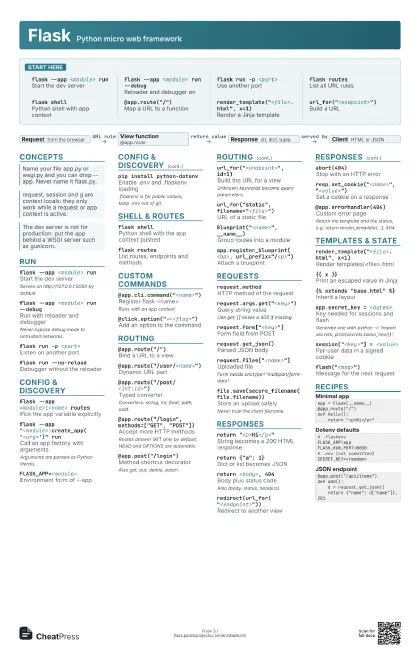
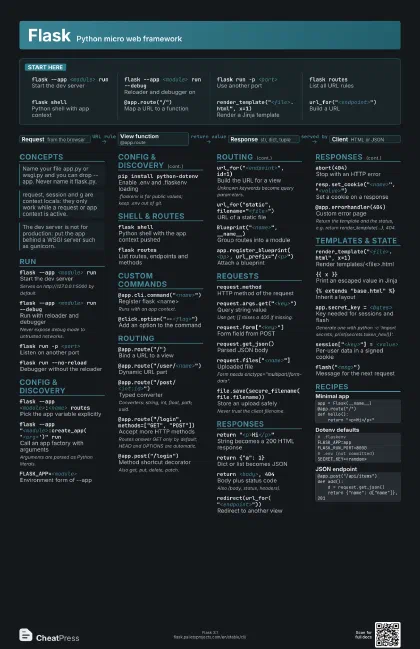
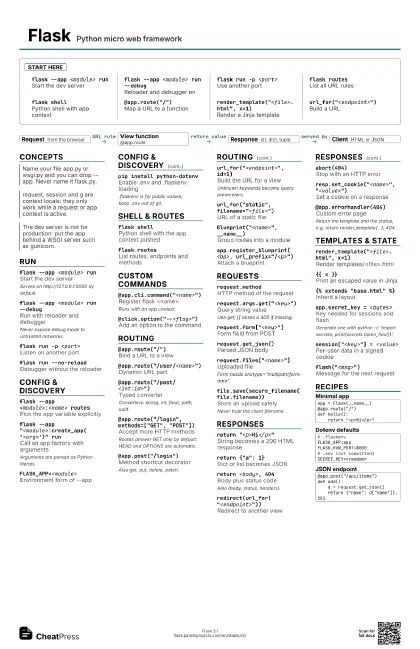
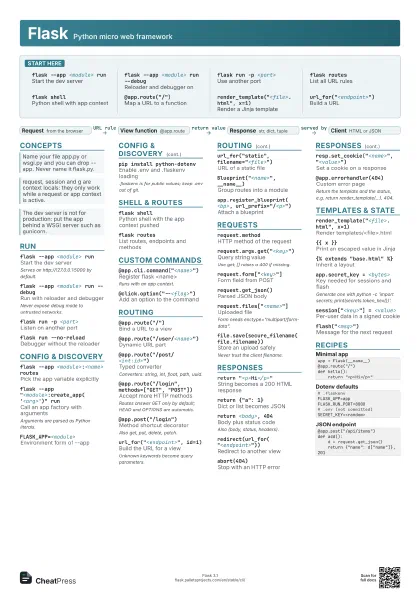
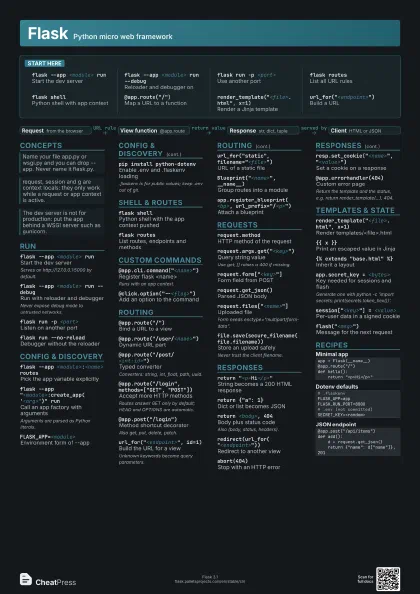
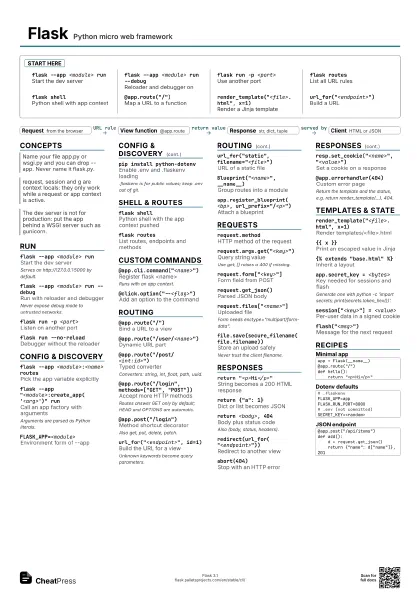
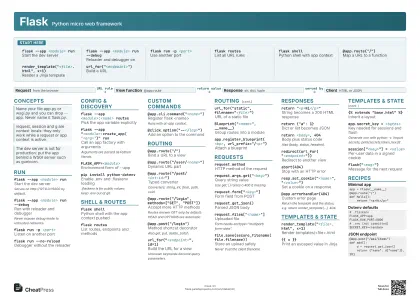
Start here
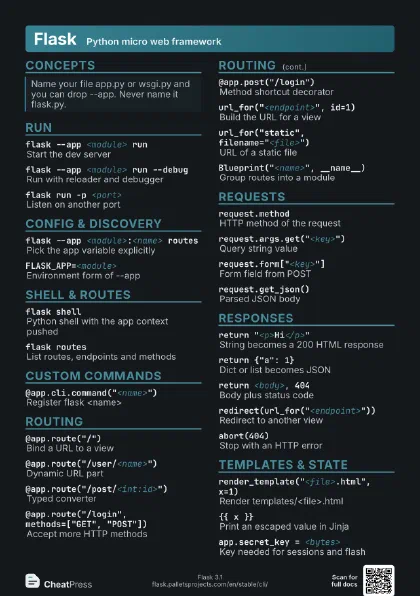
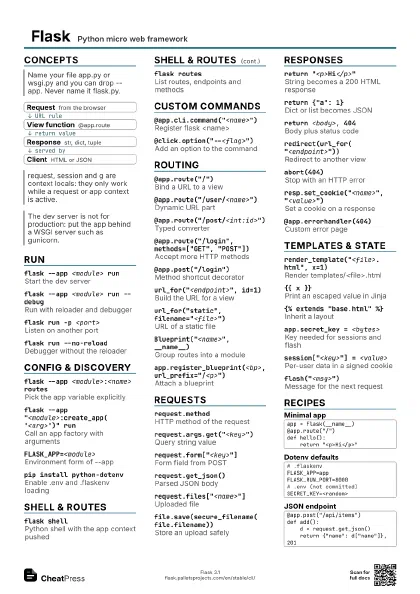
flask --app <module> run
Start the dev server
flask --app <module> run --debug
Reloader and debugger on
flask run -p <port>
Use another port
flask routesList all URL rules
flask shellPython shell with app context
@app.route("/")
Map a URL to a function
render_template("<file>.html", x=1)
Render a Jinja template
url_for("<endpoint>")
Build a URL
Concepts
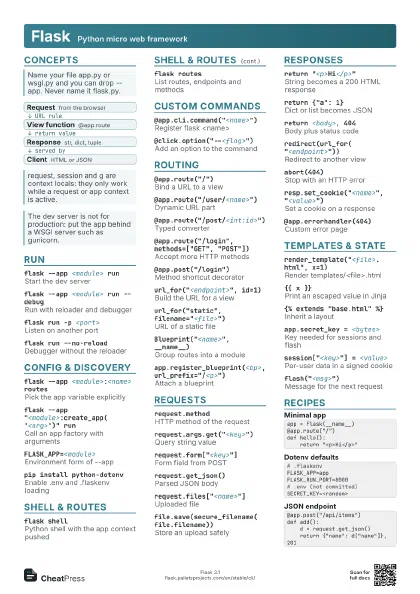
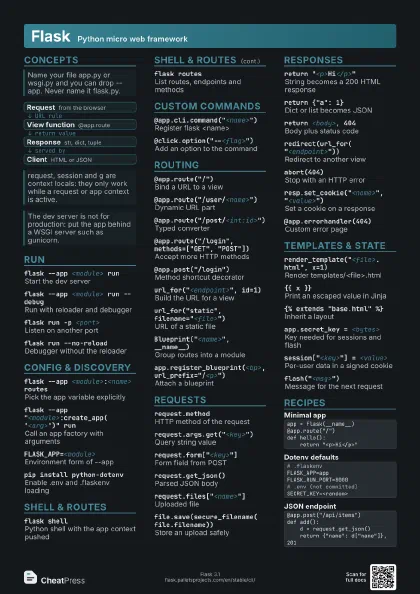
- Request from the browser
- View function @app.route
- Response str, dict, tuple
- Client HTML or JSON
Run
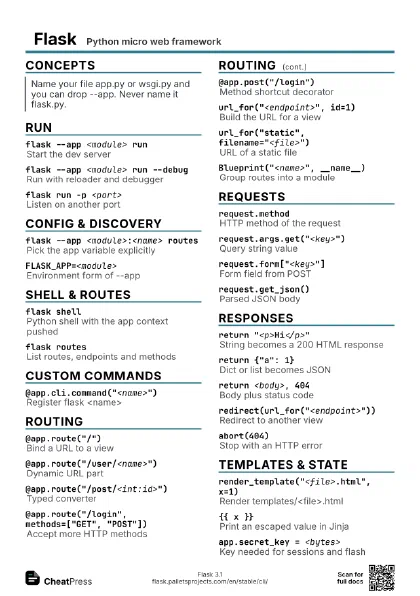
flask --app <module> run
Start the dev server
Serves on http://127.0.0.1:5000 by default.
flask --app <module> run --debug
Run with reloader and debugger
Never expose debug mode to untrusted networks.
flask run -p <port>
Listen on another port
flask run --no-reload
Debugger without the reloader
Config & discovery
flask --app <module>:<name> routes
Pick the app variable explicitly
flask --app
                    "<module>:create_app('<arg>')"
                    run
Call an app factory with arguments
Arguments are parsed as Python literals.
FLASK_APP=<module>
Environment form of --app
pip install python-dotenv
Enable .env and .flaskenv loading
.flaskenv is for public values; keep .env out of git.
Shell & routes
flask shellPython shell with the app context pushed
flask routesList routes, endpoints and methods
Custom commands
@app.cli.command("<name>")
Register flask <name>
Runs with an app context.
@click.option("--<flag>")
Add an option to the command
Routing
@app.route("/")
Bind a URL to a view
@app.route("/user/<name>")
Dynamic URL part
@app.route("/post/<int:id>")
Typed converter
Converters: string, int, float, path, uuid.
@app.route("/login", methods=["GET",
                    "POST"])
Accept more HTTP methods
Routes answer GET only by default; HEAD and OPTIONS are
automatic.
@app.post("/login")
Method shortcut decorator
Also get, put, delete, patch.
url_for("<endpoint>", id=1)
Build the URL for a view
Unknown keywords become query parameters.
url_for("static",
                    filename="<file>")
URL of a static file
Blueprint("<name>", __name__)
Group routes into a module
app.register_blueprint(<bp>,
                    url_prefix="/<p>")
Attach a blueprint
Requests
request.methodHTTP method of the request
request.args.get("<key>")
Query string value
Use get; [] raises a 400 if missing.
request.form["<key>"]
Form field from POST
request.get_json()
Parsed JSON body
request.files["<name>"]
Uploaded file
Form needs enctype="multipart/form-data".
file.save(secure_filename(file.filename))
Store an upload safely
Never trust the client filename.
Responses
return "<p>Hi</p>"
String becomes a 200 HTML response
return {"a": 1}
Dict or list becomes JSON
return <body>, 404
Body plus status code
Also (body, status, headers).
redirect(url_for("<endpoint>"))
Redirect to another view
abort(404)Stop with an HTTP error
resp.set_cookie("<name>",
                    "<value>")
Set a cookie on a response
@app.errorhandler(404)
Custom error page
Return the template and the status, e.g. return
render_template(...), 404.
Templates & state
render_template("<file>.html", x=1)
Render templates/<file>.html
{{ x }}Print an escaped value in Jinja
{% extends "base.html" %}
Inherit a layout
app.secret_key = <bytes>
Key needed for sessions and flash
Generate one with python -c 'import secrets;
print(secrets.token_hex())'.
session["<key>"] = <value>
Per-user data in a signed cookie
flash("<msg>")
Message for the next request
Recipes
app = Flask(__name__)@app.route("/")def hello(): return "<p>Hi</p>"# .flaskenvFLASK_APP=appFLASK_RUN_PORT=8000# .env (not committed)SECRET_KEY=<random>@app.post("/api/items")def add(): d = request.get_json() return {"name": d["name"]}, 201