Cheat
Traefik Edge router and proxy
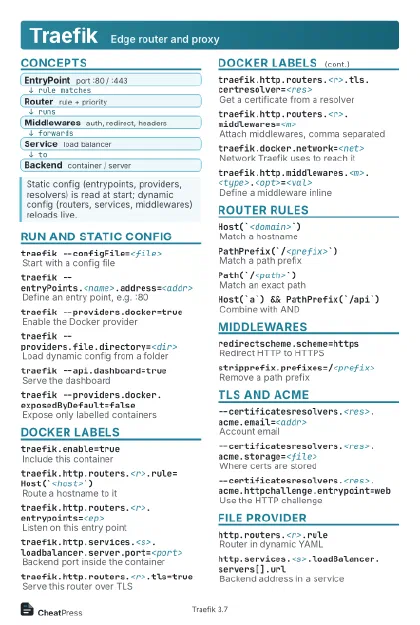 Light · Postcard
102 × 152 mm · PDF
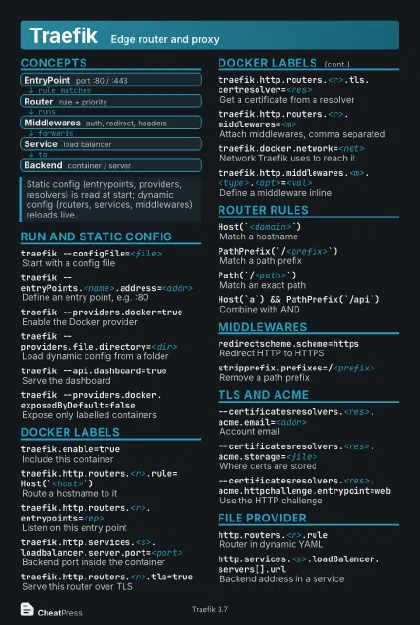 Dark · Postcard
102 × 152 mm · PDF
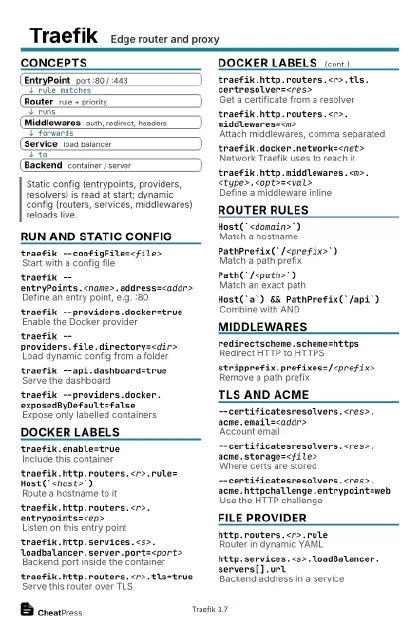 Ink saver · Postcard
102 × 152 mm · PDF
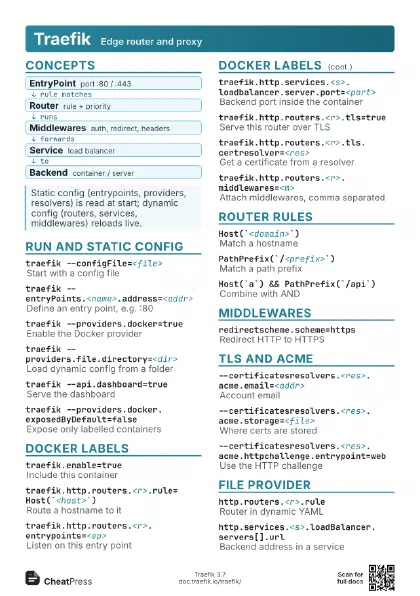
 Light · A4 landscape
297 × 210 mm · PDF
 Dark · A4 landscape
297 × 210 mm · PDF
 Ink saver · A4 landscape
297 × 210 mm · PDF


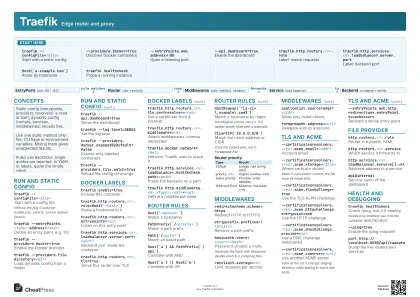 Light · A3 landscape
420 × 297 mm · PDF
 Dark · A3 landscape
420 × 297 mm · PDF
 Ink saver · A3 landscape
420 × 297 mm · PDF



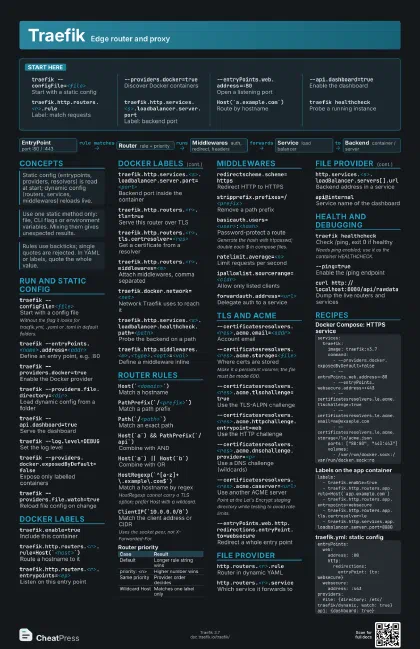

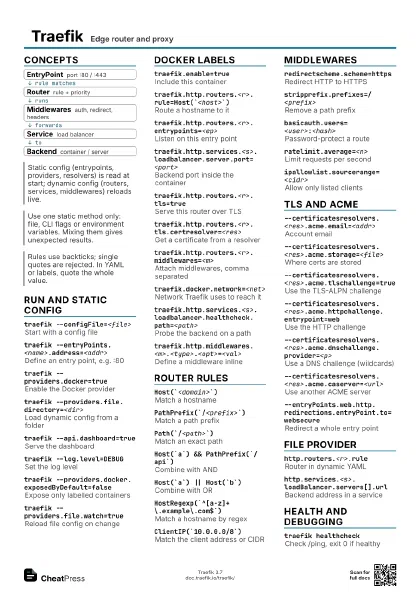
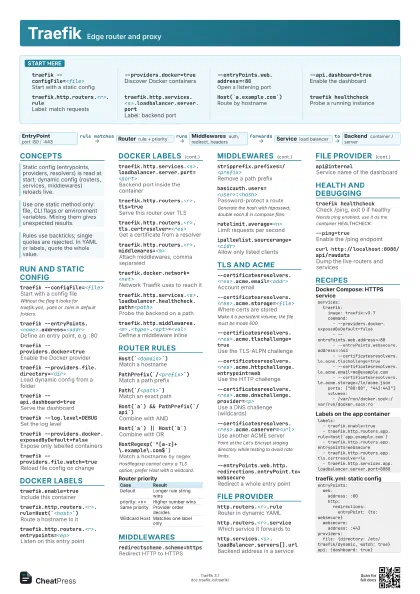
Start here
traefik --configFile=<file>
Start with a static config
--providers.docker=true
Discover Docker containers
--entryPoints.web.address=:80
Open a listening port
--api.dashboard=true
Enable the dashboard
traefik.http.routers.<r>.rule
Label: match requests
traefik.http.services.<s>.loadbalancer.server.port
Label: backend port
Host(`a.example.com`)
Route by hostname
traefik healthcheck
Probe a running instance
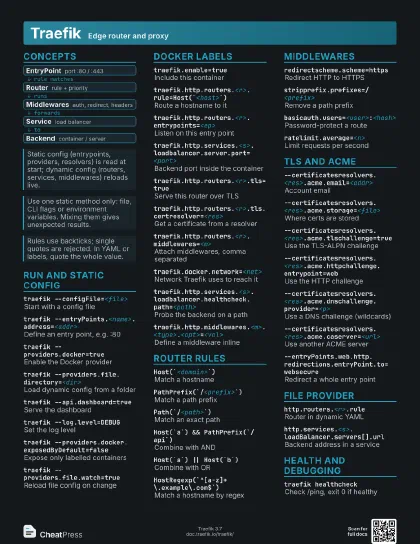
Concepts
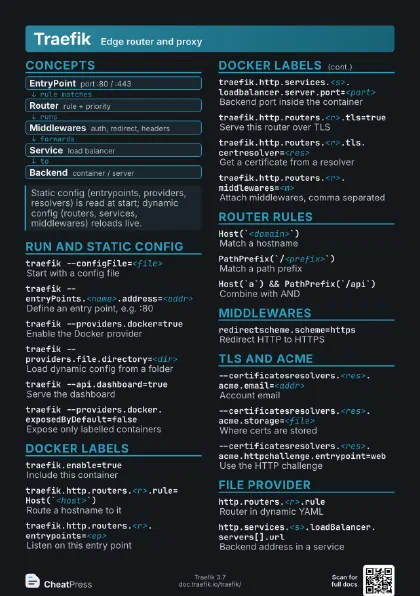
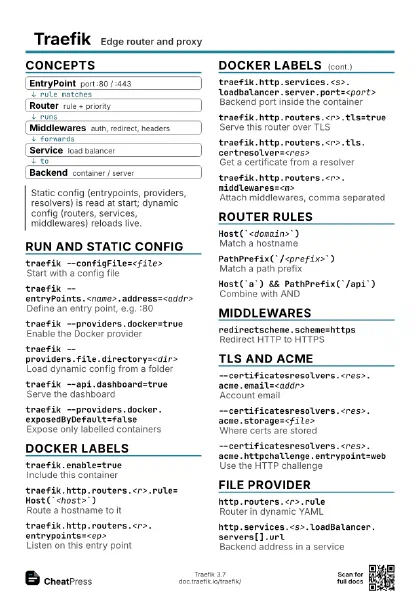
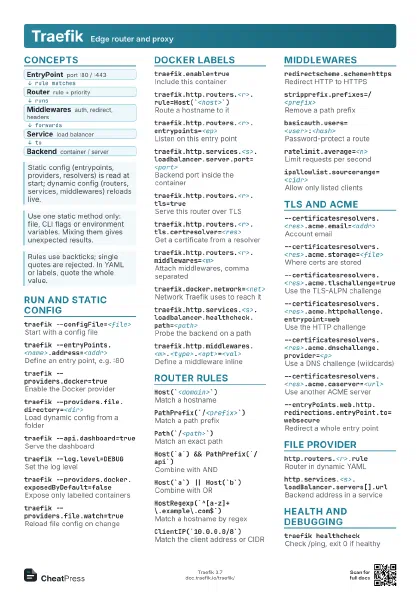
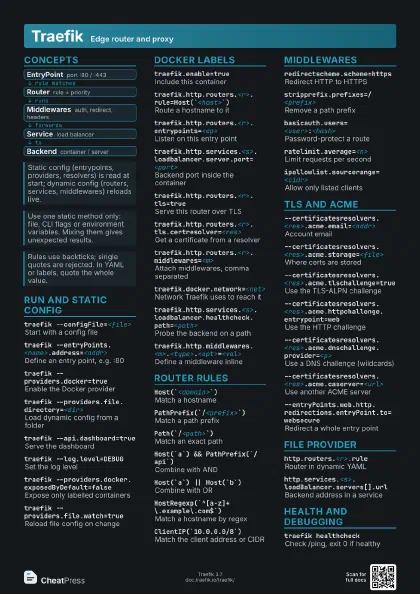
- EntryPoint port :80 / :443
- Router rule + priority
- Middlewares auth, redirect, headers
- Service load balancer
- Backend container / server
Run and static config
traefik --configFile=<file>
Start with a config file
Without the flag it looks for traefik.yml, .yaml or .toml in
default folders.
traefik
                    --entryPoints.<name>.address=<addr>
Define an entry point, e.g. :80
traefik --providers.docker=true
Enable the Docker provider
traefik --providers.file.directory=<dir>
Load dynamic config from a folder
traefik --api.dashboard=true
Serve the dashboard
traefik --log.level=DEBUG
Set the log level
traefik --providers.docker.exposedByDefault=false
Expose only labelled containers
traefik --providers.file.watch=true
Reload file config on change
Docker labels
traefik.enable=true
Include this container
traefik.http.routers.<r>.rule=Host(`<host>`)
Route a hostname to it
traefik.http.routers.<r>.entrypoints=<ep>
Listen on this entry point
traefik.http.services.<s>.loadbalancer.server.port=<port>
Backend port inside the container
traefik.http.routers.<r>.tls=true
Serve this router over TLS
traefik.http.routers.<r>.tls.certresolver=<res>
Get a certificate from a resolver
traefik.http.routers.<r>.middlewares=<m>
Attach middlewares, comma separated
traefik.docker.network=<net>
Network Traefik uses to reach it
traefik.http.services.<s>.loadbalancer.healthcheck.path=<path>
Probe the backend on a path
traefik.http.middlewares.<m>.<type>.<opt>=<val>
Define a middleware inline
Router rules
Host(`<domain>`)
Match a hostname
PathPrefix(`/<prefix>`)
Match a path prefix
Path(`/<path>`)
Match an exact path
Host(`a`) && PathPrefix(`/api`)
Combine with AND
Host(`a`) || Host(`b`)
Combine with OR
HostRegexp(`^[a-z]+\.example\.com$`)
Match a hostname by regex
HostRegexp cannot carry a TLS option; prefer Host with a
wildcard.
ClientIP(`10.0.0.0/8`)
Match the client address or CIDR
Uses the socket peer, not X-Forwarded-For.
| Case | Result |
|---|---|
| Default | Longer rule string wins |
| priority: <n> | Higher number wins |
| Same priority | Provider order decides |
| Wildcard Host | Matches one label only |
Middlewares
redirectscheme.scheme=https
Redirect HTTP to HTTPS
stripprefix.prefixes=/<prefix>
Remove a path prefix
basicauth.users=<user>:<hash>
Password-protect a route
Generate the hash with htpasswd; double each $ in compose
files.
ratelimit.average=<n>
Limit requests per second
ipallowlist.sourcerange=<cidr>
Allow only listed clients
forwardauth.address=<url>
Delegate auth to a service
TLS and ACME
--certificatesresolvers.<res>.acme.email=<addr>
Account email
--certificatesresolvers.<res>.acme.storage=<file>
Where certs are stored
Make it a persistent volume; the file must be mode 600.
--certificatesresolvers.<res>.acme.tlschallenge=true
Use the TLS-ALPN challenge
--certificatesresolvers.<res>.acme.httpchallenge.entrypoint=web
Use the HTTP challenge
--certificatesresolvers.<res>.acme.dnschallenge.provider=<p>
Use a DNS challenge (wildcards)
--certificatesresolvers.<res>.acme.caserver=<url>
Use another ACME server
Point at the Let's Encrypt staging directory while testing
to avoid rate limits.
--entryPoints.web.http.redirections.entryPoint.to=websecure
Redirect a whole entry point
File provider
http.routers.<r>.rule
Router in dynamic YAML
http.routers.<r>.service
Which service it forwards to
http.services.<s>.loadBalancer.servers[].url
Backend address in a service
api@internalService name of the dashboard
Health and debugging
traefik healthcheck
Check /ping, exit 0 if healthy
Needs ping enabled; use it as the container HEALTHCHECK.
--ping=trueEnable the /ping endpoint
curl http://localhost:8080/api/rawdata
Dump the live routers and services
Recipes
services: traefik: image: traefik:v3.7 command: - --providers.docker.exposedByDefault=false - --entryPoints.web.address=:80 - --entryPoints.websecure.address=:443 - --certificatesresolvers.le.acme.tlschallenge=true - --certificatesresolvers.le.acme.email=me@example.com - --certificatesresolvers.le.acme.storage=/le/acme.json ports: ["80:80", "443:443"] volumes: - /var/run/docker.sock:/var/run/docker.sock:rolabels: - traefik.enable=true - traefik.http.routers.app.rule=Host(`app.example.com`) - traefik.http.routers.app.entrypoints=websecure - traefik.http.routers.app.tls.certresolver=le - traefik.http.services.app.loadbalancer.server.port=8080entryPoints: web: address: :80 http: redirections: entryPoint: {to: websecure} websecure: address: :443providers: file: {directory: /etc/traefik/dynamic, watch: true}api: {dashboard: true}http: routers: app: rule: Host(`app.example.com`) service: app tls: {certResolver: le} services: app: loadBalancer: servers: - url: http://127.0.0.1:8080