Cheat
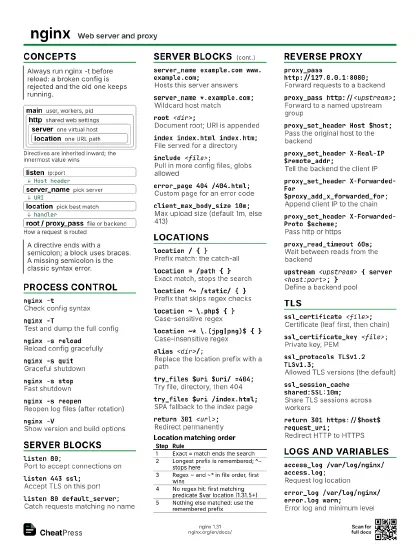
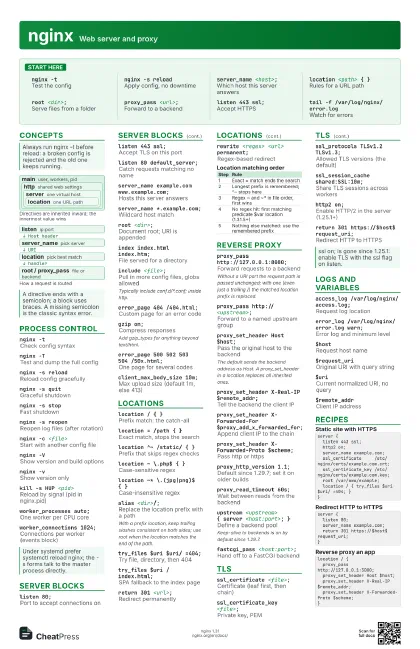
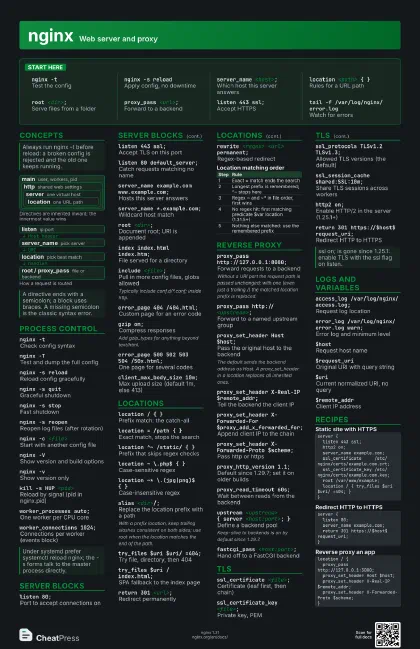
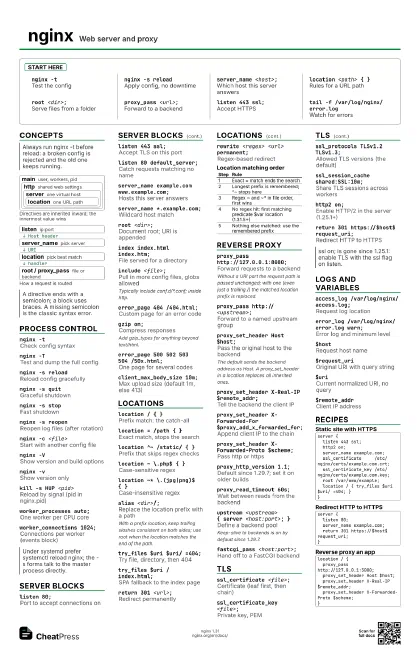
nginx Web server and proxy
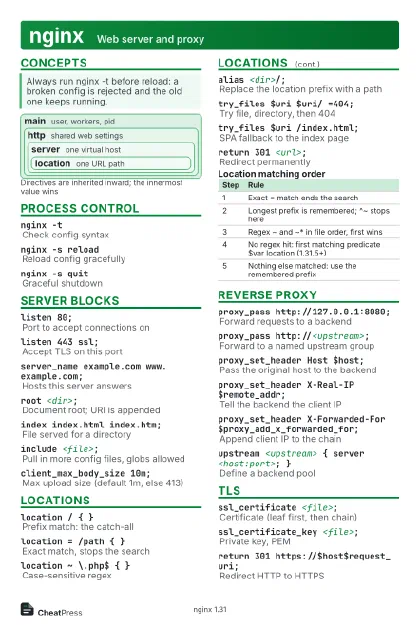 Light · Postcard
102 × 152 mm · PDF
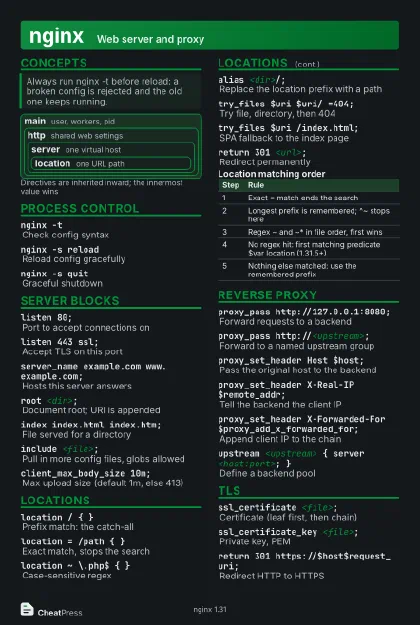 Dark · Postcard
102 × 152 mm · PDF
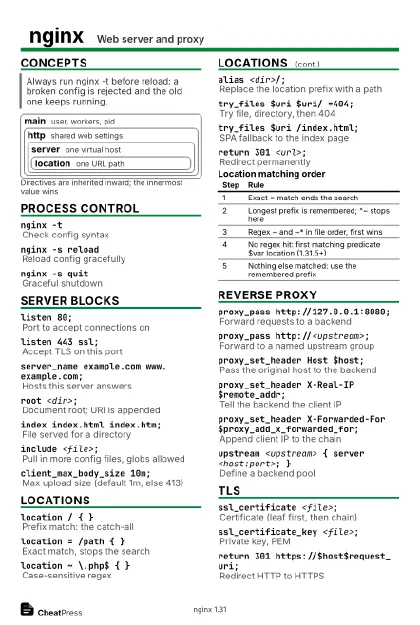 Ink saver · Postcard
102 × 152 mm · PDF
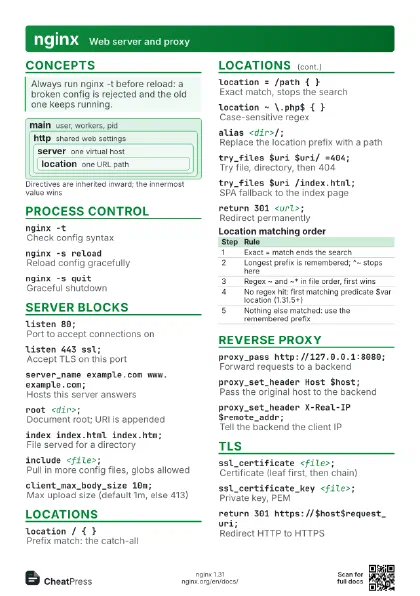
 Light · A4 landscape
297 × 210 mm · PDF
 Dark · A4 landscape
297 × 210 mm · PDF
 Ink saver · A4 landscape
297 × 210 mm · PDF
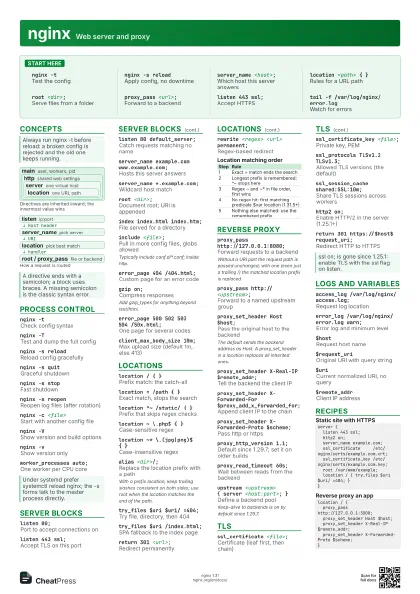
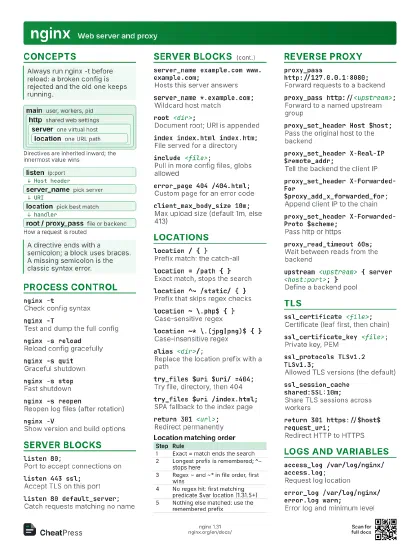
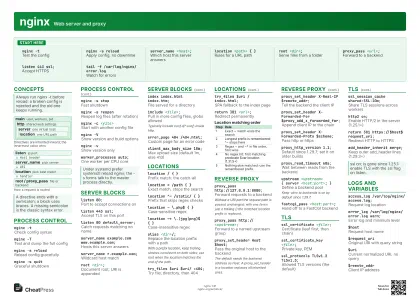 Light · A3 landscape
420 × 297 mm · PDF
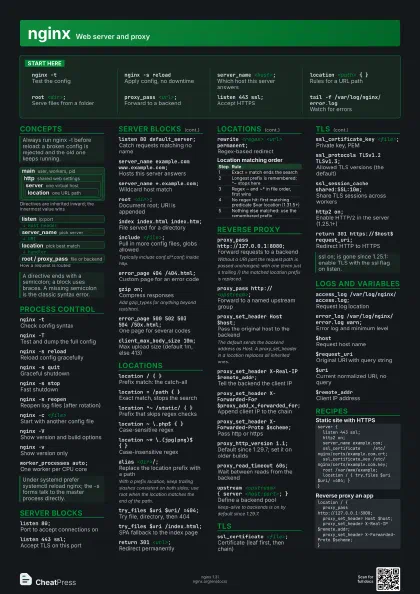
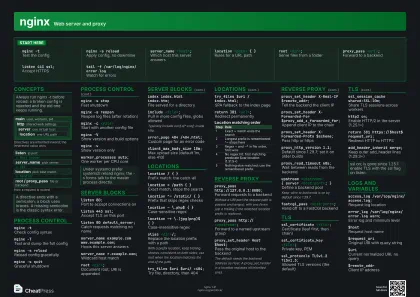 Dark · A3 landscape
420 × 297 mm · PDF
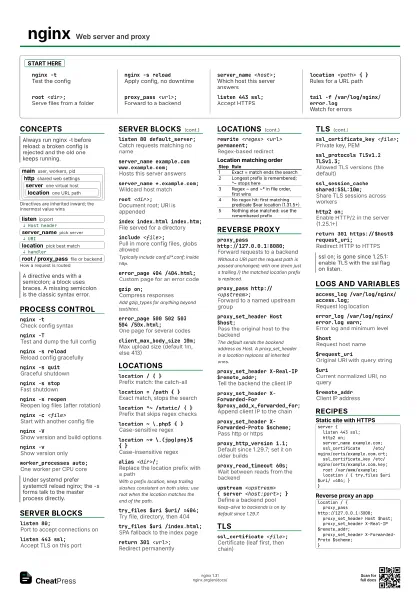
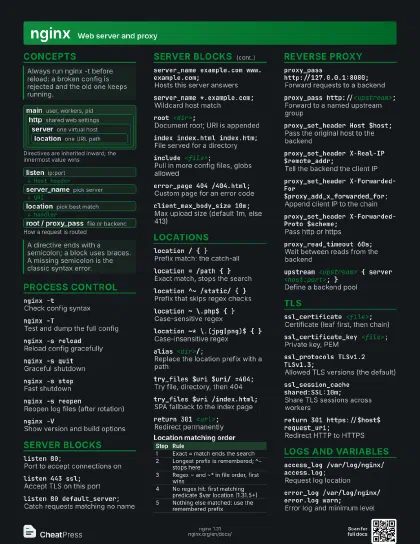
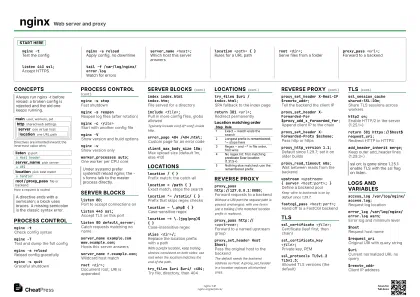 Ink saver · A3 landscape
420 × 297 mm · PDF
Start here
nginx -tTest the config
nginx -s reloadApply config, no downtime
server_name <host>;
Which host this server answers
location <path> { }
Rules for a URL path
root <dir>;
Serve files from a folder
proxy_pass <url>;
Forward to a backend
listen 443 ssl;Accept HTTPS
tail -f /var/log/nginx/error.log
Watch for errors
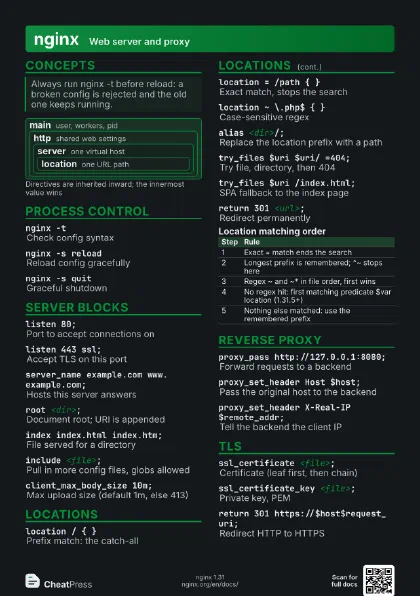
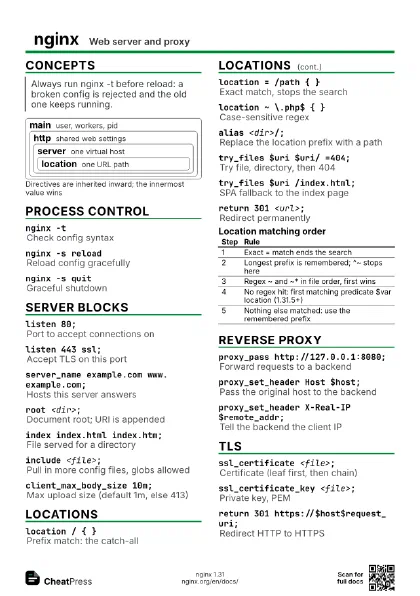
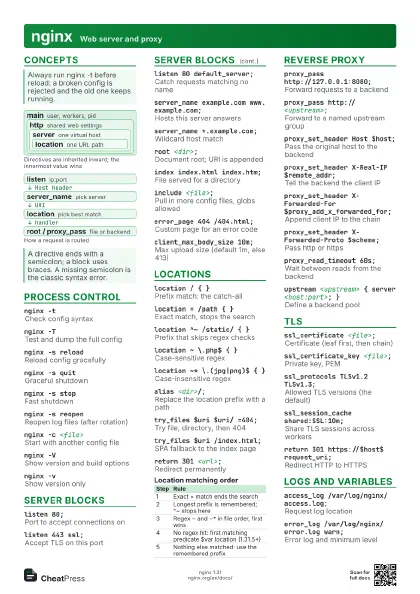
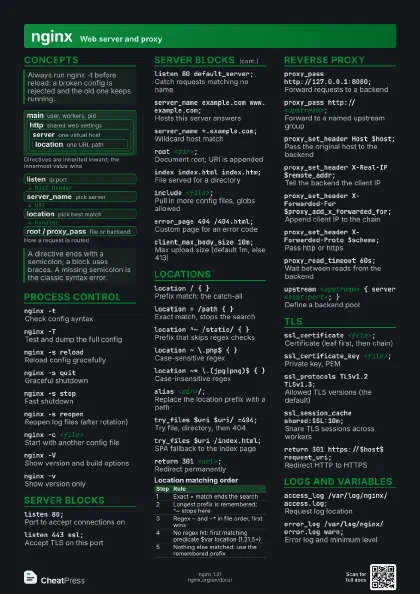
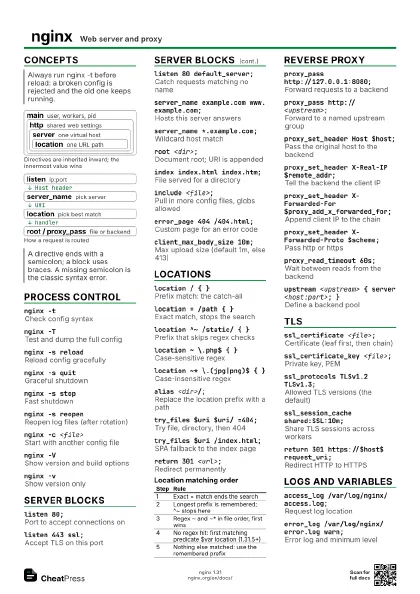
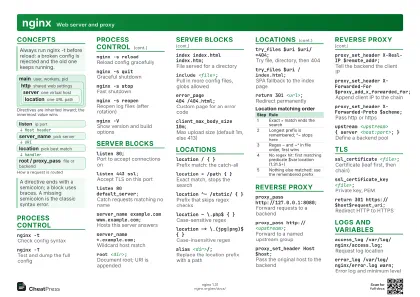
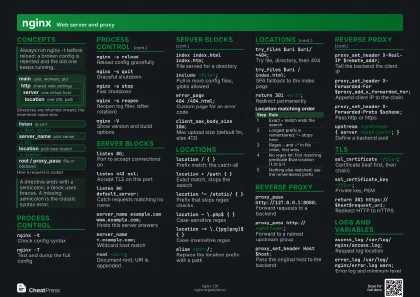
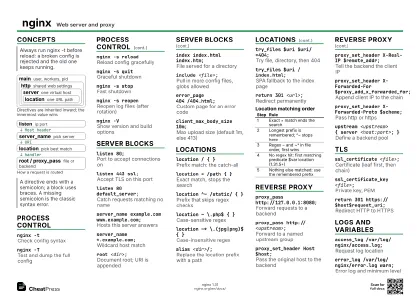
Concepts
main user, workers, pid
http shared web settings
server one virtual host
location one URL path
- listen ip:port
- server_name pick server
- location pick best match
- root / proxy_pass file or backend
Process Control
nginx -tCheck config syntax
nginx -TTest and dump the full config
nginx -s reloadReload config gracefully
nginx -s quitGraceful shutdown
nginx -s stopFast shutdown
nginx -s reopenReopen log files (after rotation)
nginx -c <file>
Start with another config file
nginx -VShow version and build options
nginx -vShow version only
kill -s HUP <pid>
Reload by signal (pid in nginx.pid)
nginx -g "<directive>;"
Set a global directive from the CLI
worker_processes auto;
One worker per CPU core
worker_connections 1024;
Connections per worker (events block)
Server Blocks
listen 80;Port to accept connections on
listen 443 ssl;Accept TLS on this port
listen 80 default_server;
Catch requests matching no name
server_name example.com www.example.com;
Hosts this server answers
server_name *.example.com;
Wildcard host match
root <dir>;
Document root; URI is appended
index index.html index.htm;
File served for a directory
include <file>;
Pull in more config files, globs allowed
Typically include conf.d/*.conf; inside http.
error_page 404 /404.html;
Custom page for an error code
gzip on;Compress responses
Add gzip_types for anything beyond text/html.
allow <ip>; deny all;
Restrict access by client address
auth_basic "<realm>";
Ask for a password (needs auth_basic_user_file)
error_page 500 502 503 504 /50x.html;
One page for several codes
client_max_body_size 10m;
Max upload size (default 1m, else 413)
keepalive_timeout 75s;
Idle time for keep-alive connections
Locations
location / { }Prefix match: the catch-all
location = /path { }
Exact match, stops the search
location ^~ /static/ { }
Prefix that skips regex checks
location ~ \.php$ { }
Case-sensitive regex
location ~* \.(jpg|png)$ { }
Case-insensitive regex
location @fallback { }
Named location for internal jumps
alias <dir>/;
Replace the location prefix with a path
With a prefix location, keep trailing slashes consistent on
both sides; use root when the location matches the end of the
path.
try_files $uri $uri/ =404;
Try file, directory, then 404
try_files $uri /index.html;
SPA fallback to the index page
return 301 <url>;
Redirect permanently
return 200 "<text>";
Answer directly with a body
rewrite <regex> <url> permanent;
Regex-based redirect
autoindex on;List directory contents
| Step | Rule |
|---|---|
| 1 | Exact = match ends the search |
| 2 | Longest prefix is remembered; ^~ stops here |
| 3 | Regex ~ and ~* in file order, first wins |
| 4 | No regex hit: first matching predicate $var location (1.31.5+) |
| 5 | Nothing else matched: use the remembered prefix |
Reverse Proxy
proxy_pass http://127.0.0.1:8080;
Forward requests to a backend
Without a URI part the request path is passed unchanged; with
one (even just a trailing /) the matched location prefix is
replaced.
proxy_pass http://<upstream>;
Forward to a named upstream group
proxy_set_header Host $host;
Pass the original host to the backend
The default sends the backend address as Host. A
proxy_set_header in a location replaces all inherited ones.
proxy_set_header X-Real-IP $remote_addr;
Tell the backend the client IP
proxy_set_header X-Forwarded-For
                    $proxy_add_x_forwarded_for;
Append client IP to the chain
proxy_set_header X-Forwarded-Proto $scheme;
Pass http or https
proxy_http_version 1.1;
Default since 1.29.7; set it on older builds
proxy_read_timeout 60s;
Wait between reads from the backend
proxy_buffering off;
Stream responses, e.g. for SSE
limit_req zone=<zone> burst=<n>;
Rate limit (needs limit_req_zone)
upstream <upstream> { server <host:port>;
                    }
Define a backend pool
Keep-alive to backends is on by default since 1.29.7.
least_conn;
Balance by fewest connections (in upstream)
proxy_redirect off;
Keep backend Location headers as is
fastcgi_pass <host:port>;
Hand off to a FastCGI backend
TLS
ssl_certificate <file>;
Certificate (leaf first, then chain)
ssl_certificate_key <file>;
Private key, PEM
ssl_protocols TLSv1.2 TLSv1.3;
Allowed TLS versions (the default)
ssl_session_cache shared:SSL:10m;
Share TLS sessions across workers
http2 on;
Enable HTTP/2 in the server (1.25.1+)
return 301 https://$host$request_uri;
Redirect HTTP to HTTPS
add_header Strict-Transport-Security
                    "max-age=31536000" always;
Send an HSTS header
An add_header in a deeper block drops this one unless
add_header_inherit merge; is set.
add_header_inherit merge;
Keep outer add_header lines (1.29.3+)
Logs and Variables
access_log /var/log/nginx/access.log;
Request log location
access_log off;Silence the log for this scope
error_log /var/log/nginx/error.log warn;
Error log and minimum level
log_format <name> '<fields>';
Define a custom log format
$hostRequest host name
$request_uriOriginal URI with query string
$uriCurrent normalized URI, no query
$remote_addrClient IP address
$schemehttp or https
Recipes
server { listen 443 ssl; http2 on; server_name example.com; ssl_certificate /etc/nginx/certs/example.com.crt; ssl_certificate_key /etc/nginx/certs/example.com.key; root /var/www/example; location / { try_files $uri $uri/ =404; }}server { listen 80; server_name example.com; return 301 https://$host$request_uri;}location / { proxy_pass http://127.0.0.1:3000; proxy_set_header Host $host; proxy_set_header X-Real-IP $remote_addr; proxy_set_header X-Forwarded-Proto $scheme;}location /ws/ { proxy_pass http://127.0.0.1:3000; # needed before 1.29.7 proxy_http_version 1.1; proxy_set_header Upgrade $http_upgrade; proxy_set_header Connection "upgrade";}