Cheat
SoX Audio swiss knife
 Light · Postcard
102 × 152 mm · PDF
 Dark · Postcard
102 × 152 mm · PDF
 Ink saver · Postcard
102 × 152 mm · PDF
 Light · A4 landscape
297 × 210 mm · PDF
 Dark · A4 landscape
297 × 210 mm · PDF
 Ink saver · A4 landscape
297 × 210 mm · PDF
 Light · A3 landscape
420 × 297 mm · PDF
 Dark · A3 landscape
420 × 297 mm · PDF
 Ink saver · A3 landscape
420 × 297 mm · PDF
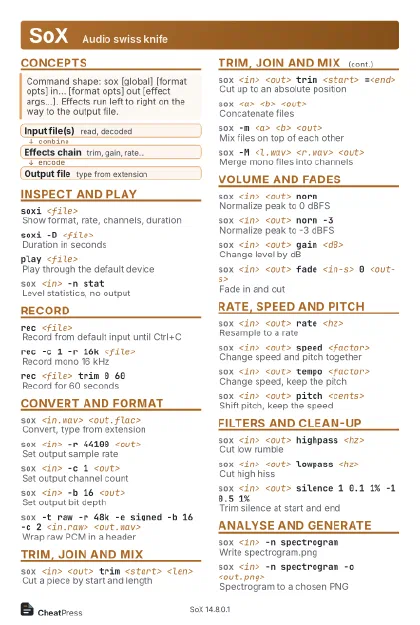
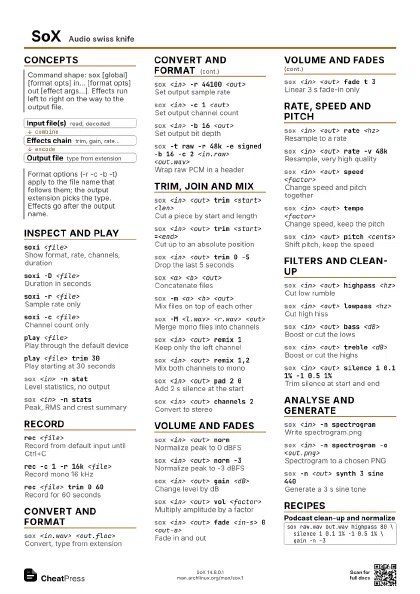
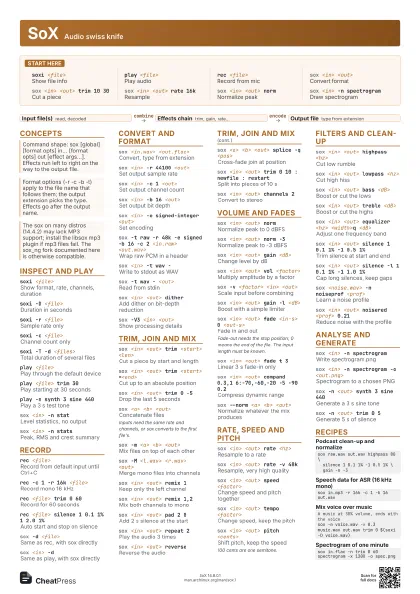
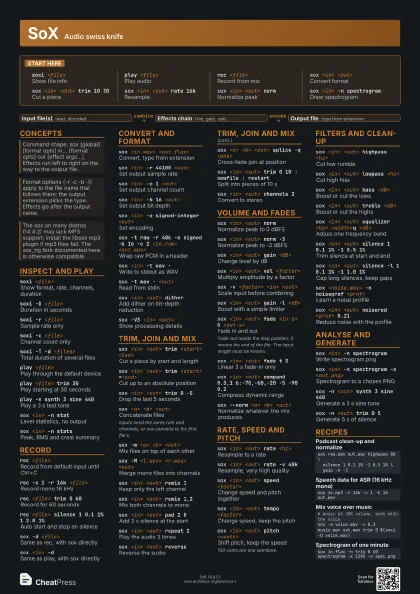
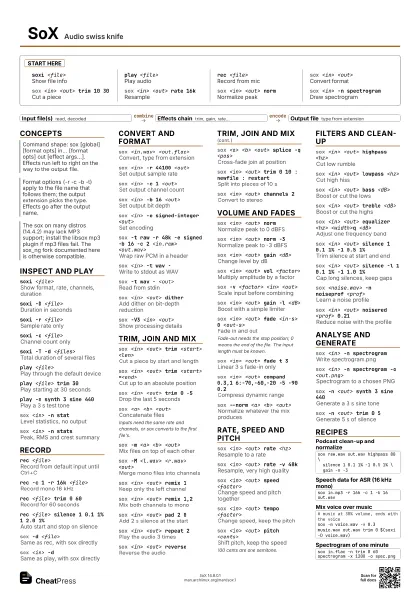
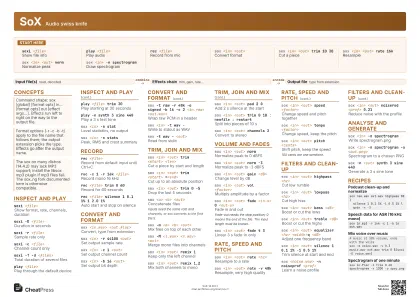
Start here
soxi <file>
Show file info
play <file>
Play audio
rec <file>
Record from mic
sox <in> <out>
Convert format
sox <in> <out> trim 10 30
Cut a piece
sox <in> <out> rate 16k
Resample
sox <in> <out> norm
Normalize peak
sox <in> -n spectrogram
Draw spectrogram
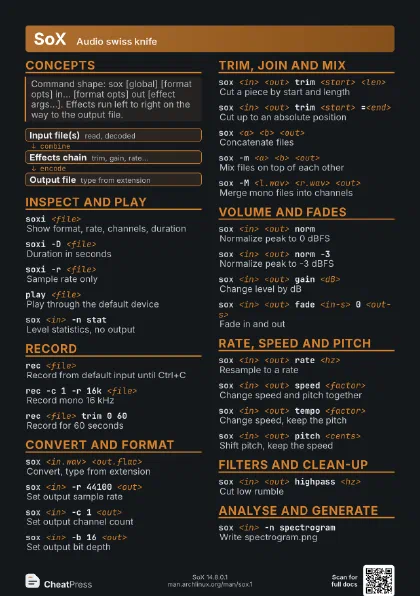
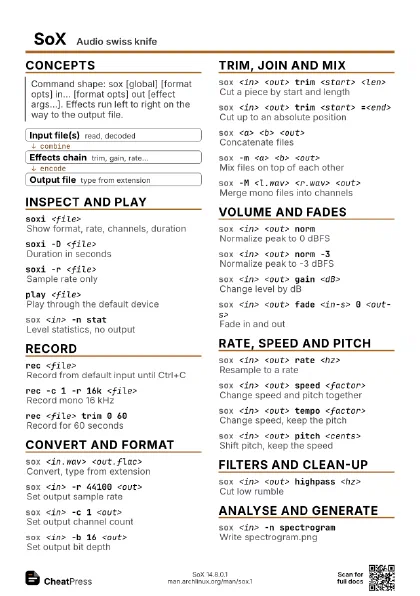
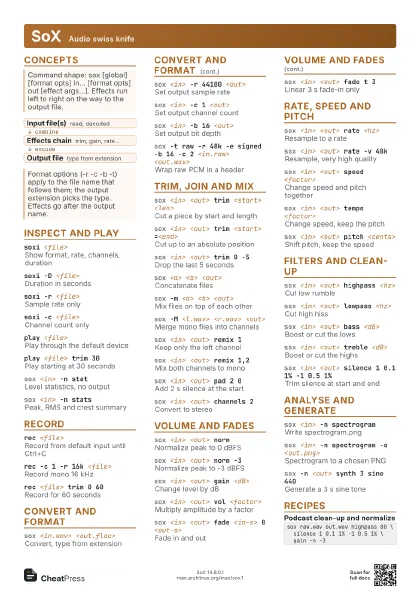
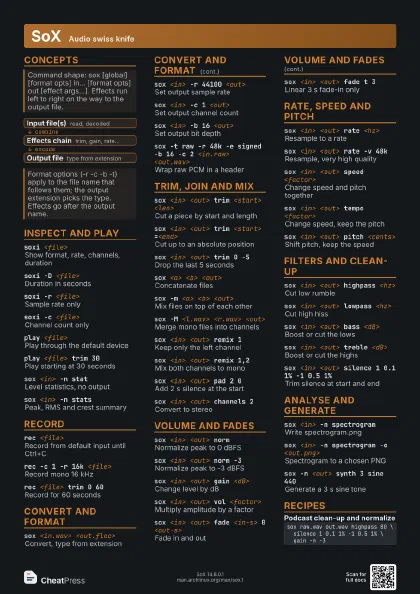
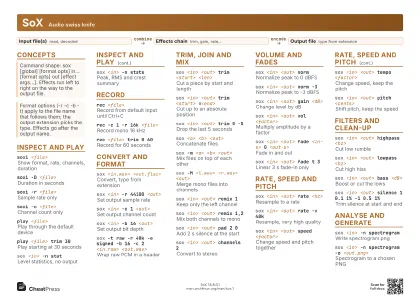
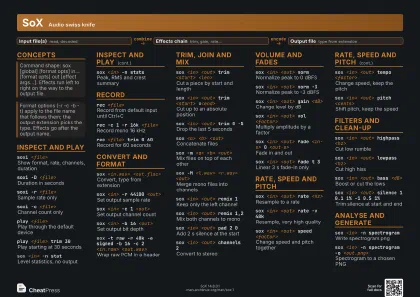
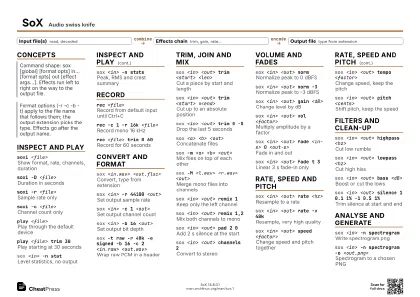
Concepts
- Input file(s) read, decoded
- Effects chain trim, gain, rate...
- Output file type from extension
Inspect and play
soxi <file>
Show format, rate, channels, duration
soxi -D <file>
Duration in seconds
soxi -r <file>
Sample rate only
soxi -c <file>
Channel count only
soxi -T -d <files>
Total duration of several files
play <file>
Play through the default device
play <file> trim 30
Play starting at 30 seconds
play -n synth 3 sine 440
Play a 3 s test tone
sox <in> -n stat
Level statistics, no output
sox <in> -n stats
Peak, RMS and crest summary
Record
rec <file>
Record from default input until Ctrl+C
rec -c 1 -r 16k <file>
Record mono 16 kHz
rec <file> trim 0 60
Record for 60 seconds
rec <file> silence 1 0.1 1% 1 2.0 1%
Auto start and stop on silence
sox -d <file>
Same as rec, with sox directly
sox <in> -d
Same as play, with sox directly
Convert and format
sox <in.wav> <out.flac>
Convert, type from extension
sox <in> -r 44100 <out>
Set output sample rate
sox <in> -c 1 <out>
Set output channel count
sox <in> -b 16 <out>
Set output bit depth
sox <in> -e signed-integer <out>
Set encoding
sox -t raw -r 48k -e signed -b 16 -c 2 <in.raw>
                    <out.wav>
Wrap raw PCM in a header
sox <in> -t wav -
Write to stdout as WAV
sox -t wav - <out>
Read from stdin
sox <in> <out> dither
Add dither on bit-depth reduction
sox -V3 <in> <out>
Show processing details
Trim, join and mix
sox <in> <out> trim <start>
                    <len>
Cut a piece by start and length
sox <in> <out> trim <start>
                    =<end>
Cut up to an absolute position
sox <in> <out> trim 0 -5
Drop the last 5 seconds
sox <a> <b> <out>
Concatenate files
Inputs need the same rate and channels, or sox converts to the
first file's.
sox -m <a> <b> <out>
Mix files on top of each other
sox -M <l.wav> <r.wav> <out>
Merge mono files into channels
sox <in> <out> remix 1
Keep only the left channel
sox <in> <out> remix 1,2
Mix both channels to mono
sox <in> <out> pad 2 0
Add 2 s silence at the start
sox <in> <out> repeat 2
Play the audio 3 times
sox <in> <out> reverse
Reverse the audio
sox <a> <b> <out> splice -q
                    <pos>
Cross-fade join at position
sox <in> <out> delay 1 1
Delay each channel by 1 s
sox <in> <out> trim 0 10 : newfile :
                    restart
Split into pieces of 10 s
sox <in> <out> channels 2
Convert to stereo
Volume and fades
sox <in> <out> norm
Normalize peak to 0 dBFS
sox <in> <out> norm -3
Normalize peak to -3 dBFS
sox <in> <out> gain <dB>
Change level by dB
sox <in> <out> vol <factor>
Multiply amplitude by a factor
sox -v <factor> <in> <out>
Scale input before combining
sox <in> <out> gain -n -3
Same as norm -3
sox <in> <out> gain -l <dB>
Boost with a simple limiter
sox <in> <out> fade <in-s> 0
                    <out-s>
Fade in and out
Fade-out needs the stop position; 0 means the end of the file.
The input length must be known.
sox <in> <out> fade t 3
Linear 3 s fade-in only
sox <in> <out> compand 0.3,1 6:-70,-60,-20 -5
                    -90 0.2
Compress dynamic range
sox --norm <a> <b> <out>
Normalize whatever the mix produces
Rate, speed and pitch
sox <in> <out> rate <hz>
Resample to a rate
sox <in> <out> rate -v 48k
Resample, very high quality
sox <in> <out> speed <factor>
Change speed and pitch together
sox <in> <out> tempo <factor>
Change speed, keep the pitch
sox <in> <out> pitch <cents>
Shift pitch, keep the speed
100 cents are one semitone.
sox <in> <out> speed 1.0595
Raise one semitone with speed
sox <in> <out> tempo -s <factor>
Tempo tuned for speech
Filters and clean-up
sox <in> <out> highpass <hz>
Cut low rumble
sox <in> <out> lowpass <hz>
Cut high hiss
sox <in> <out> bass <dB>
Boost or cut the lows
sox <in> <out> treble <dB>
Boost or cut the highs
sox <in> <out> equalizer <hz>
                    <width>q <dB>
Adjust one frequency band
sox <in> <out> silence 1 0.1 1% -1 0.5 1%
Trim silence at start and end
sox <in> <out> silence -l 1 0.1 1% -1 1.0
                    1%
Cap long silences, keep gaps
sox <noise.wav> -n noiseprof <prof>
Learn a noise profile
sox <in> <out> noisered <prof> 0.21
Reduce noise with the profile
sox <in> <out> loudness
Equal-loudness compensation
Analyse and generate
sox <in> -n spectrogram
Write spectrogram.png
sox <in> -n spectrogram -o <out.png>
Spectrogram to a chosen PNG
sox <in> -n spectrogram -x 1600 -Y 400
Set image width and height
sox <in> -n spectrogram -l -r
Light background, raw, no axes
sox <in> -n stat -v
Print the volume adjustment for norm
sox -n <out> synth 3 sine 440
Generate a 3 s sine tone
sox -n <out> synth 5 whitenoise
Generate noise
sox -n <out> trim 0 5
Generate 5 s of silence
Recipes
sox raw.wav out.wav highpass 80 \ silence 1 0.1 1% -1 0.5 1% \ gain -n -3sox in.mp3 -r 16k -c 1 -b 16 out.wav# music at 30% volume, ends with the voicesox -m voice.wav -v 0.3 music.wav out.wav trim 0 $(soxi -D voice.wav)sox in.flac -n trim 0 60 spectrogram -x 1200 -o spec.png