Cheat
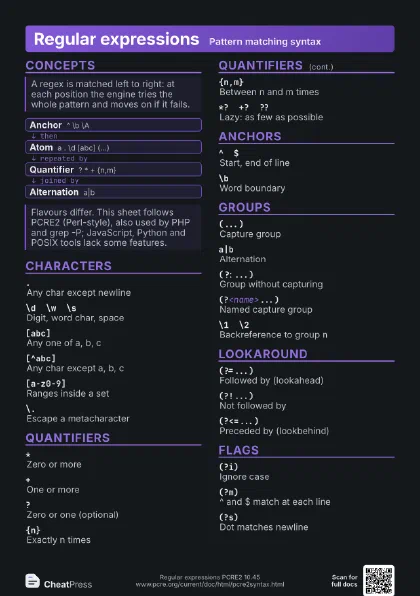
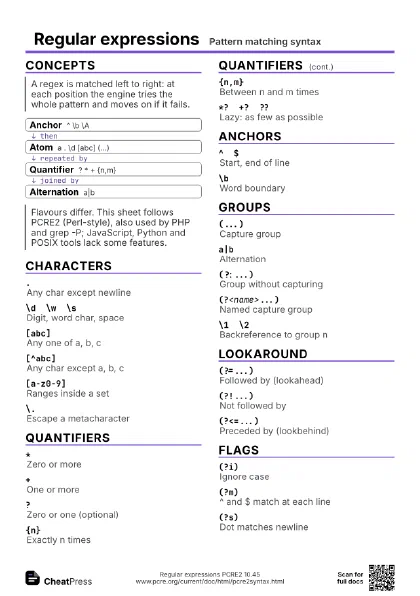
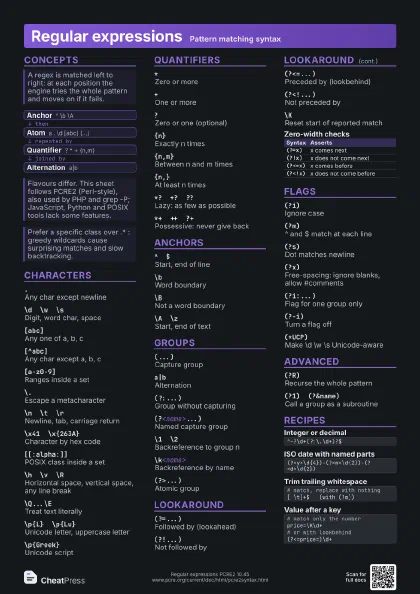
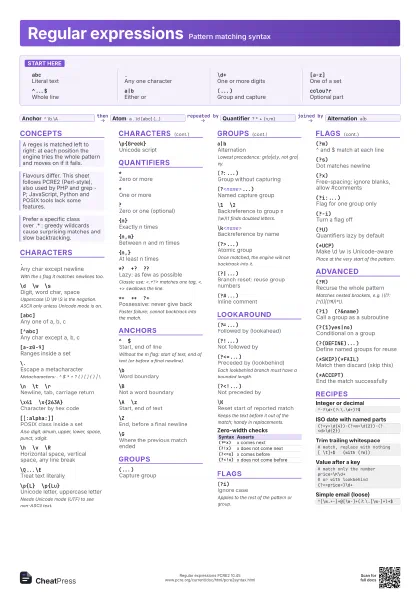
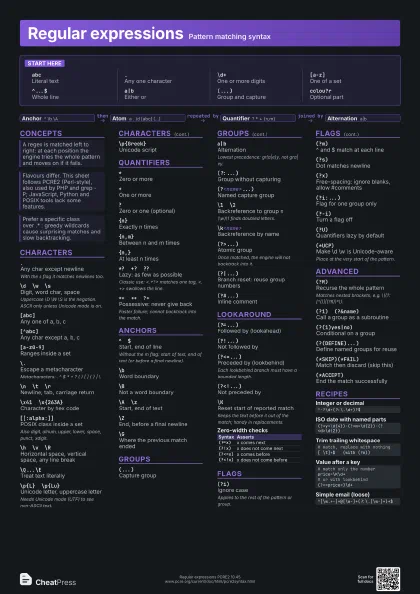
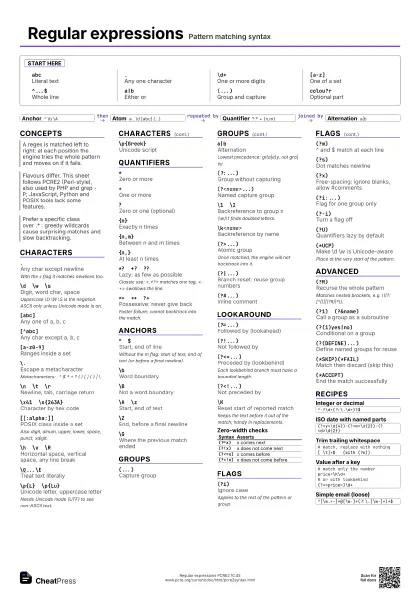
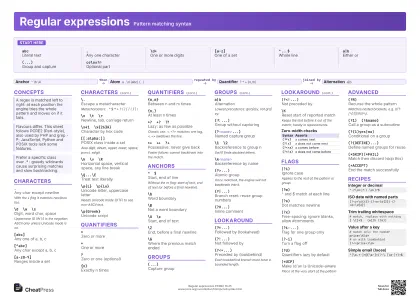
Regular expressions Pattern matching syntax
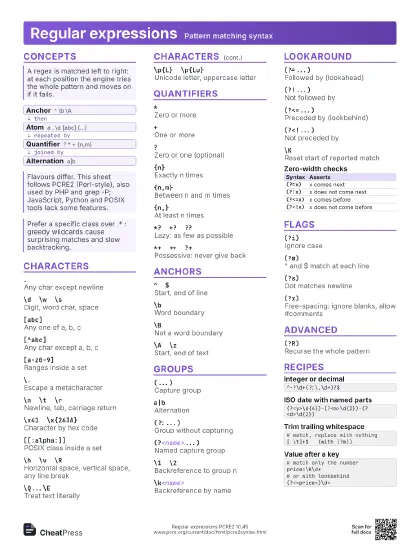
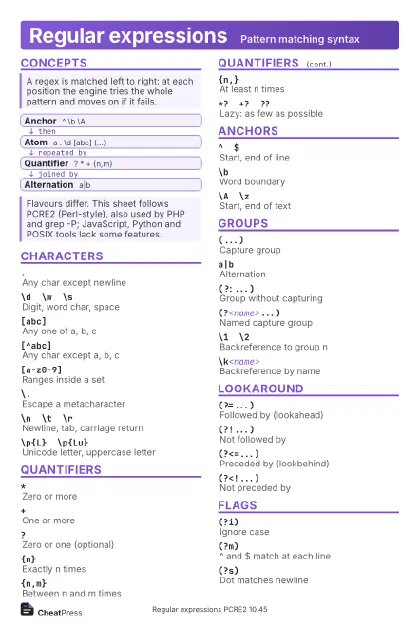 Light · Postcard
102 × 152 mm · PDF
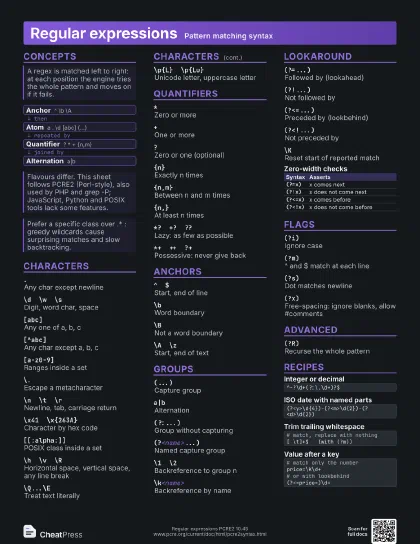
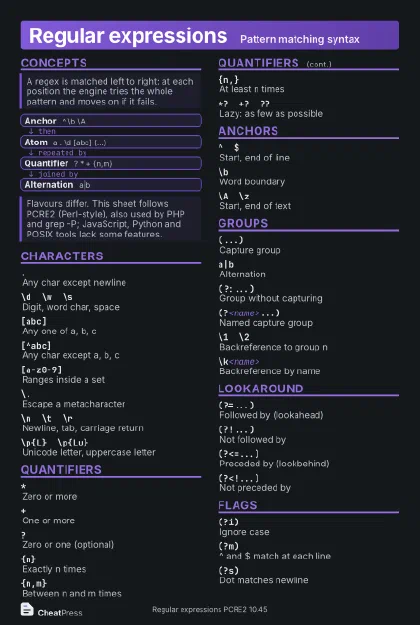 Dark · Postcard
102 × 152 mm · PDF
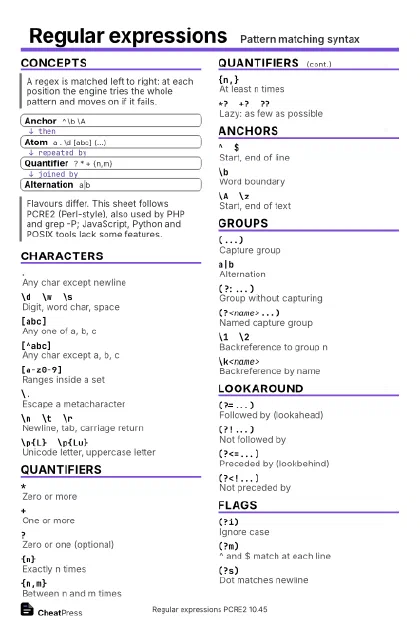 Ink saver · Postcard
102 × 152 mm · PDF
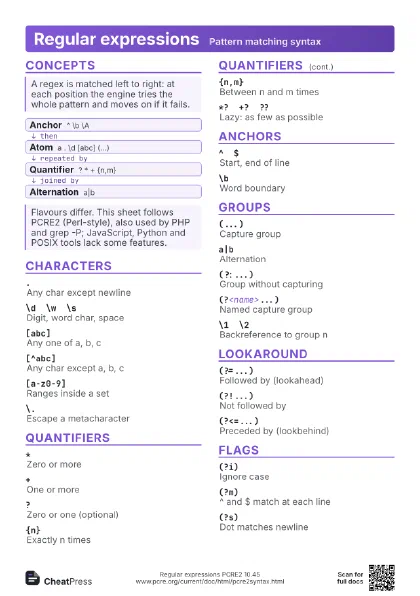
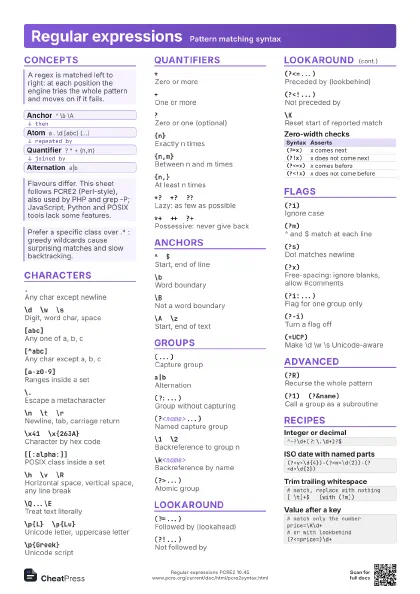
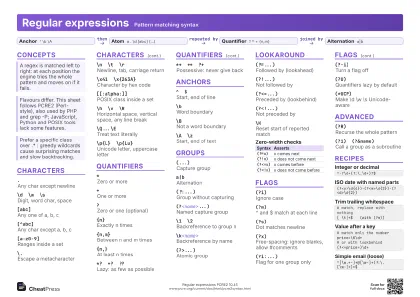 Light · A4 landscape
297 × 210 mm · PDF
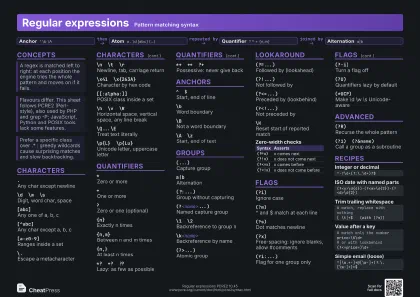 Dark · A4 landscape
297 × 210 mm · PDF
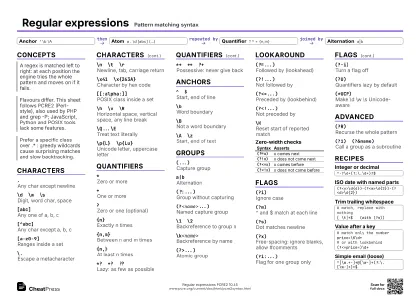 Ink saver · A4 landscape
297 × 210 mm · PDF
 Light · A3 landscape
420 × 297 mm · PDF
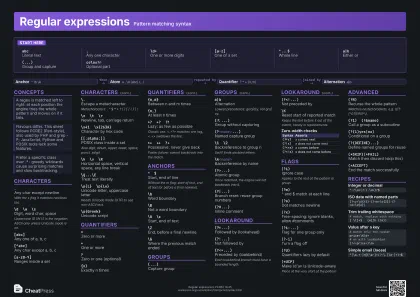 Dark · A3 landscape
420 × 297 mm · PDF
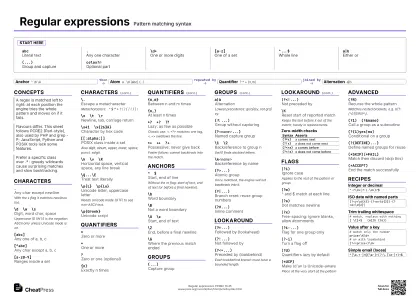 Ink saver · A3 landscape
420 × 297 mm · PDF
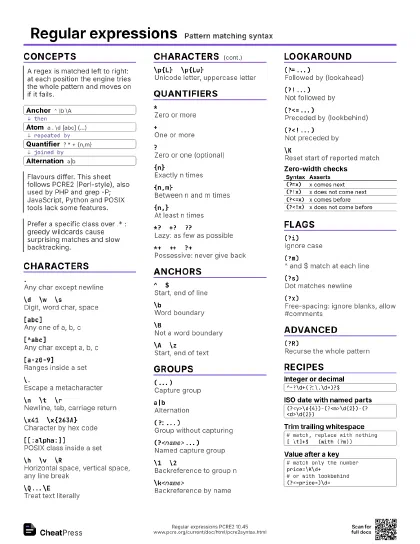
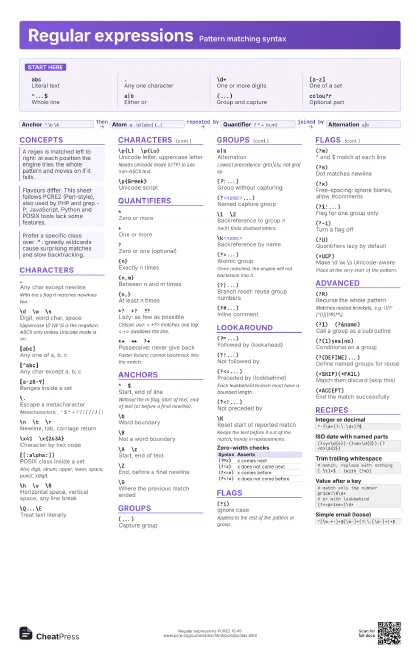
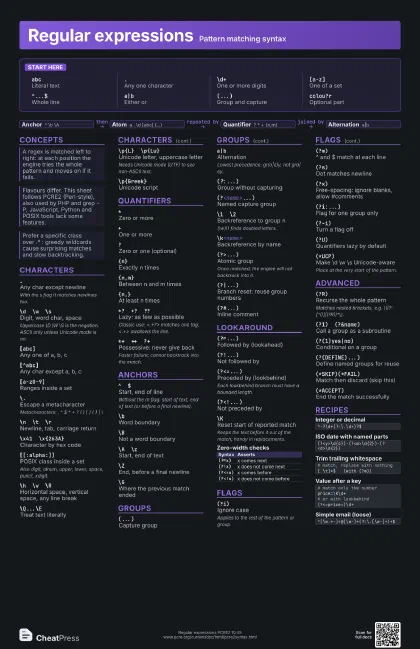
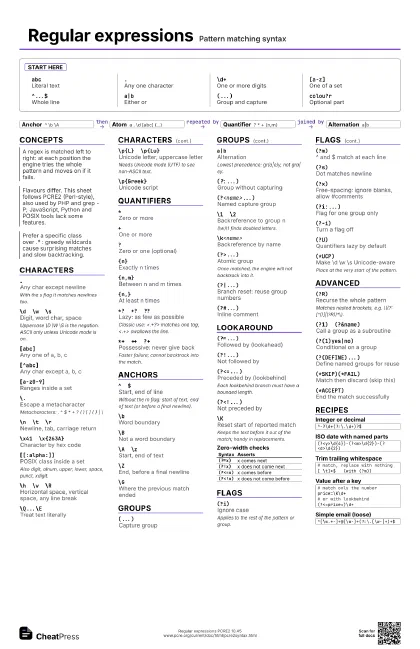
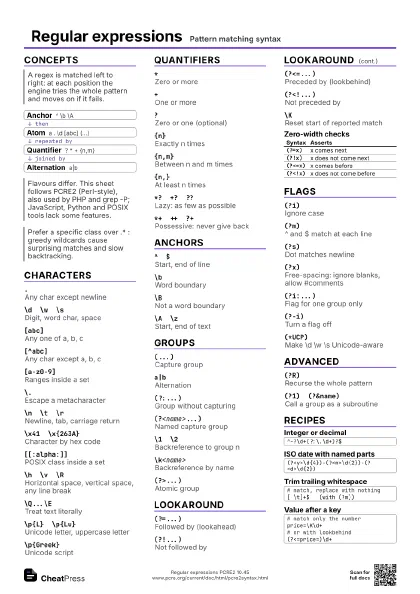
Start here
abcLiteral text
.Any one character
\d+One or more digits
[a-z]One of a set
^...$Whole line
a|bEither or
(...)Group and capture
colou?rOptional part
Concepts
- Anchor ^ \b \A
- Atom a . \d [abc] (...)
- Quantifier ? * + {n,m}
- Alternation a|b
Characters
.Any char except newline
With the s flag it matches newlines too.
\d \w \sDigit, word char, space
Uppercase \D \W \S is the negation. ASCII only unless Unicode
mode is on.
[abc]Any one of a, b, c
[^abc]Any char except a, b, c
[a-z0-9]Ranges inside a set
\.Escape a metacharacter
Metacharacters: . ^ $ * + ? ( ) [ ] { } | \
\n \t \rNewline, tab, carriage return
\x41 \x{263A}Character by hex code
[[:alpha:]]POSIX class inside a set
Also digit, alnum, upper, lower, space, punct, xdigit.
\h \v \R
Horizontal space, vertical space, any line break
\Q...\ETreat text literally
\p{L} \p{Lu}Unicode letter, uppercase letter
Needs Unicode mode (UTF) to see non-ASCII text.
\p{Greek}Unicode script
Quantifiers
*Zero or more
+One or more
?Zero or one (optional)
{n}Exactly n times
{n,m}Between n and m times
{n,}At least n times
*? +? ??Lazy: as few as possible
Classic use: <.+?> matches one tag, <.+>
swallows the line.
*+ ++ ?+
Possessive: never give back
Faster failure; cannot backtrack into the match.
Anchors
^ $Start, end of line
Without the m flag: start of text, end of text (or before a
final newline).
\bWord boundary
\BNot a word boundary
\A \zStart, end of text
\ZEnd, before a final newline
\GWhere the previous match ended
Groups
(...)Capture group
a|bAlternation
Lowest precedence: gr(a|e)y, not gra|ey.
(?:...)Group without capturing
(?<name>...)
Named capture group
\1 \2Backreference to group n
(\w)\1 finds doubled letters.
\k<name>Backreference by name
(?>...)Atomic group
Once matched, the engine will not backtrack into it.
(?|...)Branch reset: reuse group numbers
(?#...)Inline comment
Lookaround
(?=...)Followed by (lookahead)
(?!...)Not followed by
(?<=...)Preceded by (lookbehind)
Each lookbehind branch must have a bounded length.
(?<!...)Not preceded by
\KReset start of reported match
Keeps the text before it out of the match; handy in
replacements.
| Syntax | Asserts |
|---|---|
(?=x) |
x comes next |
(?!x) |
x does not come next |
(?<=x) |
x comes before |
(?<!x) |
x does not come before |
Flags
(?i)Ignore case
Applies to the rest of the pattern or group.
(?m)^ and $ match at each line
(?s)Dot matches newline
(?x)
Free-spacing: ignore blanks, allow #comments
(?i:...)Flag for one group only
(?-i)Turn a flag off
(?U)Quantifiers lazy by default
(*UCP)Make \d \w \s Unicode-aware
Place at the very start of the pattern.
Advanced
(?R)Recurse the whole pattern
Matches nested brackets, e.g. \((?:[^()]|(?R))*\).
(?1) (?&name)
Call a group as a subroutine
(?(1)yes|no)Conditional on a group
(?(DEFINE)...)Define named groups for reuse
(*SKIP)(*FAIL)Match then discard (skip this)
(*ACCEPT)End the match successfully
Recipes
^-?\d+(?:\.\d+)?$(?<y>\d{4})-(?<m>\d{2})-(?<d>\d{2})# match, replace with nothing[ \t]+$ (with (?m))# match only the numberprice=\K\d+# or with lookbehind(?<=price=)\d+^[\w.+-]+@[\w-]+(?:\.[\w-]+)+$