Cheat
sed Stream editor
 Light · Postcard
102 × 152 mm · PDF
 Dark · Postcard
102 × 152 mm · PDF
 Ink saver · Postcard
102 × 152 mm · PDF
 Light · A4 landscape
297 × 210 mm · PDF
 Dark · A4 landscape
297 × 210 mm · PDF
 Ink saver · A4 landscape
297 × 210 mm · PDF
 Light · A3 landscape
420 × 297 mm · PDF
 Dark · A3 landscape
420 × 297 mm · PDF
 Ink saver · A3 landscape
420 × 297 mm · PDF
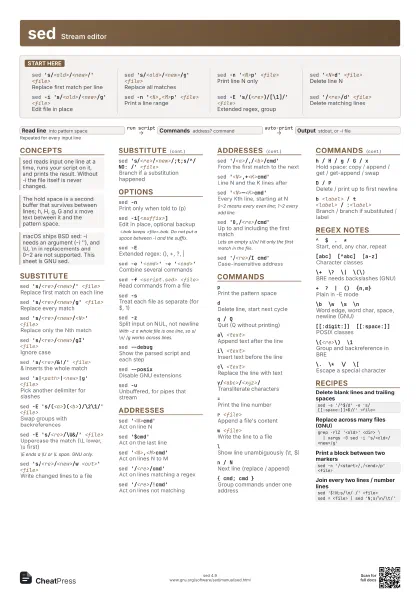
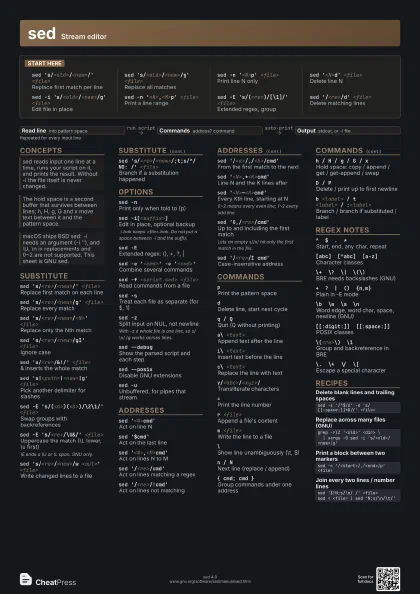
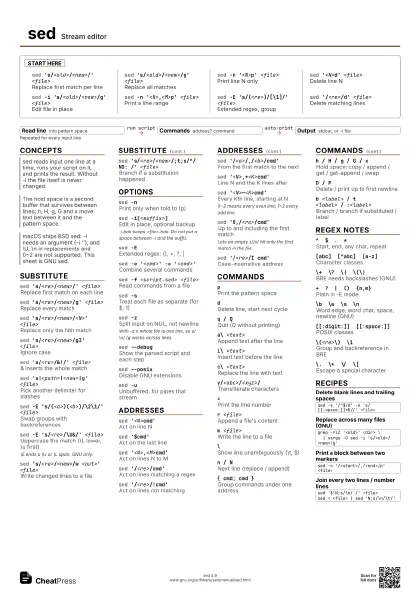
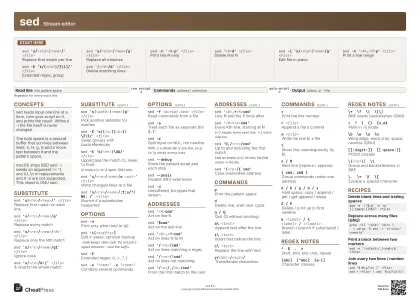
Start here
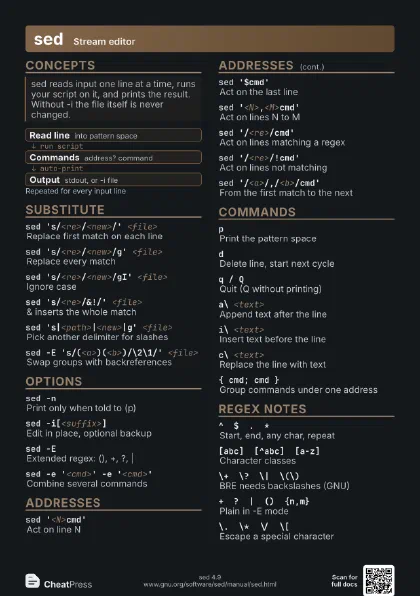
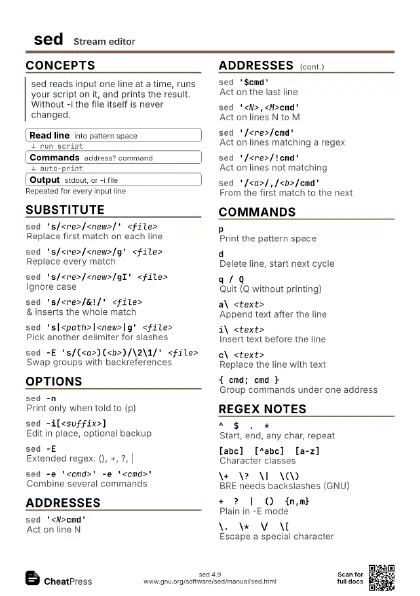
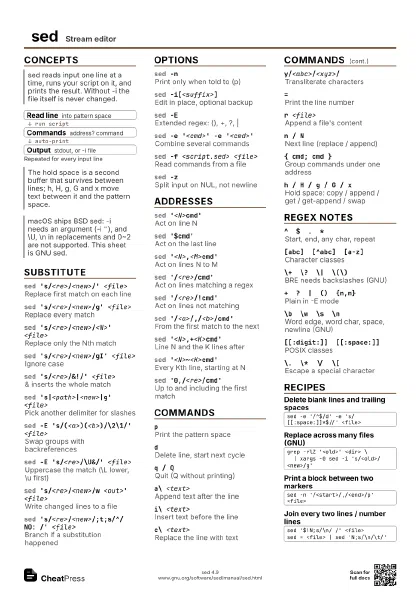
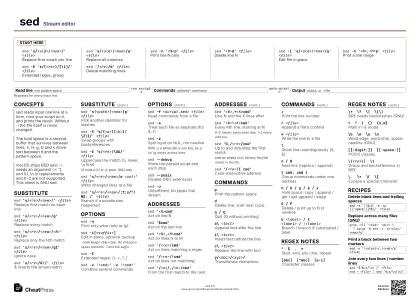
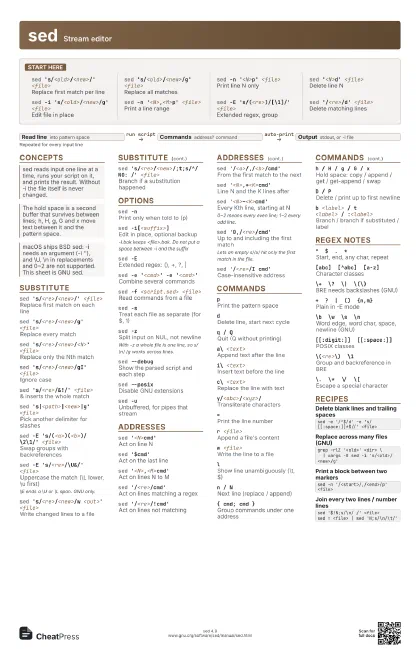
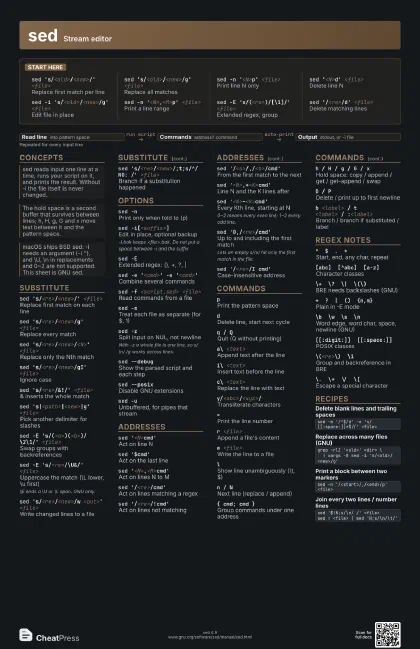
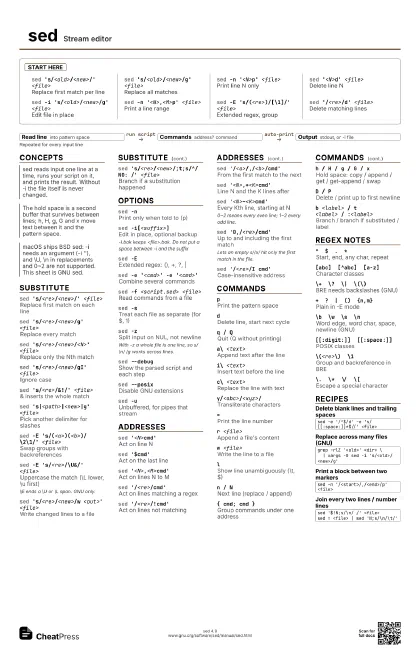
sed 's/<old>/<new>/' <file>
Replace first match per line
sed 's/<old>/<new>/g'
                    <file>
Replace all matches
sed -n '<N>p' <file>
Print line N only
sed '<N>d' <file>
Delete line N
sed -i 's/<old>/<new>/g'
                    <file>
Edit file in place
sed -n '<N>,<M>p' <file>
Print a line range
sed -E 's/(<re>)/[\1]/' <file>
Extended regex, group
sed '/<re>/d' <file>
Delete matching lines
Concepts
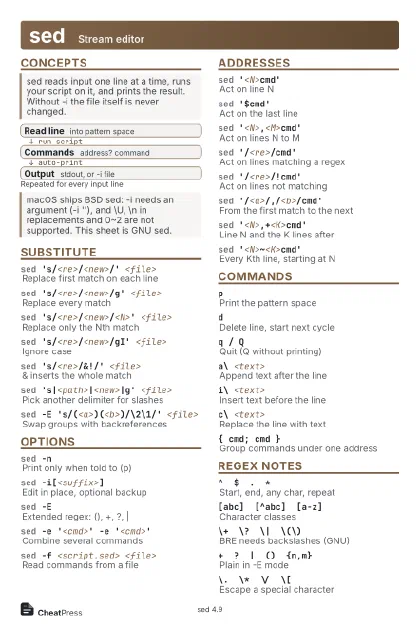
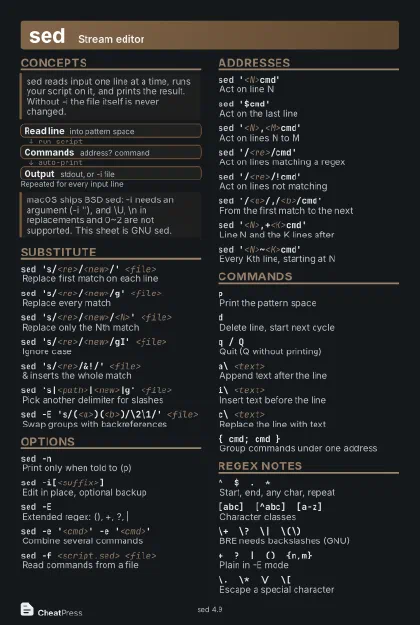
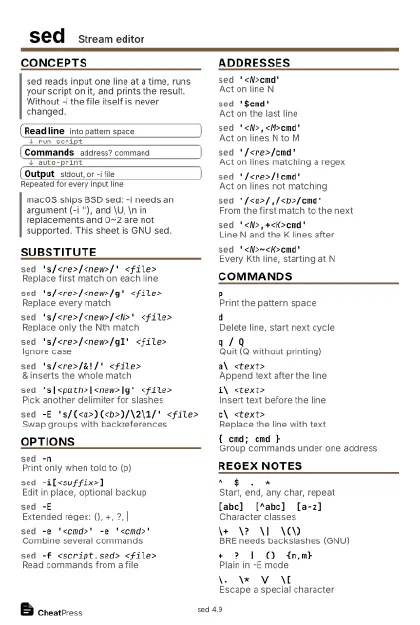
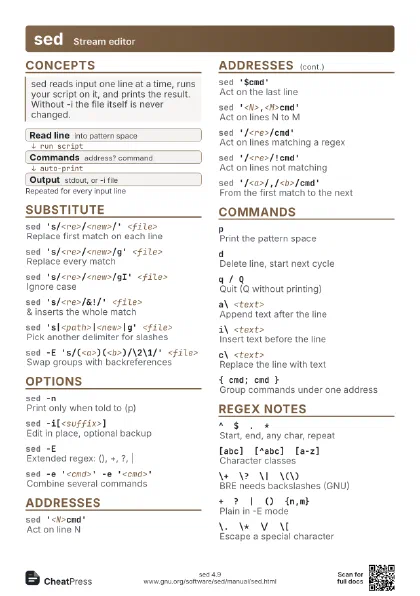
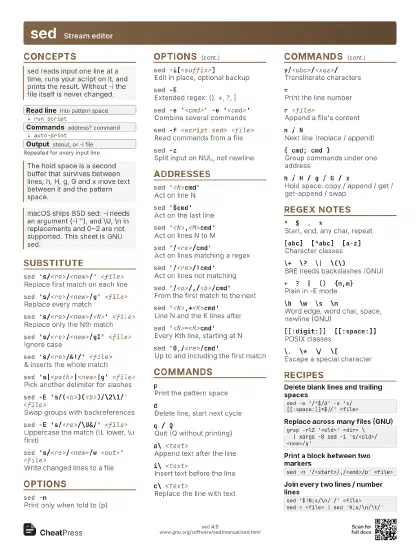
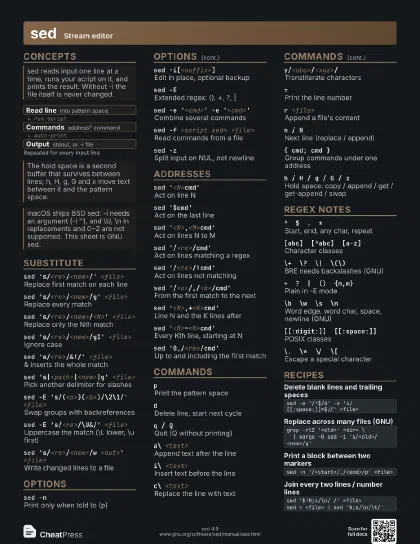
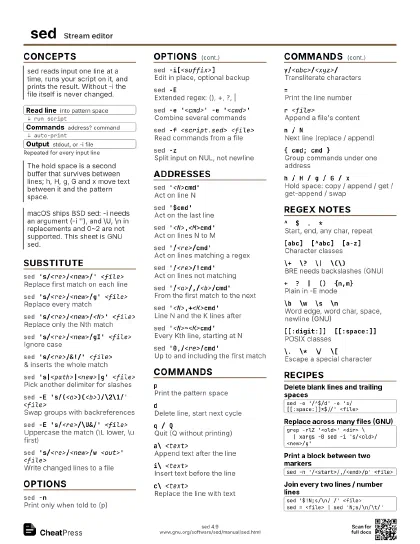
- Read line into pattern space
- Commands address? command
- Output stdout, or -i file
Substitute
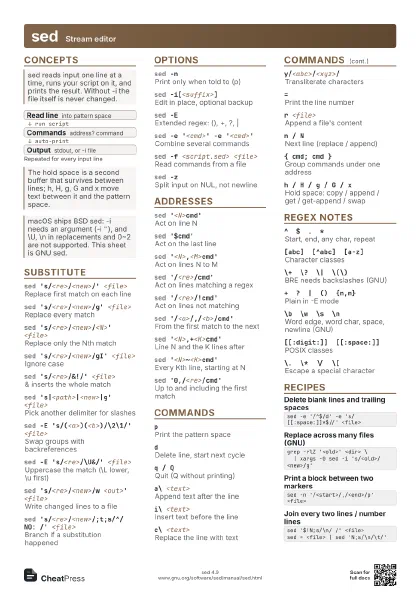
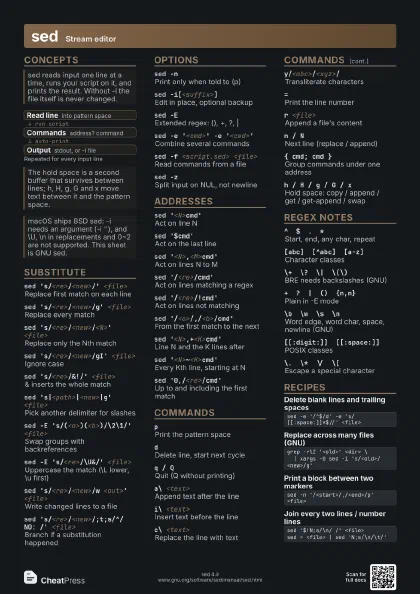
sed 's/<re>/<new>/' <file>
Replace first match on each line
sed 's/<re>/<new>/g' <file>
Replace every match
sed 's/<re>/<new>/<N>'
                    <file>
Replace only the Nth match
sed 's/<re>/<new>/gI'
                    <file>
Ignore case
sed 's/<re>/&!/' <file>
& inserts the whole match
sed 's|<path>|<new>|g'
                    <file>
Pick another delimiter for slashes
sed -E 's/(<a>)(<b>)/\2\1/'
                    <file>
Swap groups with backreferences
sed -E 's/<re>/\U&/' <file>
Uppercase the match (\L lower, \u first)
\E ends a \U or \L span. GNU only.
sed 's/<re>/<new>/w <out>'
                    <file>
Write changed lines to a file
sed 's/<re>/<new>/;t;s/^/NO: /'
                    <file>
Branch if a substitution happened
Options
sed -nPrint only when told to (p)
sed -i[<suffix>]
Edit in place, optional backup
-i.bak keeps <file>.bak. Do not put a space between -i
and the suffix.
sed -EExtended regex: (), +, ?, |
sed -e '<cmd>' -e '<cmd>'
Combine several commands
sed -f <script.sed> <file>
Read commands from a file
sed -sTreat each file as separate (for $, 1)
sed -zSplit input on NUL, not newline
With -z a whole file is one line, so s/\n/ /g works across
lines.
sed --debugShow the parsed script and each step
sed --posixDisable GNU extensions
sed -uUnbuffered, for pipes that stream
Addresses
sed '<N>cmd'
Act on line N
sed '$cmd'
Act on the last line
sed '<N>,<M>cmd'
Act on lines N to M
sed '/<re>/cmd'
Act on lines matching a regex
sed '/<re>/!cmd'
Act on lines not matching
sed '/<a>/,/<b>/cmd'
From the first match to the next
sed '<N>,+<K>cmd'
Line N and the K lines after
sed '<N>~<K>cmd'
Every Kth line, starting at N
0~2 means every even line; 1~2 every odd line.
sed '0,/<re>/cmd'
Up to and including the first match
Lets an empty s//x/ hit only the first match in the file.
sed '/<re>/I cmd'
Case-insensitive address
Commands
pPrint the pattern space
dDelete line, start next cycle
q / QQuit (Q without printing)
a\ <text>Append text after the line
i\ <text>Insert text before the line
c\ <text>Replace the line with text
y/<abc>/<xyz>/
Transliterate characters
=Print the line number
r <file>Append a file's content
w <file>Write the line to a file
lShow line unambiguously (\t, $)
n / NNext line (replace / append)
{ cmd; cmd }Group commands under one address
h / H / g / G / x
Hold space: copy / append / get / get-append / swap
D / PDelete / print up to first newline
b <label> / t <label> / :<label>
Branch / branch if substituted / label
Regex notes
^ $ . *Start, end, any char, repeat
[abc] [^abc] [a-z]
Character classes
\+ \? \| \(\)
BRE needs backslashes (GNU)
+ ? | () {n,m}
Plain in -E mode
\b \w \s \n
Word edge, word char, space, newline (GNU)
[[:digit:]] [[:space:]]
POSIX classes
\(<re>\) \1
Group and backreference in BRE
\. \* \/ \[Escape a special character
Recipes
sed -e '/^$/d' -e 's/[[:space:]]*$//' <file>grep -rlZ '<old>' <dir> \ | xargs -0 sed -i 's/<old>/<new>/g'sed -n '/<start>/,/<end>/p' <file>sed '$!N;s/\n/ /' <file>sed = <file> | sed 'N;s/\n/\t/'