Cheat
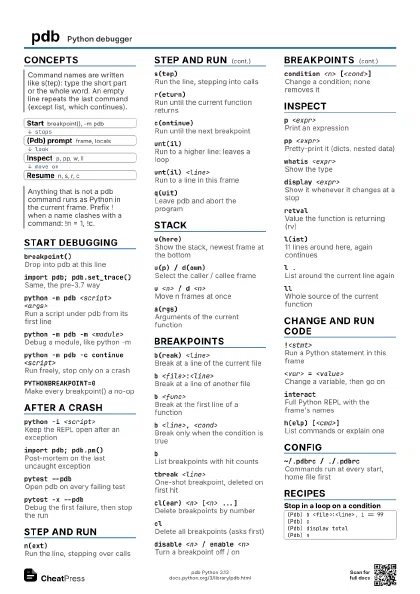
pdb Python debugger
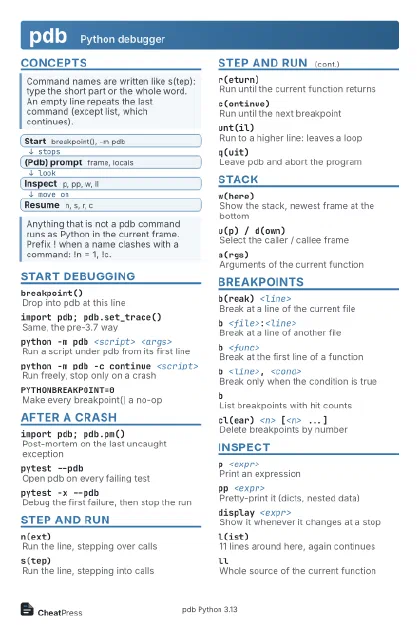 Light · Postcard
102 × 152 mm · PDF
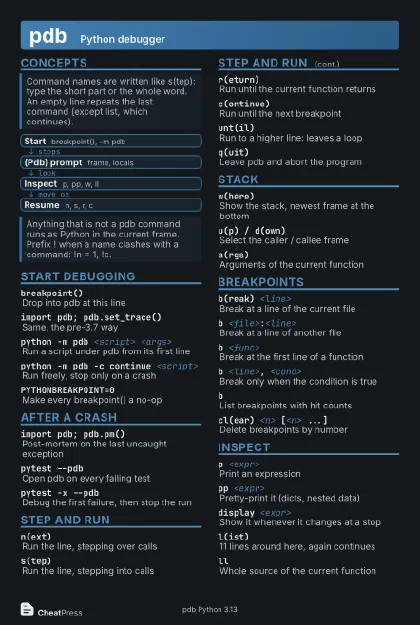 Dark · Postcard
102 × 152 mm · PDF
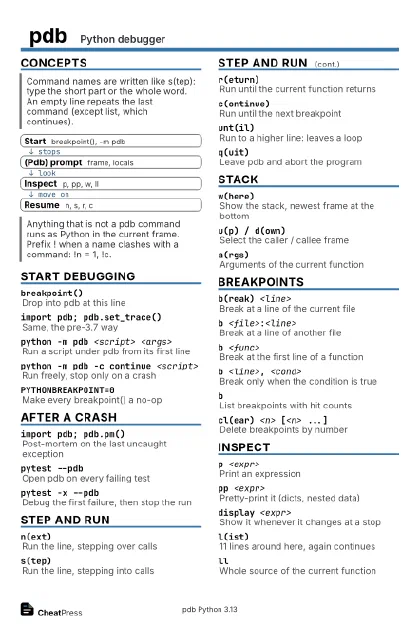 Ink saver · Postcard
102 × 152 mm · PDF
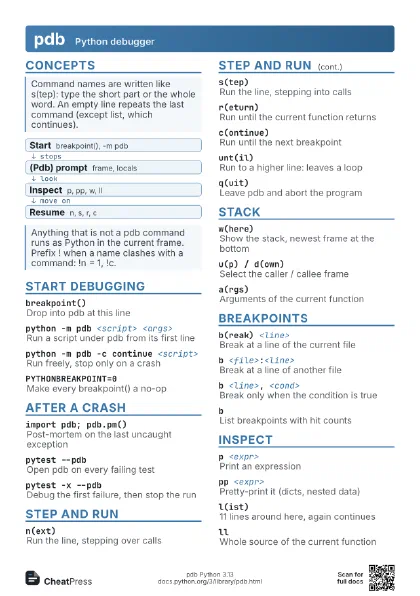
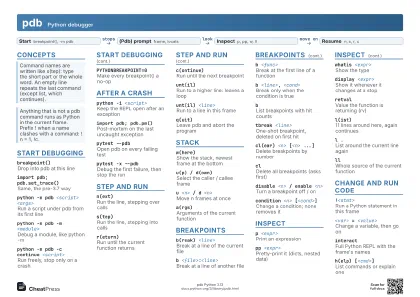 Light · A4 landscape
297 × 210 mm · PDF
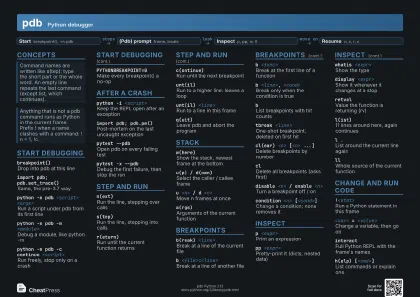 Dark · A4 landscape
297 × 210 mm · PDF
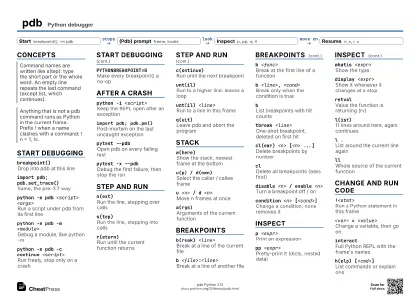 Ink saver · A4 landscape
297 × 210 mm · PDF
 Light · A3 landscape
420 × 297 mm · PDF
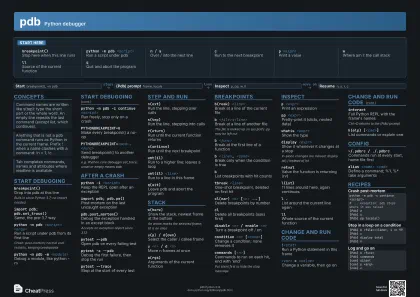 Dark · A3 landscape
420 × 297 mm · PDF
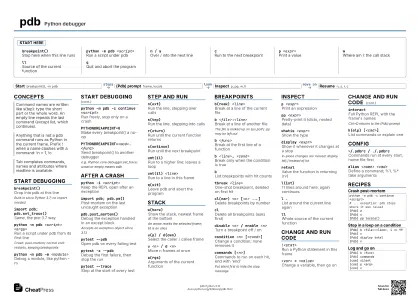 Ink saver · A3 landscape
420 × 297 mm · PDF
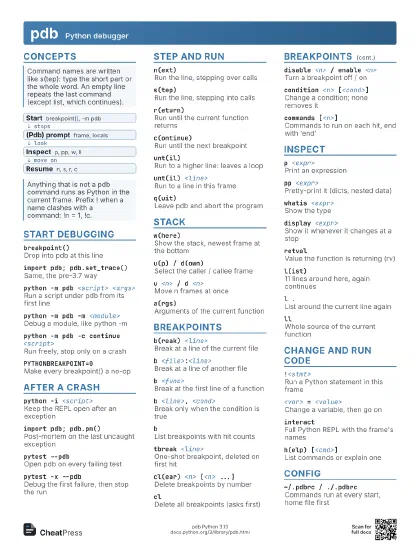
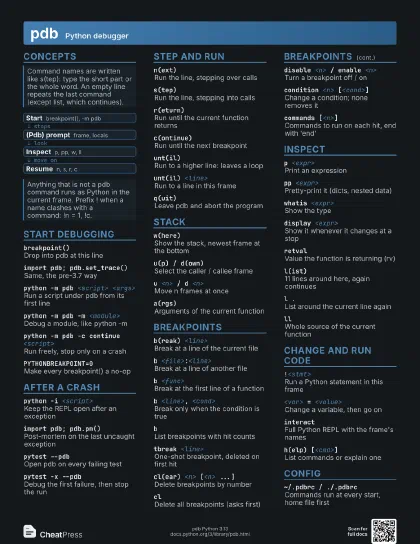
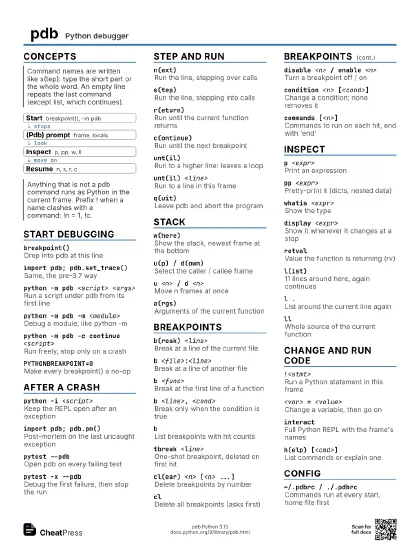
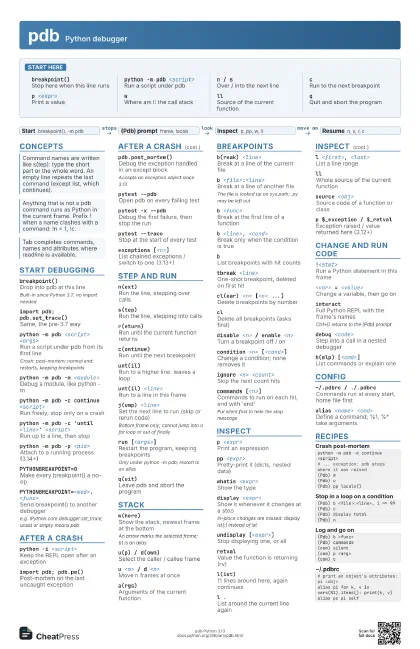
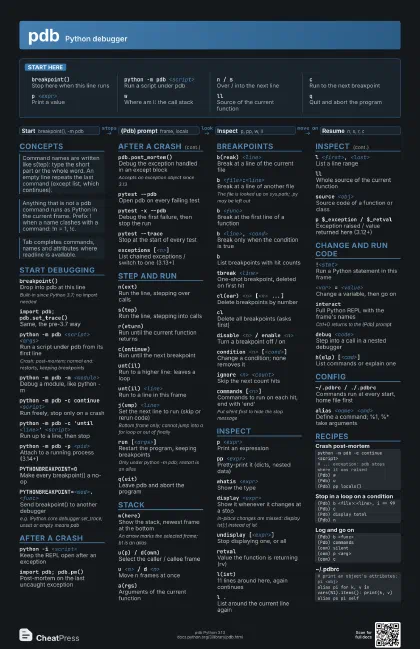
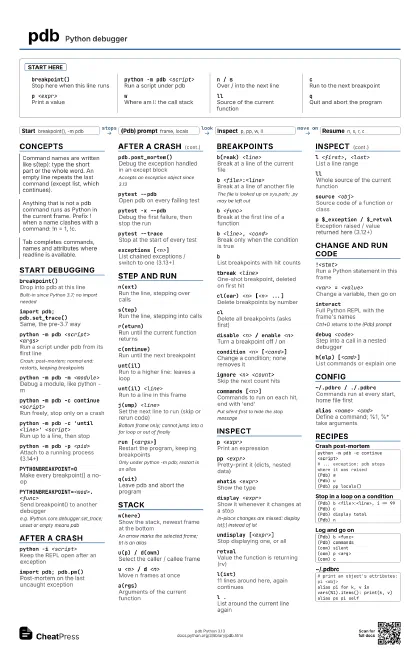
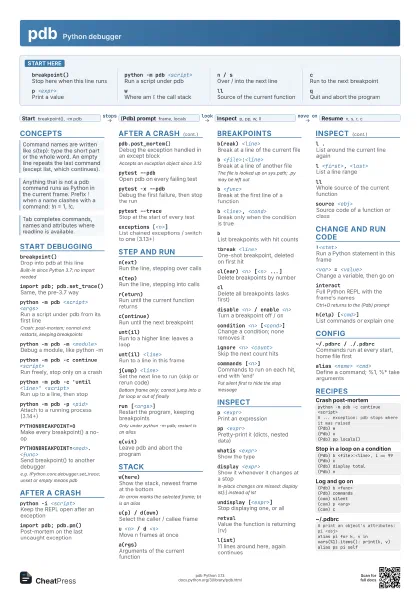
Start here
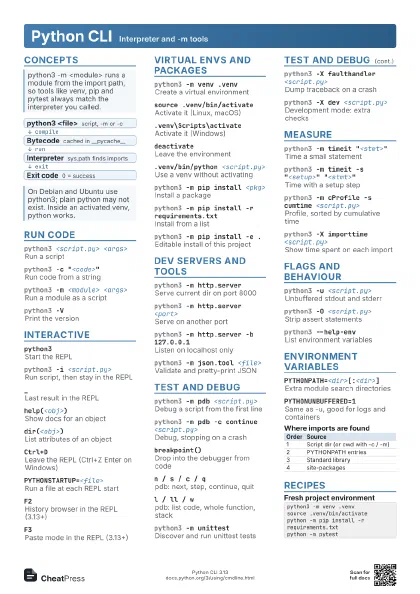
breakpoint()Stop here when this line runs
python -m pdb <script>
Run a script under pdb
n / sOver / into the next line
cRun to the next breakpoint
p <expr>Print a value
wWhere am I: the call stack
llSource of the current function
qQuit and abort the program
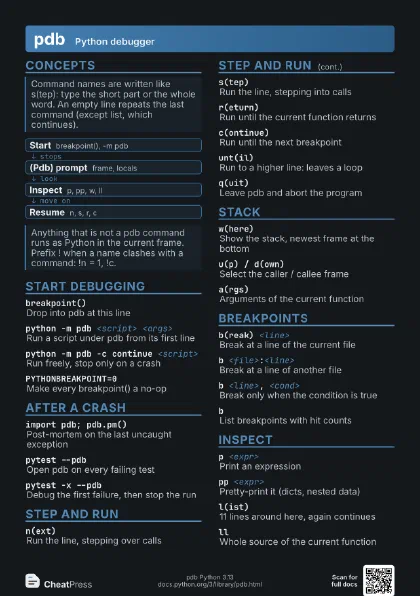
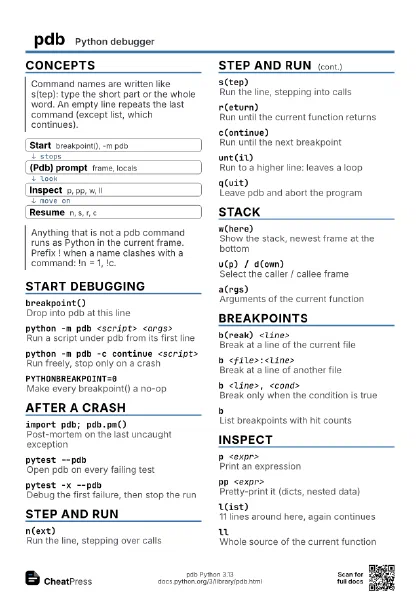
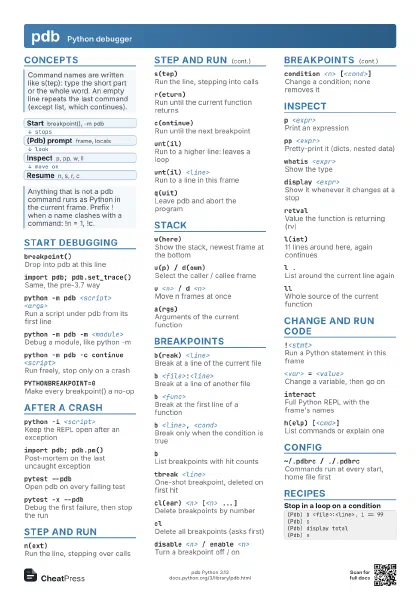
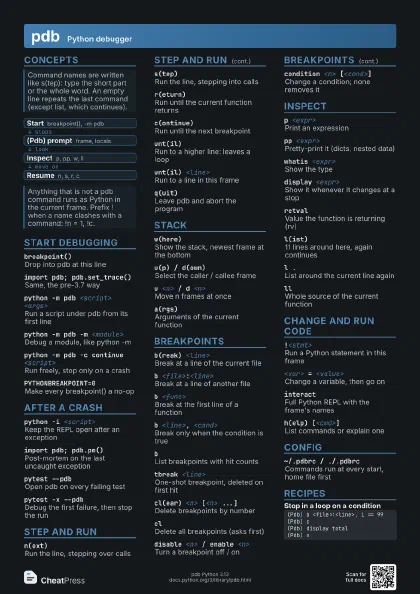
Concepts
- Start breakpoint(), -m pdb
- (Pdb) prompt frame, locals
- Inspect p, pp, w, ll
- Resume n, s, r, c
Start debugging
breakpoint()Drop into pdb at this line
Built-in since Python 3.7; no import needed
import pdb; pdb.set_trace()
Same, the pre-3.7 way
python -m pdb <script> <args>
Run a script under pdb from its first line
Crash: post-mortem; normal end: restarts, keeping breakpoints
python -m pdb -m <module>
Debug a module, like python -m
python -m pdb -c continue <script>
Run freely, stop only on a crash
python -m pdb -c 'until <line>'
                    <script>
Run up to a line, then stop
python -m pdb -p <pid>
Attach to a running process (3.14+)
PYTHONBREAKPOINT=0
Make every breakpoint() a no-op
PYTHONBREAKPOINT=<mod>.<func>
Send breakpoint() to another debugger
e.g. IPython.core.debugger.set_trace; unset or empty means pdb
After a crash
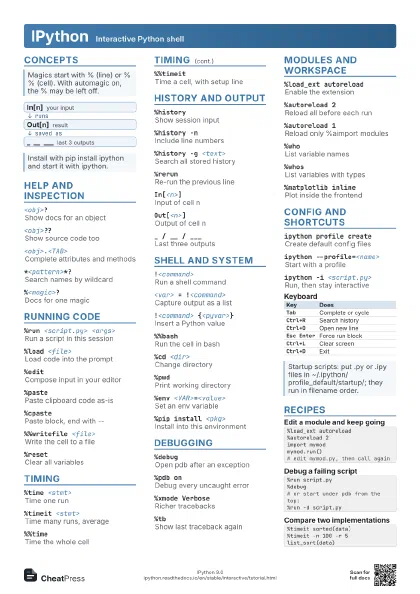
python -i <script>
Keep the REPL open after an exception
import pdb; pdb.pm()
Post-mortem on the last uncaught exception
pdb.post_mortem()
Debug the exception handled in an except block
Accepts an exception object since 3.13
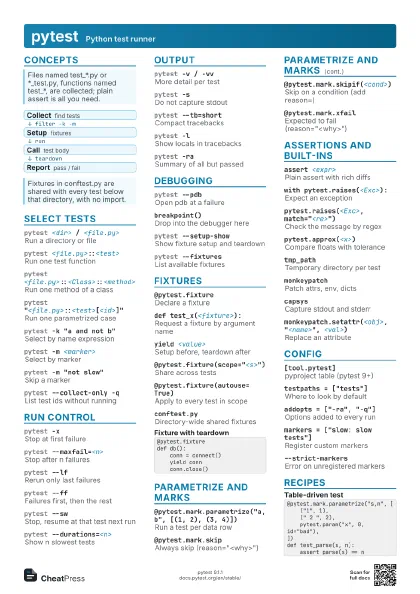
pytest --pdbOpen pdb on every failing test
pytest -x --pdb
Debug the first failure, then stop the run
pytest --traceStop at the start of every test
exceptions [<n>]
List chained exceptions / switch to one (3.13+)
Step and run
n(ext)Run the line, stepping over calls
s(tep)Run the line, stepping into calls
r(eturn)Run until the current function returns
c(ontinue)Run until the next breakpoint
unt(il)Run to a higher line: leaves a loop
unt(il) <line>
Run to a line in this frame
j(ump) <line>
Set the next line to run (skip or rerun code)
Bottom frame only; cannot jump into a for loop or out of
finally
run [<args>]
Restart the program, keeping breakpoints
Only under python -m pdb; restart is an alias
q(uit)Leave pdb and abort the program
Stack
w(here)
Show the stack, newest frame at the bottom
An arrow marks the selected frame; bt is an alias
u(p) / d(own)Select the caller / callee frame
u <n> / d <n>
Move n frames at once
w <n>Only the n newest frames (3.14+)
a(rgs)Arguments of the current function
Breakpoints
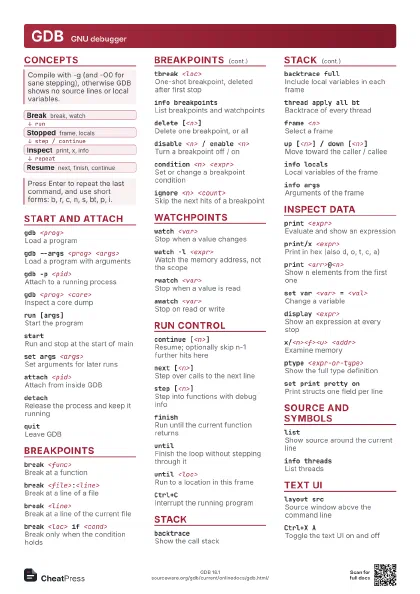
b(reak) <line>
Break at a line of the current file
b <file>:<line>
Break at a line of another file
The file is looked up on sys.path; .py may be left out
b <func>Break at the first line of a function
b <line>, <cond>
Break only when the condition is true
bList breakpoints with hit counts
tbreak <line>
One-shot breakpoint, deleted on first hit
cl(ear) <n> [<n> ...]
Delete breakpoints by number
cl <file>:<line>
Delete the breakpoints at a line
clDelete all breakpoints (asks first)
disable <n> / enable <n>
Turn a breakpoint off / on
condition <n> [<cond>]
Change a condition; none removes it
ignore <n> <count>
Skip the next count hits
commands [<n>]
Commands to run on each hit, end with 'end'
Put silent first to hide the stop message
Inspect
p <expr>Print an expression
pp <expr>Pretty-print it (dicts, nested data)
whatis <expr>
Show the type
display <expr>
Show it whenever it changes at a stop
In-place changes are missed: display lst[:] instead of lst
undisplay [<expr>]
Stop displaying one, or all
retvalValue the function is returning (rv)
l(ist)11 lines around here, again continues
l .List around the current line again
l <first>, <last>
List a line range
llWhole source of the current function
source <obj>
Source code of a function or class
p $_exception / $_retval
Exception raised / value returned here (3.12+)
Change and run code
!<stmt>Run a Python statement in this frame
<var> = <value>
Change a variable, then go on
interact
Full Python REPL with the frame's names
Ctrl+D returns to the (Pdb) prompt
debug <code>
Step into a call in a nested debugger
h(elp) [<cmd>]
List commands or explain one
Config
~/.pdbrc / ./.pdbrc
Commands run at every start, home file first
alias <name> <cmd>
Define a command; %1, %* take arguments
unalias <name>
Remove an alias
Recipes
python -m pdb -c continue <script># ... exception: pdb stops where it was raised(Pdb) w(Pdb) u(Pdb) pp locals()(Pdb) b <file>:<line>, i == 99(Pdb) c(Pdb) display total(Pdb) n(Pdb) b <func>(Pdb) commands(com) silent(com) p <arg>(com) c# print an object's attributes: pi <obj>alias pi for k, v in vars(%1).items(): print(k, v)alias ps pi self