Cheat
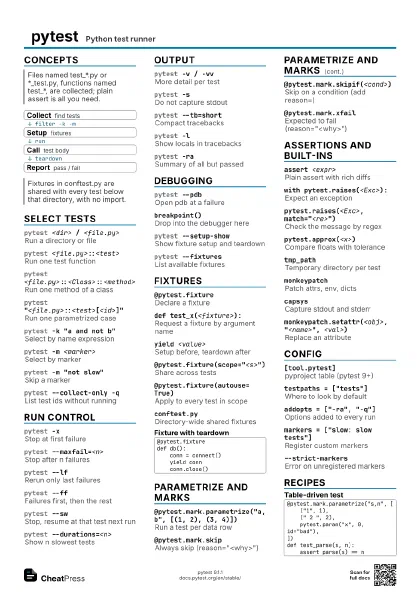
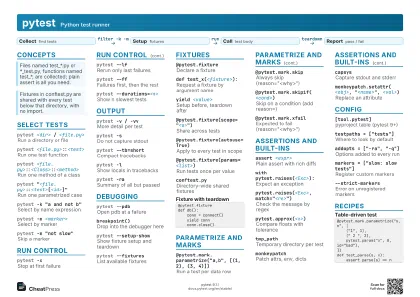
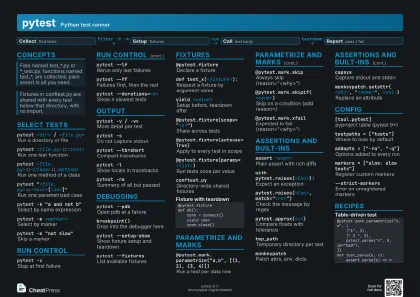
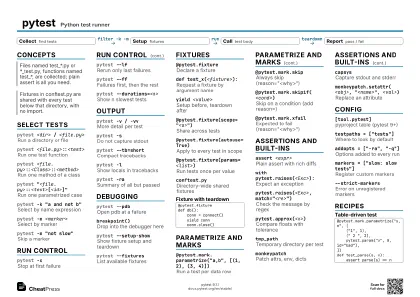
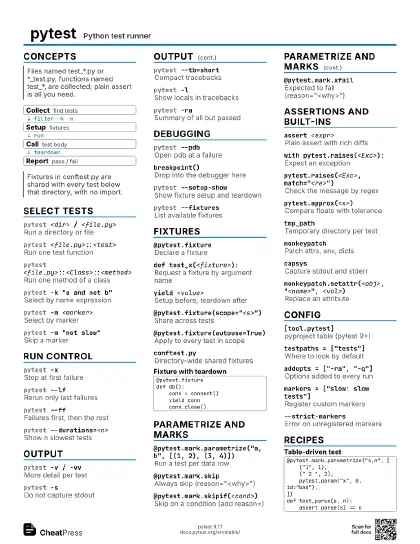
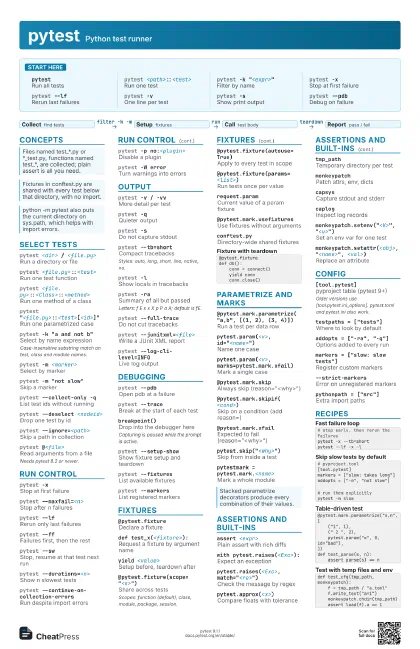
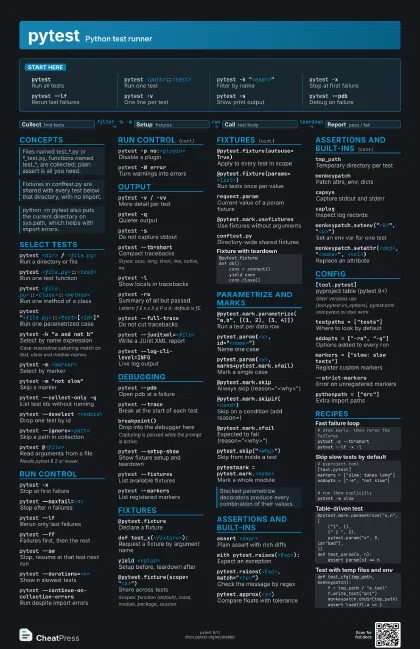
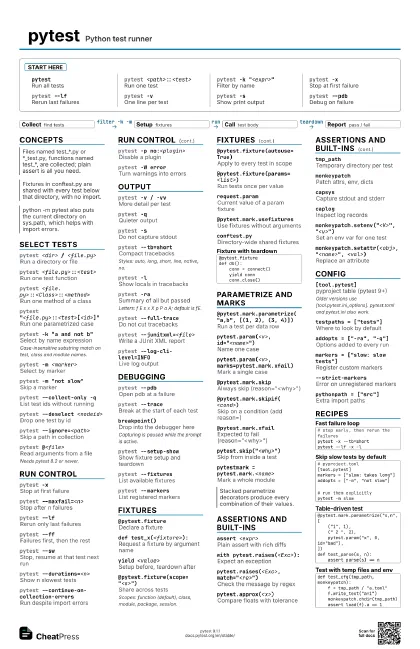
pytest Python test runner
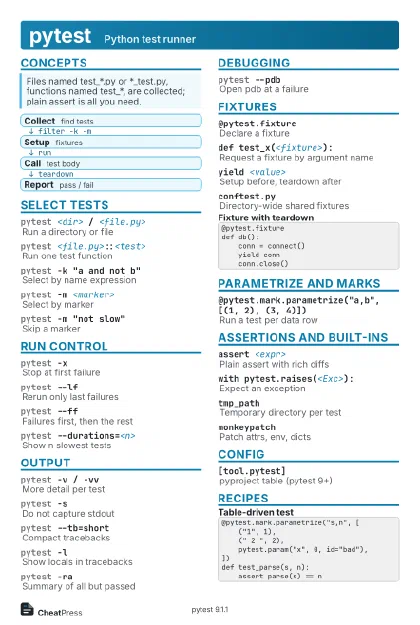 Light · Postcard
102 × 152 mm · PDF
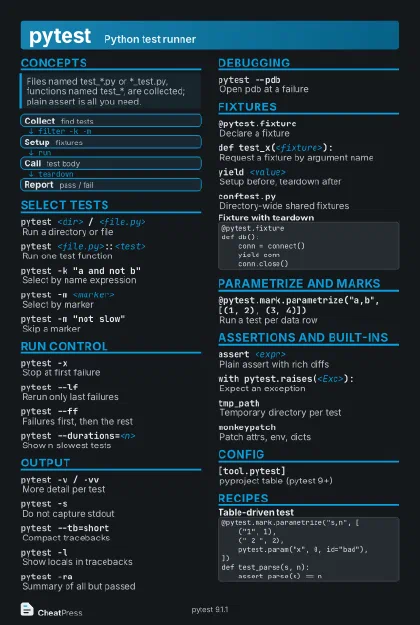 Dark · Postcard
102 × 152 mm · PDF
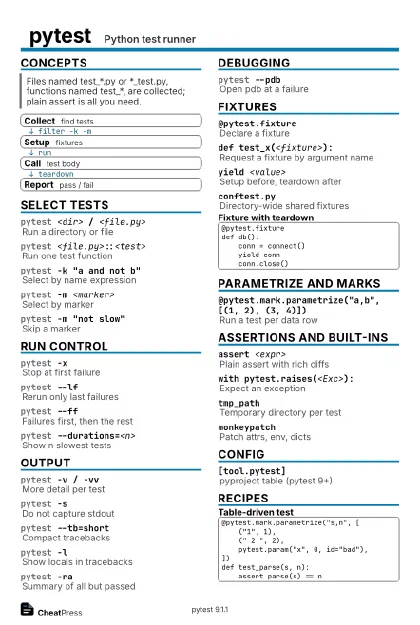 Ink saver · Postcard
102 × 152 mm · PDF
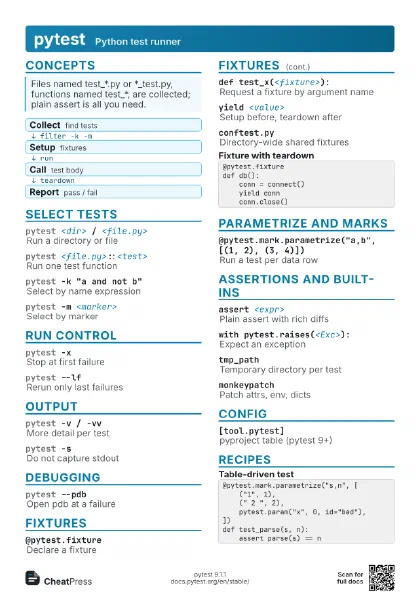
 Light · A4 landscape
297 × 210 mm · PDF
 Dark · A4 landscape
297 × 210 mm · PDF
 Ink saver · A4 landscape
297 × 210 mm · PDF
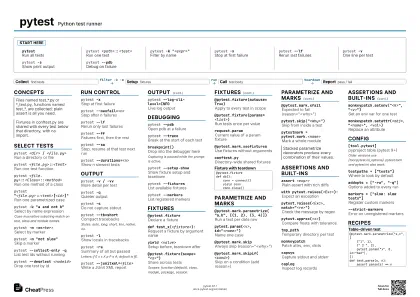
 Light · A3 landscape
420 × 297 mm · PDF
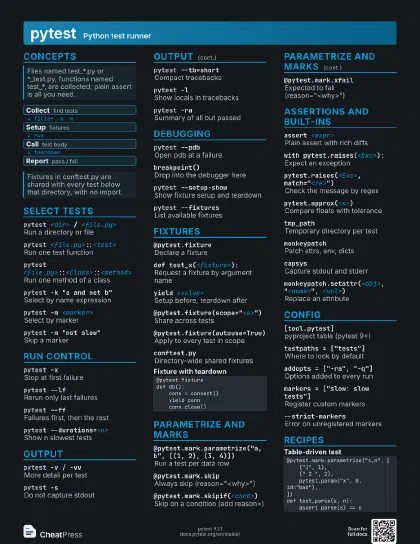
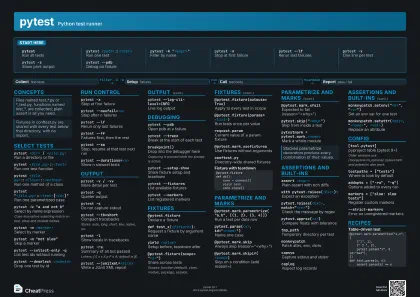 Dark · A3 landscape
420 × 297 mm · PDF
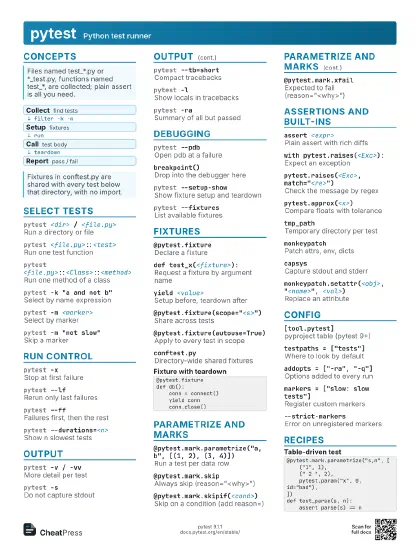
 Ink saver · A3 landscape
420 × 297 mm · PDF
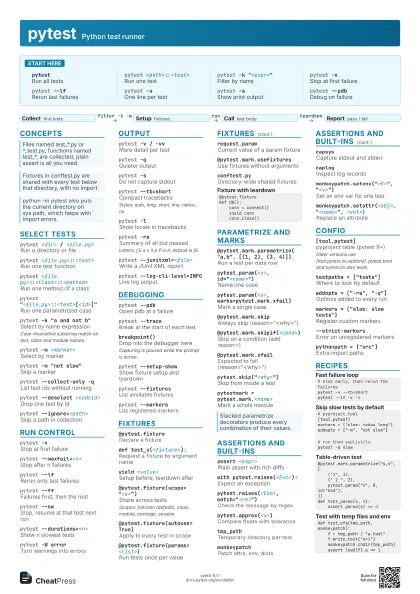
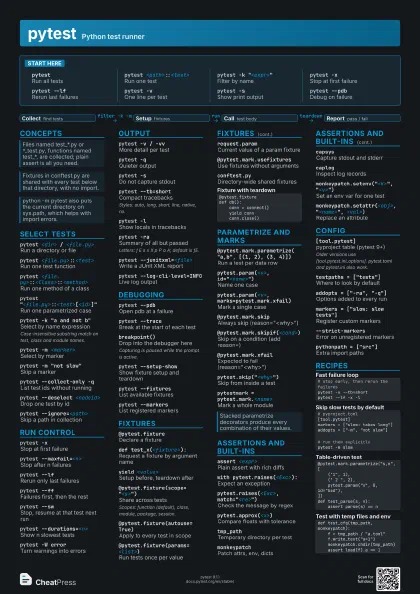
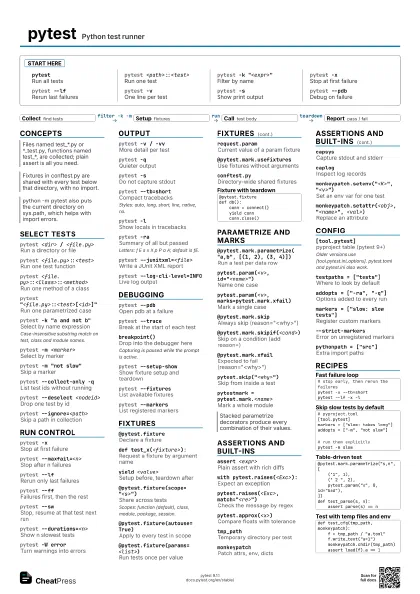
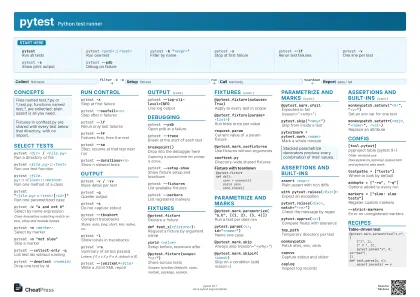
Start here
pytestRun all tests
pytest <path>::<test>
Run one test
pytest -k "<expr>"
Filter by name
pytest -xStop at first failure
pytest --lfRerun last failures
pytest -vOne line per test
pytest -sShow print output
pytest --pdbDebug on failure
Concepts
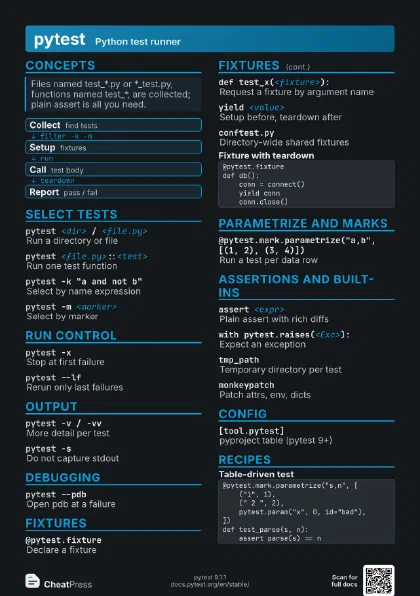
- Collect find tests
- Setup fixtures
- Call test body
- Report pass / fail
Select tests
pytest <dir> / <file.py>
Run a directory or file
pytest <file.py>::<test>
Run one test function
pytest <file.py>::<Class>::<method>
Run one method of a class
pytest
                    "<file.py>::<test>[<id>]"
Run one parametrized case
pytest -k "a and not b"
Select by name expression
Case-insensitive substring match on test, class and module
names.
pytest -m <marker>
Select by marker
pytest -m "not slow"
Skip a marker
pytest --collect-only -q
List test ids without running
pytest --deselect <nodeid>
Drop one test by id
pytest --ignore=<path>
Skip a path in collection
pytest @<file>
Read arguments from a file
Needs pytest 8.2 or newer.
Run control
pytest -xStop at first failure
pytest --maxfail=<n>
Stop after n failures
pytest --lfRerun only last failures
pytest --ffFailures first, then the rest
pytest --swStop, resume at that test next run
pytest --durations=<n>
Show n slowest tests
pytest --continue-on-collection-errors
Run despite import errors
pytest -p no:<plugin>
Disable a plugin
pytest -W errorTurn warnings into errors
pytest --import-mode=importlib
Import tests without sys.path edits
Output
pytest -v / -vvMore detail per test
pytest -qQuieter output
pytest -sDo not capture stdout
pytest --tb=short
Compact tracebacks
Styles: auto, long, short, line, native, no.
pytest -lShow locals in tracebacks
pytest -raSummary of all but passed
Letters: f E s x X p P a A; default is fE.
pytest --full-trace
Do not cut tracebacks
pytest --junitxml=<file>
Write a JUnit XML report
pytest --log-cli-level=INFO
Live log output
Debugging
pytest --pdbOpen pdb at a failure
pytest --traceBreak at the start of each test
breakpoint()Drop into the debugger here
Capturing is paused while the prompt is active.
pytest --setup-show
Show fixture setup and teardown
pytest --fixtures
List available fixtures
pytest --markers
List registered markers
pytest --runxfail
Run xfail tests as normal
Fixtures
@pytest.fixtureDeclare a fixture
def test_x(<fixture>):
Request a fixture by argument name
yield <value>
Setup before, teardown after
@pytest.fixture(scope="<s>")
Share across tests
Scopes: function (default), class, module, package, session.
@pytest.fixture(autouse=True)
Apply to every test in scope
@pytest.fixture(params=<list>)
Run tests once per value
request.paramCurrent value of a param fixture
request.addfinalizer(<fn>)
Register a teardown function
@pytest.mark.usefixtures
Use fixtures without arguments
conftest.pyDirectory-wide shared fixtures
@pytest.fixturedef db(): conn = connect() yield conn conn.close()Parametrize and marks
@pytest.mark.parametrize("a,b", [(1, 2), (3,
                    4)])
Run a test per data row
pytest.param(<v>, id="<name>")
Name one case
pytest.param(<v>, marks=pytest.mark.xfail)
Mark a single case
@pytest.mark.skip
Always skip (reason="<why>")
@pytest.mark.skipif(<cond>)
Skip on a condition (add reason=)
@pytest.mark.xfail
Expected to fail (reason="<why>")
@pytest.mark.xfail(strict=True)
Unexpected pass fails the run
pytest.skip("<why>")
Skip from inside a test
pytest.importorskip("<module>")
Skip if import fails
@pytest.mark.filterwarnings("error")
Warning filter for one test
pytestmark = pytest.mark.<name>
Mark a whole module
Assertions and built-ins
assert <expr>
Plain assert with rich diffs
with pytest.raises(<Exc>):
Expect an exception
pytest.raises(<Exc>,
                    match="<re>")
Check the message by regex
pytest.approx(<x>)
Compare floats with tolerance
pytest.warns(<Warning>)
Expect a warning
tmp_pathTemporary directory per test
monkeypatchPatch attrs, env, dicts
capsysCapture stdout and stderr
caplogInspect log records
monkeypatch.setenv("<K>",
                    "<v>")
Set an env var for one test
monkeypatch.setattr(<obj>, "<name>",
                    <val>)
Replace an attribute
Config
[tool.pytest]pyproject table (pytest 9+)
Older versions use [tool.pytest.ini_options]. pytest.toml and
pytest.ini also work.
testpaths = ["tests"]
Where to look by default
addopts = ["-ra", "-q"]
Options added to every run
markers = ["slow: slow tests"]
Register custom markers
--strict-markers
Error on unregistered markers
pythonpath = ["src"]
Extra import paths
filterwarnings = ["error"]
Default warning policy
-o <opt>=<val>
Override a config option once
PYTEST_ADDOPTSExtra options via environment
Recipes
# stop early, then rerun the failurespytest -x --tb=shortpytest --lf -x -l# pyproject.toml[tool.pytest]markers = ["slow: takes long"]addopts = ["-m", "not slow"]# run them explicitlypytest -m slow@pytest.mark.parametrize("s,n", [ ("1", 1), (" 2 ", 2), pytest.param("x", 0, id="bad"),])def test_parse(s, n): assert parse(s) == ndef test_cfg(tmp_path, monkeypatch): f = tmp_path / "a.toml" f.write_text("a=1") monkeypatch.chdir(tmp_path) assert load(f).a == 1