Cheat
NumPy Python array computing
 Light · Postcard
102 × 152 mm · PDF
 Dark · Postcard
102 × 152 mm · PDF
 Ink saver · Postcard
102 × 152 mm · PDF
 Light · A4 landscape
297 × 210 mm · PDF
 Dark · A4 landscape
297 × 210 mm · PDF
 Ink saver · A4 landscape
297 × 210 mm · PDF
 Light · A3 landscape
420 × 297 mm · PDF
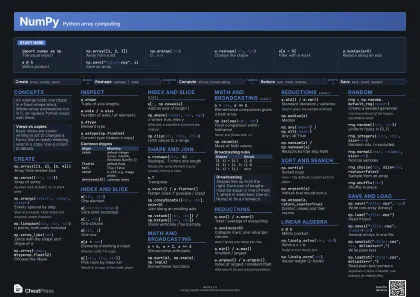 Dark · A3 landscape
420 × 297 mm · PDF
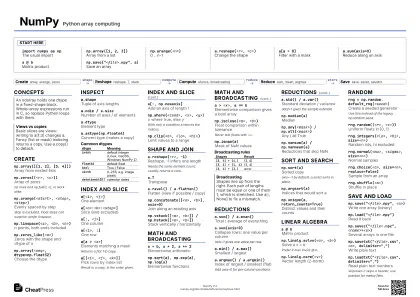 Ink saver · A3 landscape
420 × 297 mm · PDF
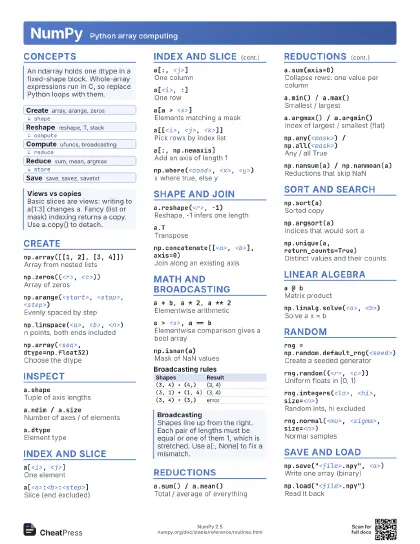
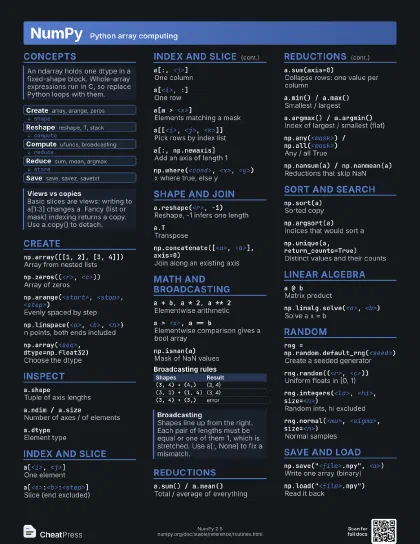
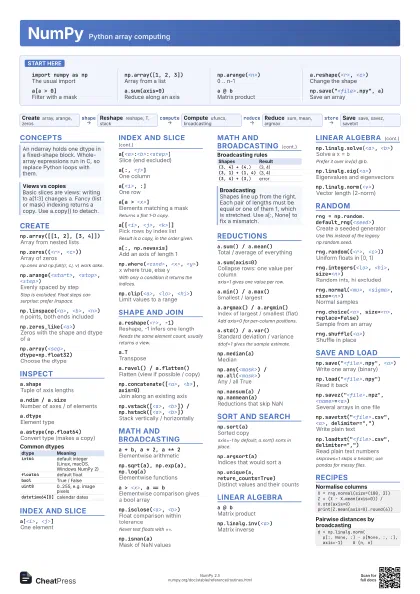
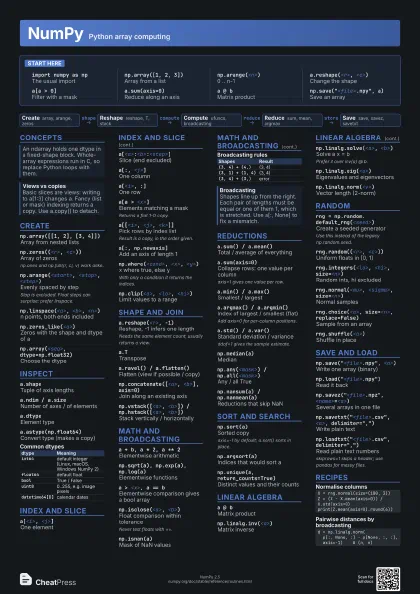
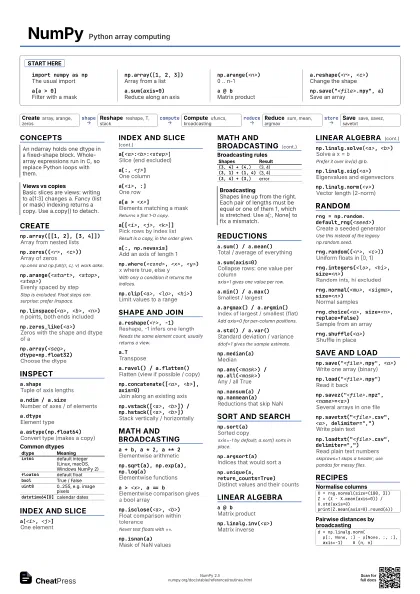
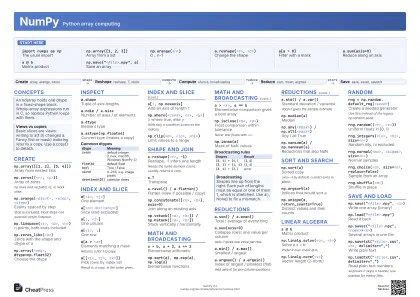
Start here
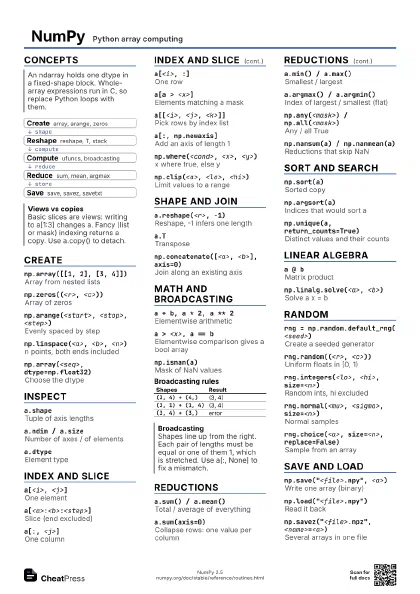
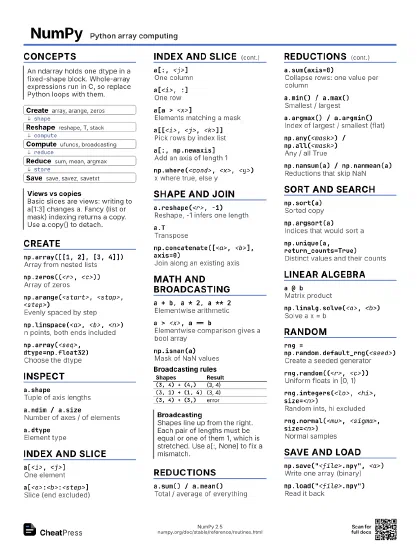
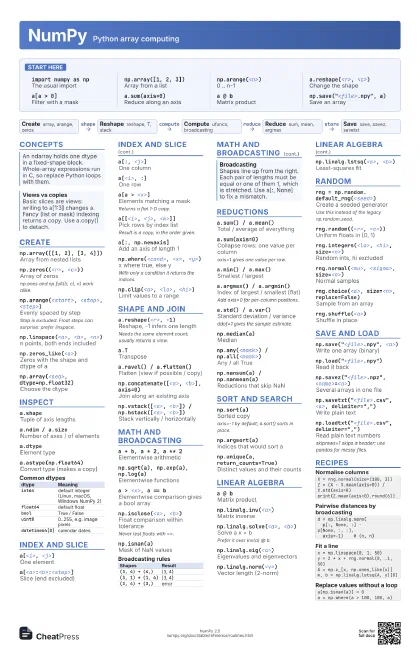
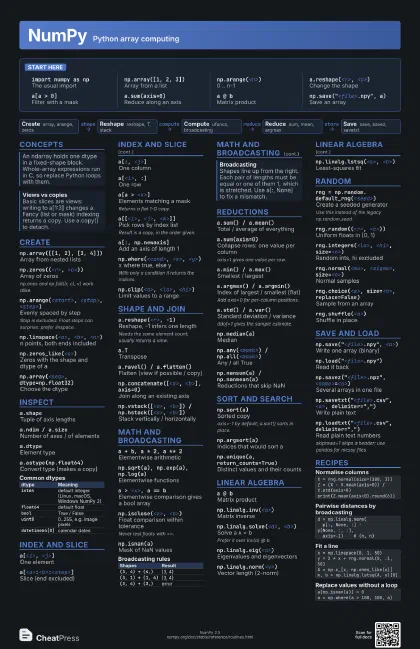
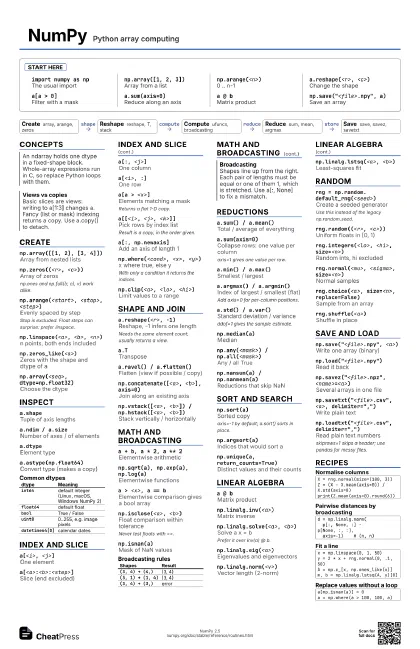
import numpy as np
The usual import
np.array([1, 2, 3])
Array from a list
np.arange(<n>)
0 .. n-1
a.reshape(<r>, <c>)
Change the shape
a[a > 0]Filter with a mask
a.sum(axis=0)Reduce along an axis
a @ bMatrix product
np.save("<file>.npy", a)
Save an array
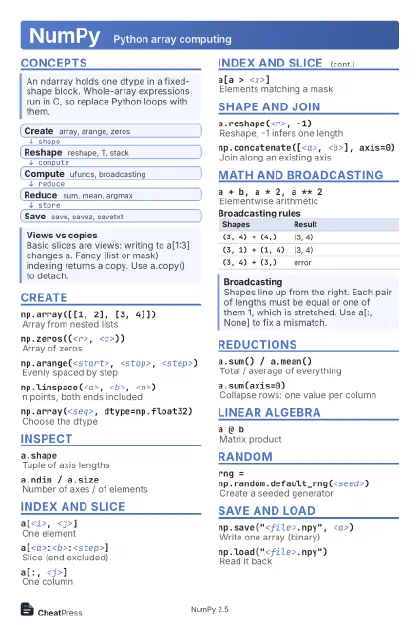
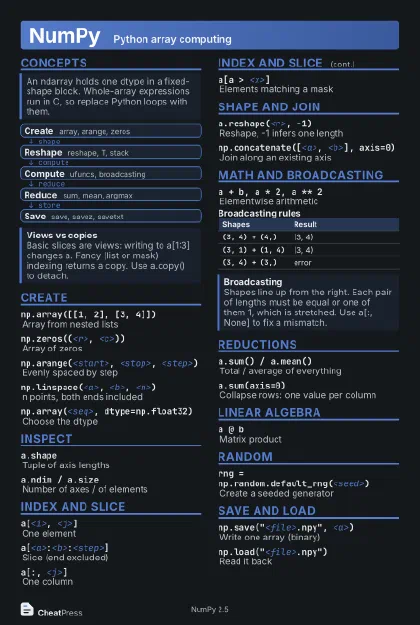
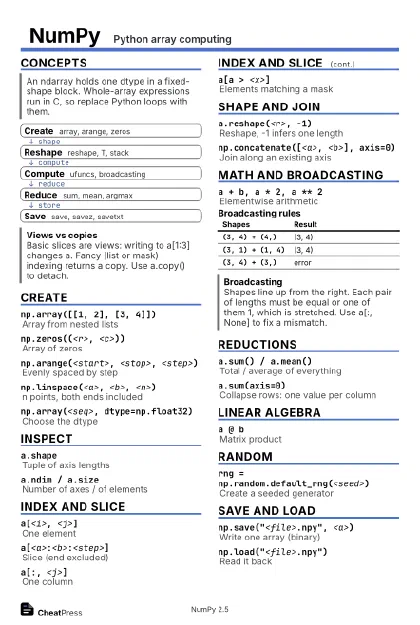
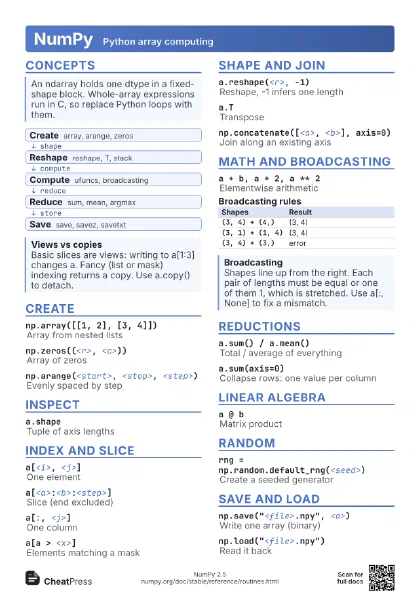
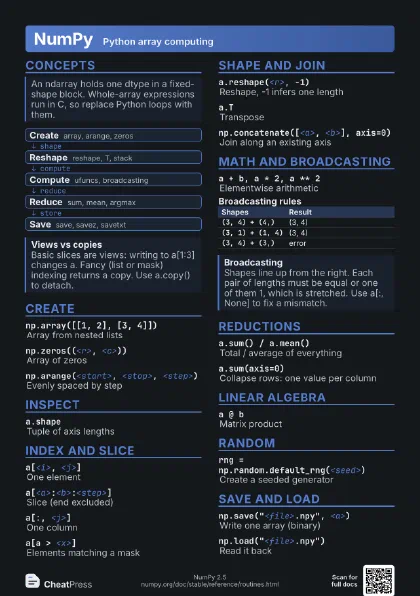
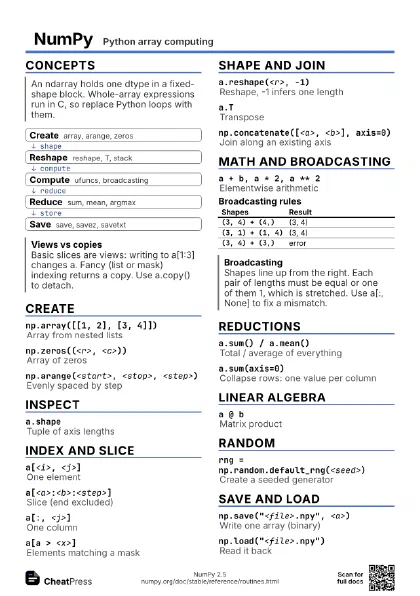
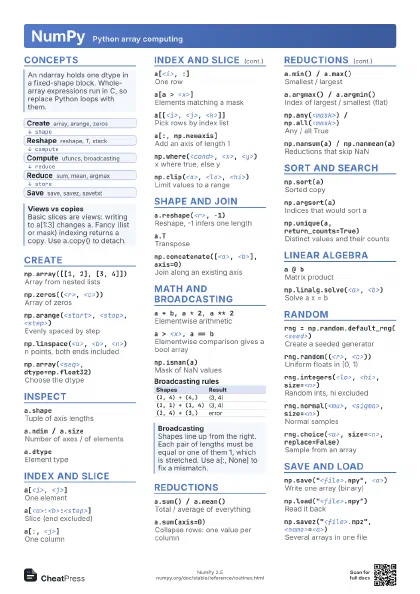
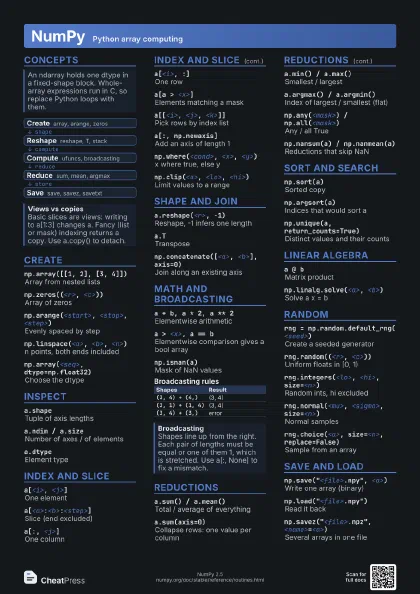
Concepts
- Create array, arange, zeros
- Reshape reshape, T, stack
- Compute ufuncs, broadcasting
- Reduce sum, mean, argmax
- Save save, savez, savetxt
Create
np.array([[1, 2], [3, 4]])
Array from nested lists
np.zeros((<r>, <c>))
Array of zeros
np.ones and np.full((r, c), v) work alike.
np.arange(<start>, <stop>, <step>)
Evenly spaced by step
Stop is excluded. Float steps can surprise: prefer linspace.
np.linspace(<a>, <b>, <n>)
n points, both ends included
np.zeros_like(<a>)
Zeros with the shape and dtype of a
np.array(<seq>, dtype=np.float32)
Choose the dtype
Inspect
a.shapeTuple of axis lengths
a.ndim / a.sizeNumber of axes / of elements
a.dtypeElement type
a.astype(np.float64)
Convert type (makes a copy)
| dtype | Meaning |
|---|---|
int64 |
default integer (Linux, macOS, Windows NumPy 2) |
float64 |
default float |
bool |
True / False |
uint8 |
0..255, e.g. image pixels |
datetime64[D] |
calendar dates |
Index and slice
a[<i>, <j>]
One element
a[<a>:<b>:<step>]
Slice (end excluded)
a[:, <j>]One column
a[<i>, :]One row
a[a > <x>]
Elements matching a mask
Returns a flat 1-D copy.
a[[<i>, <j>, <k>]]
Pick rows by index list
Result is a copy, in the order given.
a[:, np.newaxis]
Add an axis of length 1
np.where(<cond>, <x>, <y>)
x where true, else y
With only a condition it returns the indices.
np.clip(<a>, <lo>, <hi>)
Limit values to a range
Shape and join
a.reshape(<r>, -1)
Reshape, -1 infers one length
Needs the same element count; usually returns a view.
a.TTranspose
a.ravel() / a.flatten()
Flatten (view if possible / copy)
np.concatenate([<a>, <b>], axis=0)
Join along an existing axis
np.vstack([<a>, <b>]) / np.hstack([<a>,
                    <b>])
Stack vertically / horizontally
Math and broadcasting
a + b, a * 2, a ** 2
Elementwise arithmetic
np.sqrt(a), np.exp(a), np.log(a)
Elementwise functions
a > <x>, a == b
Elementwise comparison gives a bool array
np.isclose(<a>, <b>)
Float comparison within tolerance
Never test floats with ==.
np.isnan(a)Mask of NaN values
| Shapes | Result |
|---|---|
(3, 4) + (4,) |
(3, 4) |
(3, 1) + (1, 4) |
(3, 4) |
(3, 4) + (3,) |
error |
Reductions
a.sum() / a.mean()
Total / average of everything
a.sum(axis=0)Collapse rows: one value per column
axis=1 gives one value per row.
a.min() / a.max()
Smallest / largest
a.argmax() / a.argmin()
Index of largest / smallest (flat)
Add axis=0 for per-column positions.
a.std() / a.var()
Standard deviation / variance
ddof=1 gives the sample estimate.
np.median(a)Median
np.any(<mask>) / np.all(<mask>)
Any / all True
np.nansum(a) / np.nanmean(a)
Reductions that skip NaN
Sort and search
np.sort(a)Sorted copy
axis=-1 by default; a.sort() sorts in place.
np.argsort(a)Indices that would sort a
np.unique(a, return_counts=True)
Distinct values and their counts
Linear algebra
a @ bMatrix product
np.linalg.inv(<a>)
Matrix inverse
np.linalg.solve(<a>, <b>)
Solve a x = b
Prefer it over inv(a) @ b.
np.linalg.eig(<a>)
Eigenvalues and eigenvectors
np.linalg.norm(<v>)
Vector length (2-norm)
np.linalg.lstsq(<a>, <b>)
Least-squares fit
Random
rng = np.random.default_rng(<seed>)
Create a seeded generator
Use this instead of the legacy np.random.seed.
rng.random((<r>, <c>))
Uniform floats in [0, 1)
rng.integers(<lo>, <hi>, size=<n>)
Random ints, hi excluded
rng.normal(<mu>, <sigma>, size=<n>)
Normal samples
rng.choice(<a>, size=<n>, replace=False)
Sample from an array
rng.shuffle(<a>)
Shuffle in place
Save and load
np.save("<file>.npy", <a>)
Write one array (binary)
np.load("<file>.npy")
Read it back
np.savez("<file>.npz",
                    <name>=<a>)
Several arrays in one file
np.savetxt("<file>.csv", <a>,
                    delimiter=",")
Write plain text
np.loadtxt("<file>.csv",
                    delimiter=",")
Read plain text numbers
skiprows=1 skips a header; use pandas for messy files.
Recipes
X = rng.normal(size=(100, 3))Z = (X - X.mean(axis=0)) / X.std(axis=0)print(Z.mean(axis=0).round(6))d = np.linalg.norm( p[:, None, :] - p[None, :, :], axis=-1) # (n, n)x = np.linspace(0, 1, 50)y = 2 * x + rng.normal(0, .1, 50)A = np.c_[x, np.ones_like(x)]m, b = np.linalg.lstsq(A, y)[0]a[np.isnan(a)] = 0a = np.where(a > 100, 100, a)