Cheat
pandas Python data frames
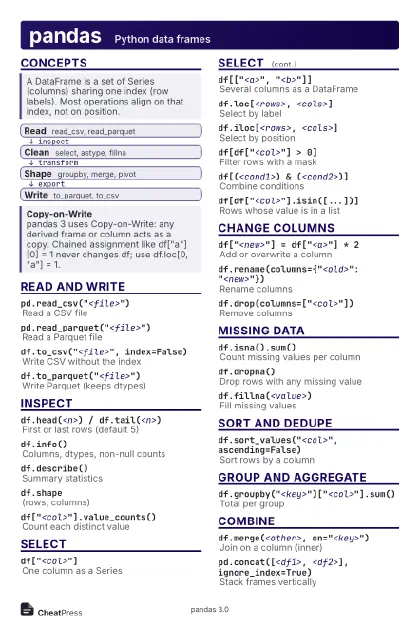 Light · Postcard
102 × 152 mm · PDF
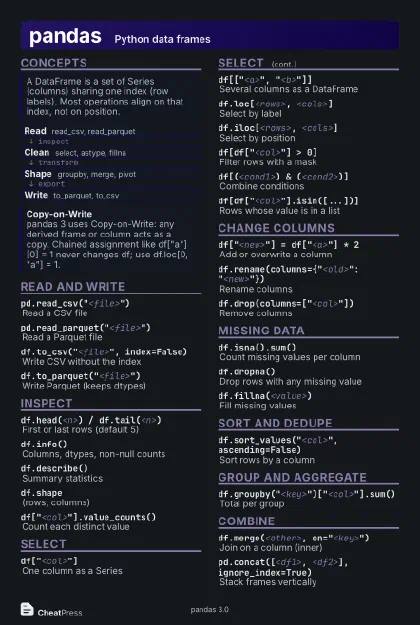 Dark · Postcard
102 × 152 mm · PDF
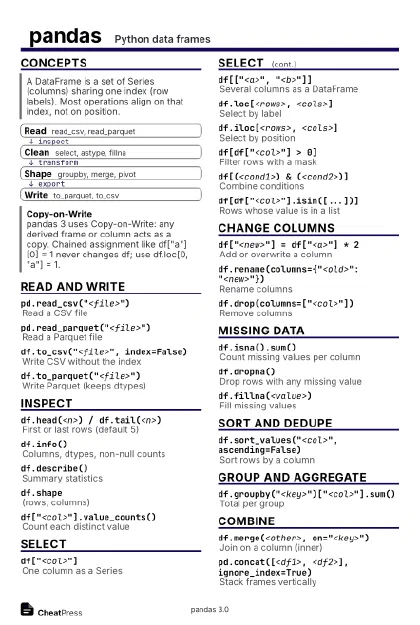 Ink saver · Postcard
102 × 152 mm · PDF
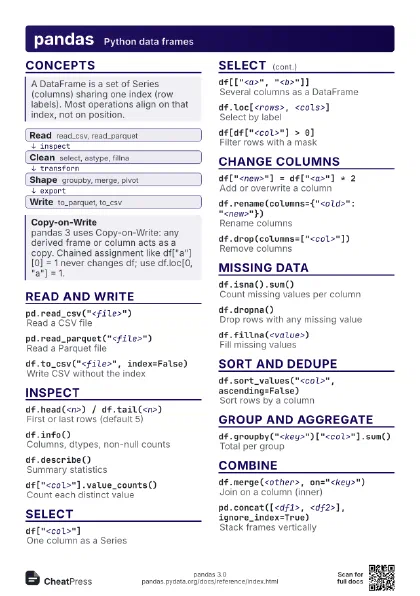
 Light · A4 landscape
297 × 210 mm · PDF
 Dark · A4 landscape
297 × 210 mm · PDF
 Ink saver · A4 landscape
297 × 210 mm · PDF
 Light · A3 landscape
420 × 297 mm · PDF
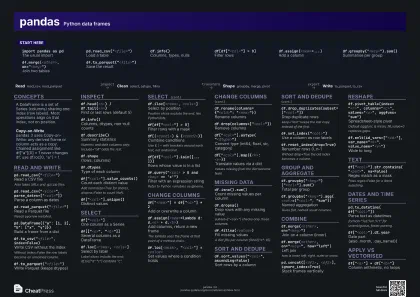 Dark · A3 landscape
420 × 297 mm · PDF
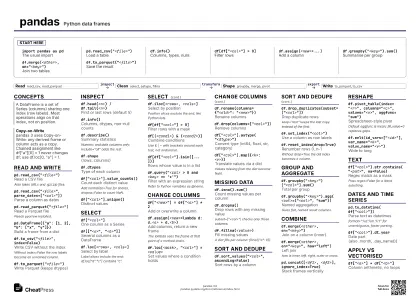 Ink saver · A3 landscape
420 × 297 mm · PDF
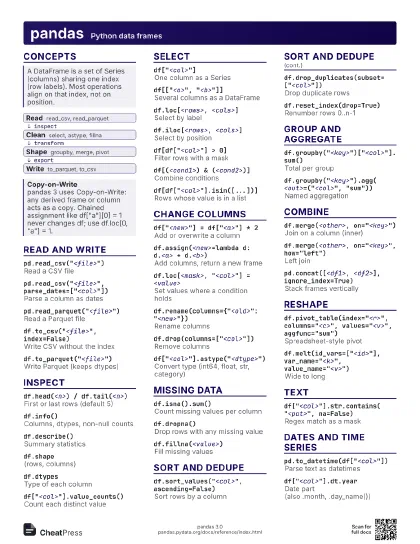
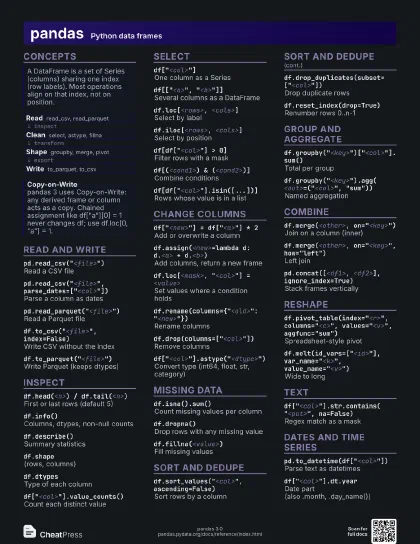
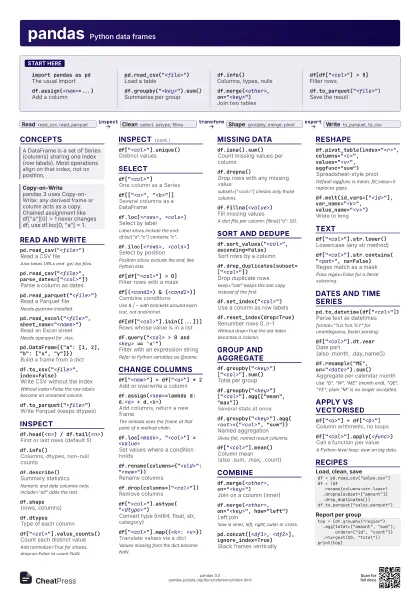
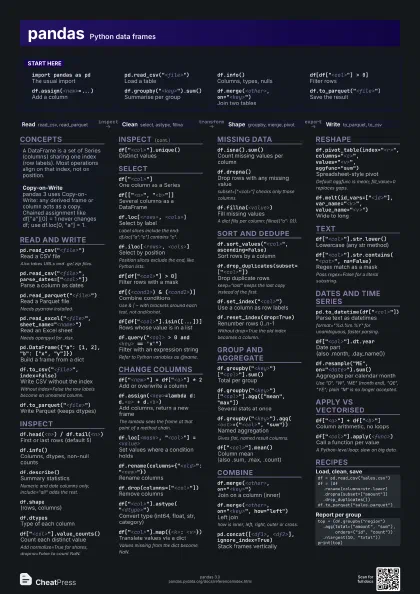
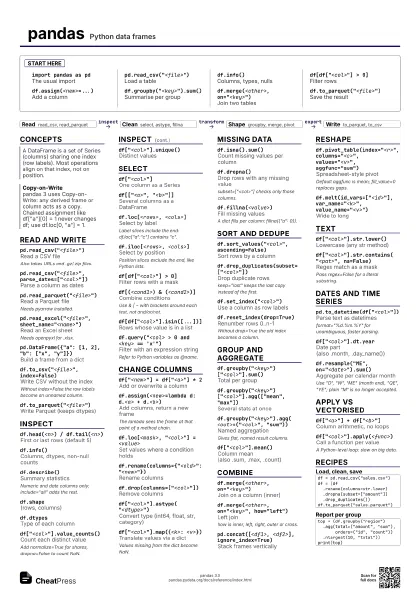
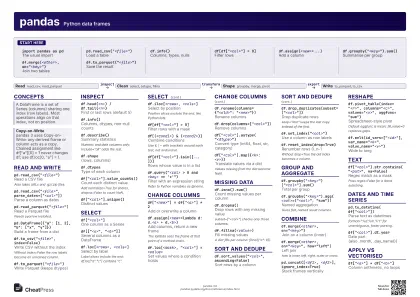
Start here
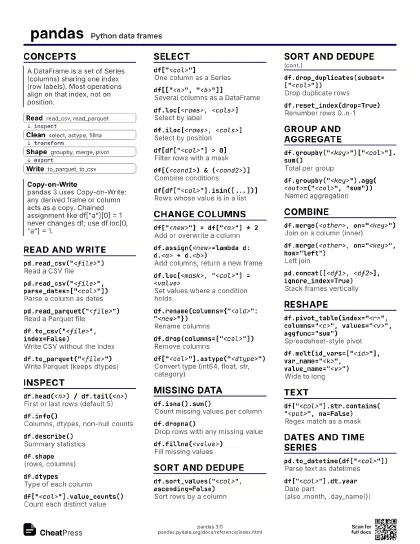
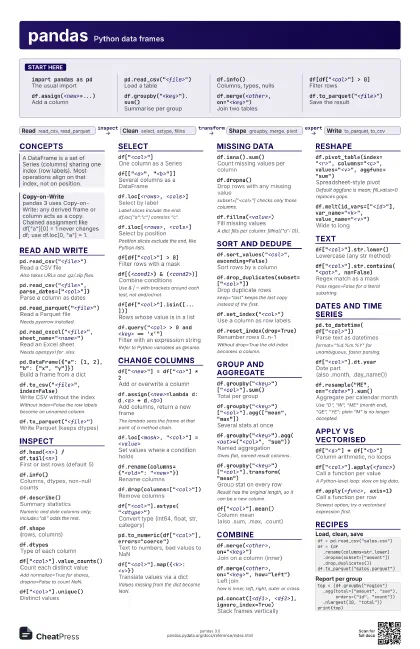
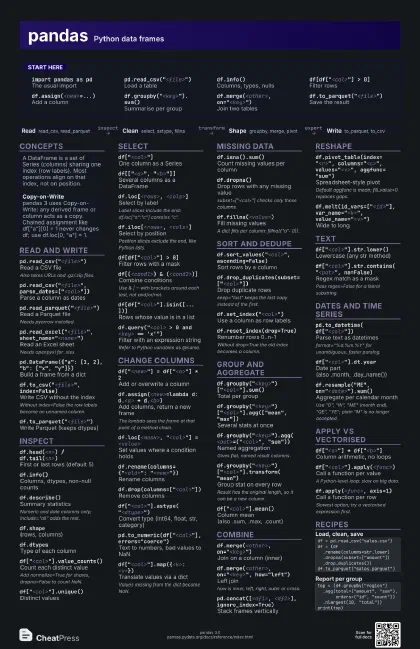
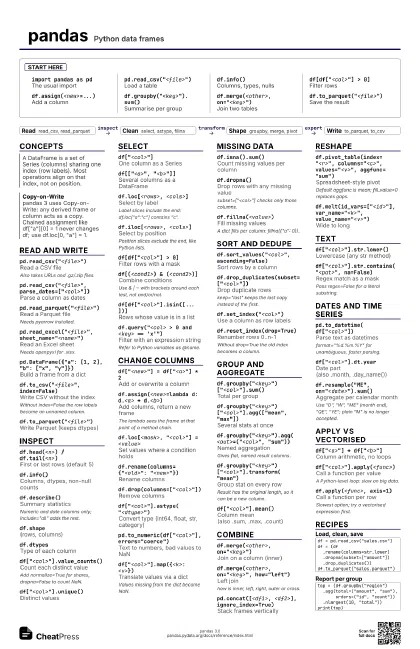
import pandas as pd
The usual import
pd.read_csv("<file>")
Load a table
df.info()Columns, types, nulls
df[df["<col>"] > 0]
Filter rows
df.assign(<new>=...)
Add a column
df.groupby("<key>").sum()
Summarise per group
df.merge(<other>, on="<key>")
Join two tables
df.to_parquet("<file>")
Save the result
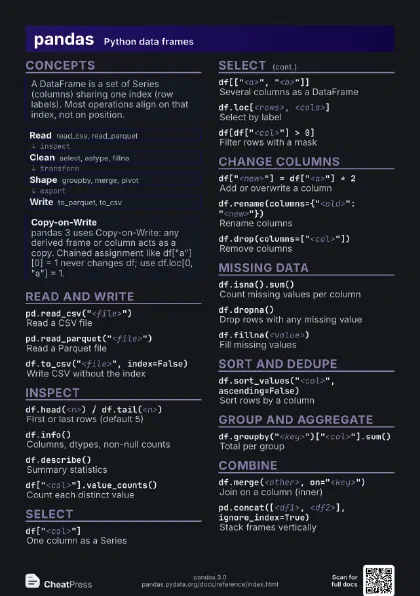
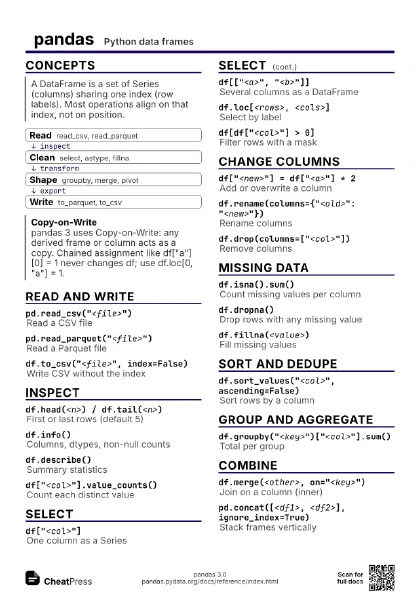
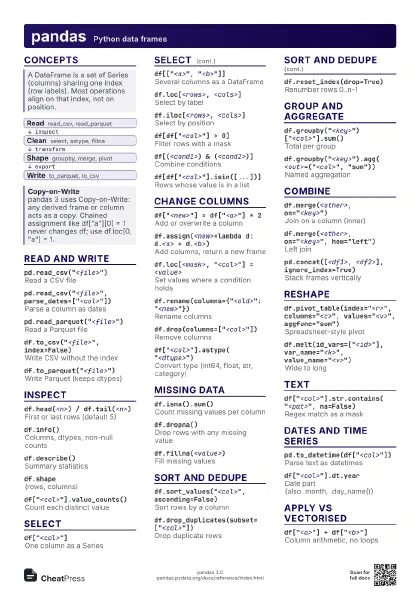
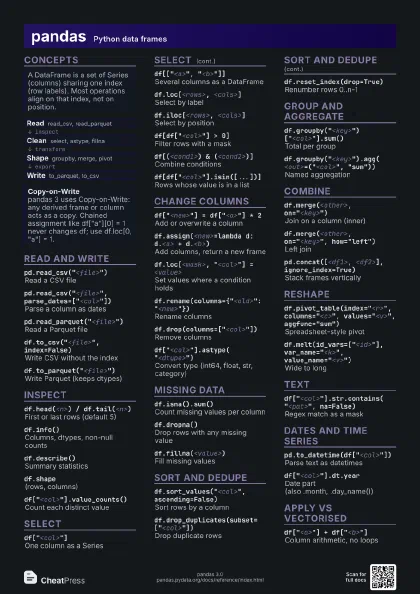
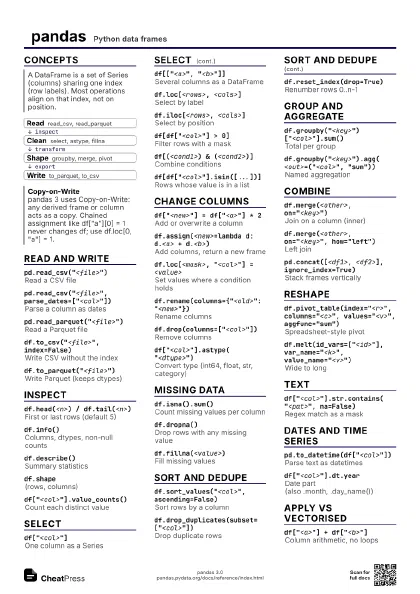
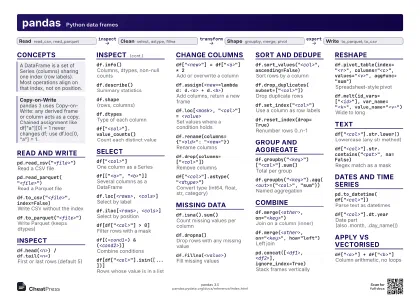
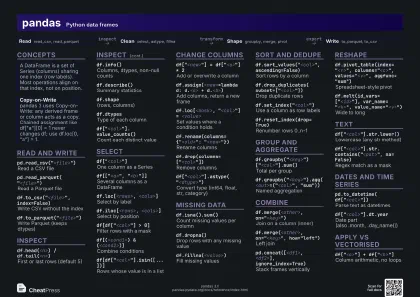
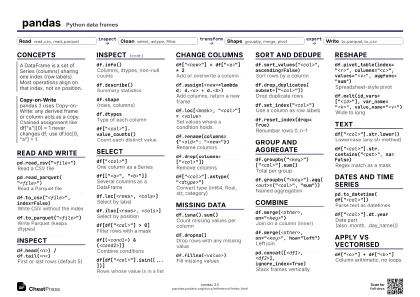
Concepts
- Read read_csv, read_parquet
- Clean select, astype, fillna
- Shape groupby, merge, pivot
- Write to_parquet, to_csv
Read and write
pd.read_csv("<file>")
Read a CSV file
Also takes URLs and .gz/.zip files.
pd.read_csv("<file>",
                    parse_dates=["<col>"])
Parse a column as dates
pd.read_parquet("<file>")
Read a Parquet file
Needs pyarrow installed.
pd.read_excel("<file>",
                    sheet_name="<name>")
Read an Excel sheet
Needs openpyxl for .xlsx.
pd.read_sql("<query>", <conn>)
Query a database
Takes a SQLAlchemy engine or a sqlite3 connection.
pd.DataFrame({"a": [1, 2], "b":
                    ["x", "y"]})
Build a frame from a dict
df.to_csv("<file>", index=False)
Write CSV without the index
Without index=False the row labels become an unnamed column.
df.to_parquet("<file>")
Write Parquet (keeps dtypes)
Inspect
df.head(<n>) / df.tail(<n>)
First or last rows (default 5)
df.info()Columns, dtypes, non-null counts
df.describe()Summary statistics
Numeric and date columns only; include="all" adds the
rest.
df.shape(rows, columns)
df.dtypesType of each column
df["<col>"].value_counts()
Count each distinct value
Add normalize=True for shares, dropna=False to count NaN.
df["<col>"].unique()
Distinct values
Select
df["<col>"]
One column as a Series
df[["<a>", "<b>"]]
Several columns as a DataFrame
df.loc[<rows>, <cols>]
Select by label
Label slices include the end: df.loc["a":"c"]
contains "c".
df.iloc[<rows>, <cols>]
Select by position
Position slices exclude the end, like Python lists.
df[df["<col>"] > 0]
Filter rows with a mask
df[(<cond1>) & (<cond2>)]
Combine conditions
Use & | ~ with brackets around each test, not and/or/not.
df[df["<col>"].isin([...])]
Rows whose value is in a list
df.query("<col> > 0 and <key> ==
                    'x'")
Filter with an expression string
Refer to Python variables as @name.
Change columns
df["<new>"] = df["<a>"] *
                    2
Add or overwrite a column
df.assign(<new>=lambda d: d.<a> +
                    d.<b>)
Add columns, return a new frame
The lambda sees the frame at that point of a method chain.
df.loc[<mask>, "<col>"] =
                    <value>
Set values where a condition holds
df.rename(columns={"<old>":
                    "<new>"})
Rename columns
df.drop(columns=["<col>"])
Remove columns
df["<col>"].astype("<dtype>")
Convert type (int64, float, str, category)
pd.to_numeric(df["<col>"],
                    errors="coerce")
Text to numbers, bad values to NaN
df["<col>"].map({<k>: <v>})
Translate values via a dict
Values missing from the dict become NaN.
Missing data
df.isna().sum()Count missing values per column
df.dropna()Drop rows with any missing value
subset=["<col>"] checks only those columns.
df.fillna(<value>)
Fill missing values
A dict fills per column: fillna({"a": 0}).
df["<col>"].ffill()
Fill forward from the last value
Sort and dedupe
df.sort_values("<col>",
                    ascending=False)
Sort rows by a column
df.nlargest(<n>, "<col>")
Top n rows by a column
df.drop_duplicates(subset=["<col>"])
Drop duplicate rows
keep="last" keeps the last copy instead of the first.
df.set_index("<col>")
Use a column as row labels
df.reset_index(drop=True)
Renumber rows 0..n-1
Without drop=True the old index becomes a column.
Group and aggregate
df.groupby("<key>")["<col>"].sum()
Total per group
df.groupby("<key>")["<col>"].agg(["mean",
                    "max"])
Several stats at once
df.groupby("<key>").agg(<out>=("<col>",
                    "sum"))
Named aggregation
Gives flat, named result columns.
df.groupby("<key>")["<col>"].transform("mean")
Group stat on every row
Result has the original length, so it can be a new column.
df["<col>"].mean()
Column mean (also .sum, .max, .count)
Combine
df.merge(<other>, on="<key>")
Join on a column (inner)
df.merge(<other>, on="<key>",
                    how="left")
Left join
how is inner, left, right, outer or cross.
df.merge(<other>, on="<key>",
                    indicator=True)
Add _merge column (both/left_only)
pd.concat([<df1>, <df2>],
                    ignore_index=True)
Stack frames vertically
Reshape
df.pivot_table(index="<r>",
                    columns="<c>", values="<v>",
                    aggfunc="sum")
Spreadsheet-style pivot
Default aggfunc is mean; fill_value=0 replaces gaps.
df.melt(id_vars=["<id>"],
                    var_name="<k>",
                    value_name="<v>")
Wide to long
df.pivot(index="<r>",
                    columns="<c>",
                    values="<v>")
Long to wide, no aggregation
Raises if an index/column pair occurs twice.
Text
df["<col>"].str.lower()
Lowercase (any str method)
df["<col>"].str.contains("<pat>",
                    na=False)
Regex match as a mask
Pass regex=False for a literal substring.
df["<col>"].str.split(",",
                    expand=True)
Split into several columns
Dates and time series
pd.to_datetime(df["<col>"])
Parse text as datetimes
format="%d.%m.%Y" for unambiguous, faster parsing.
df["<col>"].dt.year
Date part (also .month, .day_name())
df.resample("ME",
                    on="<date>").sum()
Aggregate per calendar month
Use "D", "W", "ME" (month end),
"QE", "YE"; plain "M" is no longer
accepted.
df["<col>"].rolling(7).mean()
7-row moving average
Apply vs vectorised
df["<a>"] + df["<b>"]
Column arithmetic, no loops
df["<col>"].apply(<func>)
Call a function per value
A Python-level loop: slow on big data.
df.apply(<func>, axis=1)
Call a function per row
Slowest option; try a vectorised expression first.
| Approach | Speed |
|---|---|
df.a * df.b |
vectorised, fast |
.str / .dt / .map(dict) |
fast built-ins |
s.apply(f) |
Python loop per value |
df.apply(f, axis=1) |
Python loop per row, slowest |
Recipes
df = pd.read_csv("sales.csv")df = (df .rename(columns=str.lower) .dropna(subset=["amount"]) .drop_duplicates())df.to_parquet("sales.parquet")top = (df.groupby("region") .agg(total=("amount", "sum"), orders=("id", "count")) .nlargest(10, "total"))print(top)m = orders.merge( customers, on="cust_id", how="left", indicator=True)lost = m[m._merge == "left_only"]