Cheat
HAProxy Load balancer and proxy
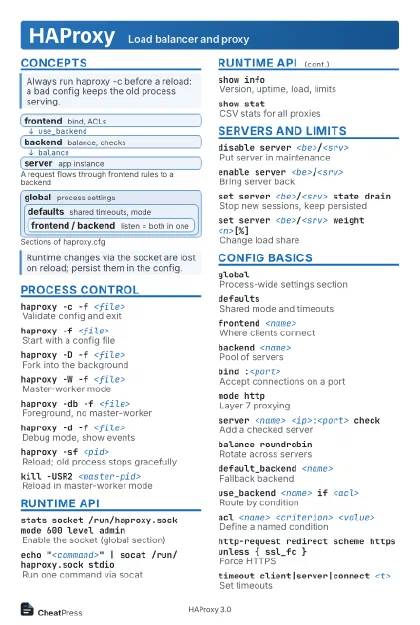 Light · Postcard
102 × 152 mm · PDF
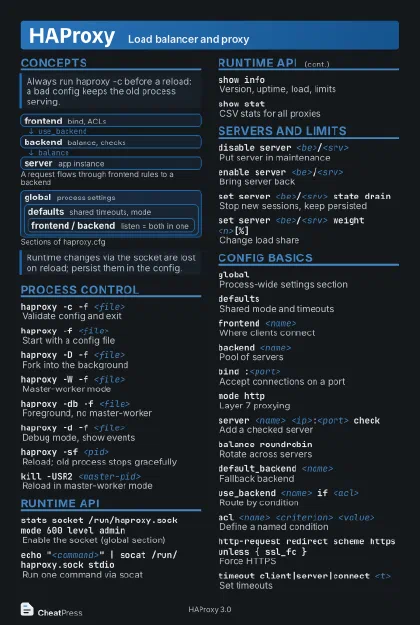 Dark · Postcard
102 × 152 mm · PDF
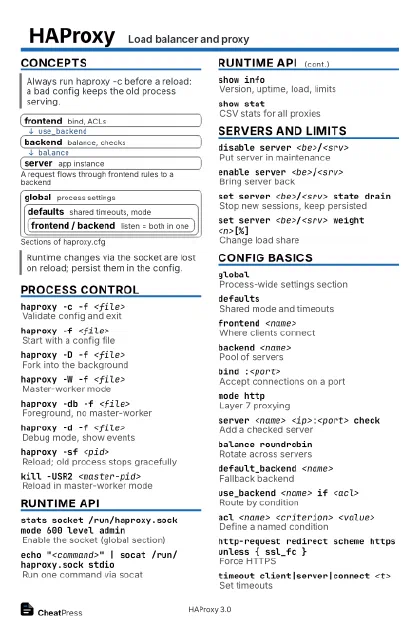 Ink saver · Postcard
102 × 152 mm · PDF
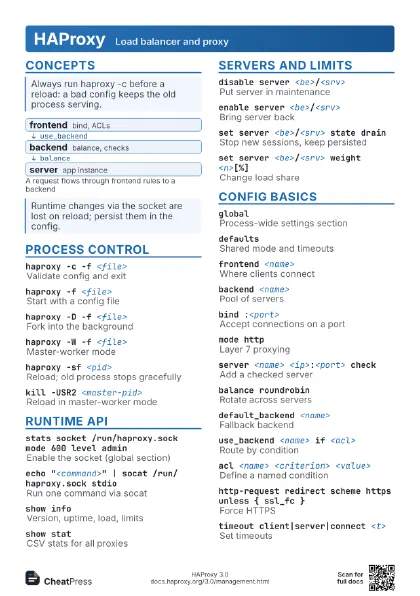
 Light · A4 landscape
297 × 210 mm · PDF
 Dark · A4 landscape
297 × 210 mm · PDF
 Ink saver · A4 landscape
297 × 210 mm · PDF


 Light · A3 landscape
420 × 297 mm · PDF
 Dark · A3 landscape
420 × 297 mm · PDF
 Ink saver · A3 landscape
420 × 297 mm · PDF

Start here
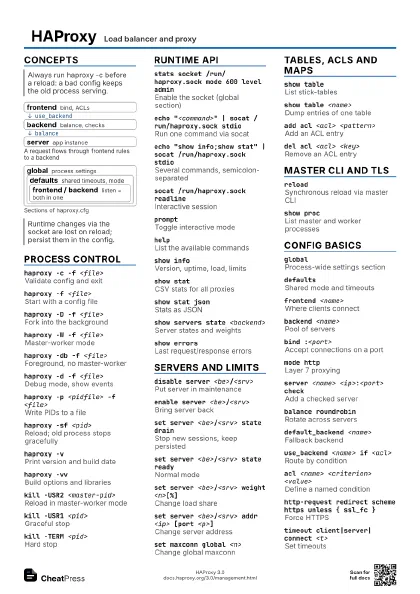
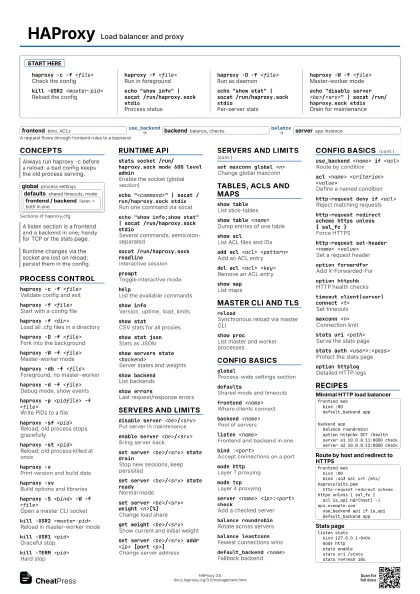
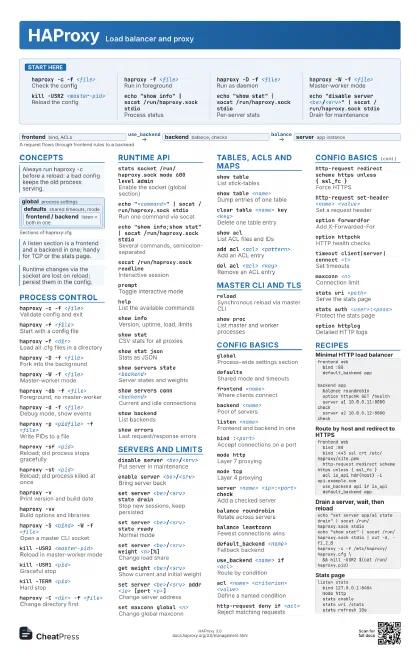
haproxy -c -f <file>
Check the config
haproxy -f <file>
Run in foreground
haproxy -D -f <file>
Run as daemon
haproxy -W -f <file>
Master-worker mode
kill -USR2 <master-pid>
Reload the config
echo "show info" | socat /run/haproxy.sock
                    stdio
Process status
echo "show stat" | socat /run/haproxy.sock
                    stdio
Per-server stats
echo "disable server <be>/<srv>" |
                    socat /run/haproxy.sock stdio
Drain for maintenance
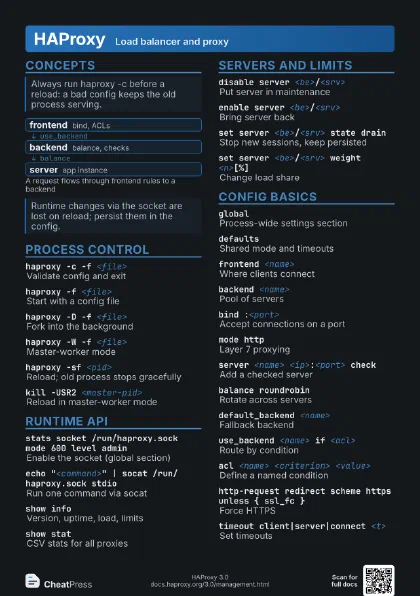
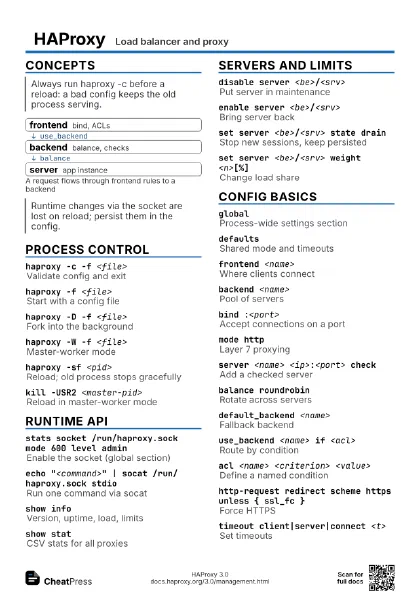
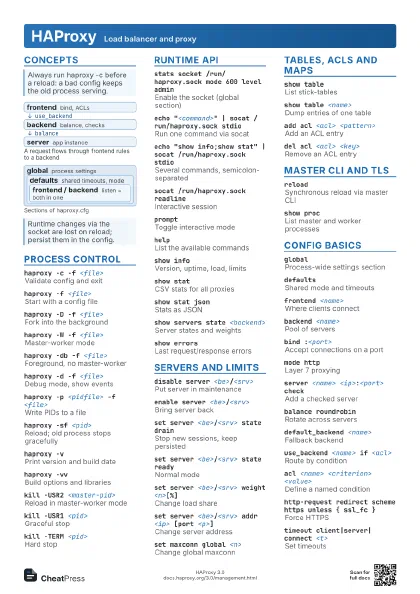
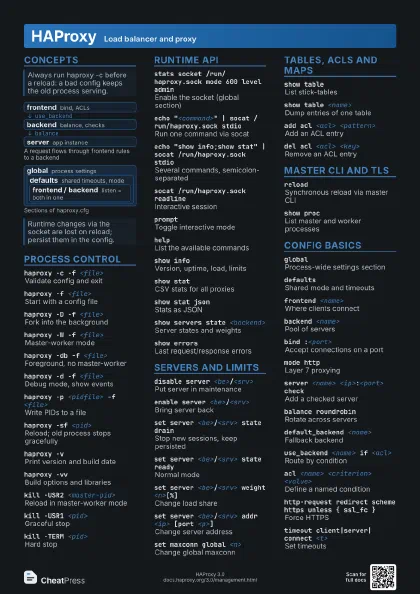
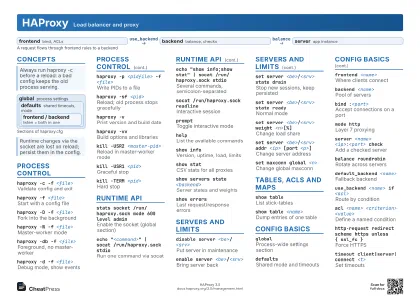
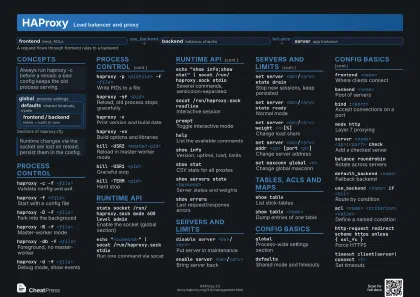
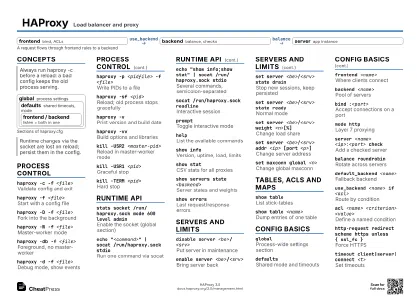
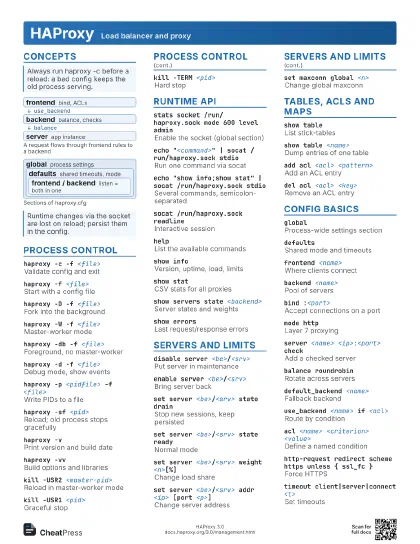
Concepts
- frontend bind, ACLs
- backend balance, checks
- server app instance
global process settings
defaults
shared timeouts, mode
frontend / backend
listen = both in one
Process Control
haproxy -c -f <file>
Validate config and exit
haproxy -f <file>
Start with a config file
haproxy -f <dir>
Load all .cfg files in a directory
haproxy -D -f <file>
Fork into the background
haproxy -W -f <file>
Master-worker mode
haproxy -db -f <file>
Foreground, no master-worker
haproxy -d -f <file>
Debug mode, show events
haproxy -p <pidfile> -f <file>
Write PIDs to a file
haproxy -sf <pid>
Reload; old process stops gracefully
haproxy -st <pid>
Reload; old process killed at once
haproxy -vPrint version and build date
haproxy -vvBuild options and libraries
haproxy -S <bind> -W -f <file>
Open a master CLI socket
kill -USR2 <master-pid>
Reload in master-worker mode
kill -USR1 <pid>
Graceful stop
kill -TERM <pid>
Hard stop
haproxy -C <dir> -f <file>
Change directory first
Runtime API
stats socket /run/haproxy.sock mode 600 level admin
Enable the socket (global section)
echo "<command>" | socat /run/haproxy.sock
                    stdio
Run one command via socat
echo "show info;show stat" | socat
                    /run/haproxy.sock stdio
Several commands, semicolon-separated
socat /run/haproxy.sock readline
Interactive session
promptToggle interactive mode
helpList the available commands
show infoVersion, uptime, load, limits
show statCSV stats for all proxies
show stat typedTyped output format
show stat jsonStats as JSON
show servers state <backend>
Server states and weights
show servers conn <backend>
Current and idle connections
show backendList backends
show sessList active streams
show errorsLast request/response errors
show poolsMemory pool usage
show activityInternal event counters
show resolvers [<id>]
DNS resolver stats
set severity-output number
Add severity prefix to output
Servers and Limits
disable server <be>/<srv>
Put server in maintenance
enable server <be>/<srv>
Bring server back
set server <be>/<srv> state drain
Stop new sessions, keep persisted
set server <be>/<srv> state ready
Normal mode
set server <be>/<srv> state maint
Same as disable server
set server <be>/<srv> weight <n>[%]
Change load share
get weight <be>/<srv>
Show current and initial weight
set server <be>/<srv> addr <ip> [port
                    <p>]
Change server address
set server <be>/<srv> health
                    <up|stopping|down>
Force health state
set server <be>/<srv> agent
                    <up|down>
Force agent state
shutdown sessions server <be>/<srv>
Kill all streams to a server
set maxconn global <n>
Change global maxconn
set maxconn frontend <fe> <n>
Change frontend maxconn
set maxconn server <be>/<srv> <n>
Change server maxconn
set rate-limit connections global <n>
Change connection rate limit
Tables, ACLs and Maps
show tableList stick-tables
show table <name>
Dump entries of one table
clear table <name> key <key>
Delete one table entry
set table <name> key <key> data.<type>
                    <v>
Create or update an entry
show aclList ACL files and IDs
add acl <acl> <pattern>
Add an ACL entry
del acl <acl> <key>
Remove an ACL entry
clear acl <acl>
Remove all entries
show mapList maps
add map <map> <key> <value>
Add a map entry
set map <map> <key> <value>
Change a map entry
del map <map> <key>
Remove a map entry
Master CLI and TLS
reloadSynchronous reload via master CLI
show procList master and worker processes
@<worker> <command>
Run a command on a worker
show ssl certList loaded certificates
set ssl cert <file> <payload>
Stage a new certificate
commit ssl cert <file>
Activate the staged certificate
show cli sockets
List CLI sockets
Config Basics
globalProcess-wide settings section
defaultsShared mode and timeouts
frontend <name>
Where clients connect
backend <name>
Pool of servers
listen <name>
Frontend and backend in one
bind :<port>
Accept connections on a port
mode httpLayer 7 proxying
mode tcpLayer 4 proxying
server <name> <ip>:<port> check
Add a checked server
balance roundrobin
Rotate across servers
balance leastconn
Fewest connections wins
balance sourcePin clients by source IP
default_backend <name>
Fallback backend
use_backend <name> if <acl>
Route by condition
acl <name> <criterion> <value>
Define a named condition
http-request deny if <acl>
Reject matching requests
http-request redirect scheme https unless { ssl_fc }
Force HTTPS
http-request set-header <name> <value>
Set a request header
option forwardfor
Add X-Forwarded-For
option httpchkHTTP health checks
http-check send meth GET uri <path>
Choose the check request
timeout client|server|connect <t>
Set timeouts
maxconn <n>
Connection limit
stats uri <path>
Serve the stats page
stats auth <user>:<pass>
Protect the stats page
option httplogDetailed HTTP logs
Recipes
frontend web bind :80 default_backend appbackend app balance roundrobin option httpchk GET /health server a1 10.0.0.11:8080 check server a2 10.0.0.12:8080 checkfrontend web bind :80 bind :443 ssl crt /etc/haproxy/site.pem http-request redirect scheme https unless { ssl_fc } acl is_api hdr(host) -i api.example.com use_backend api if is_api default_backend appecho "set server app/a1 state drain" | socat /run/haproxy.sock stdioecho "show stat" | socat /run/haproxy.sock stdio | cut -d, -f1,2,8haproxy -c -f /etc/haproxy/haproxy.cfg \ && kill -USR2 $(cat /run/haproxy.pid)listen stats bind 127.0.0.1:8404 mode http stats enable stats uri /stats stats refresh 10s