Cheat
Grype Vulnerability scanner
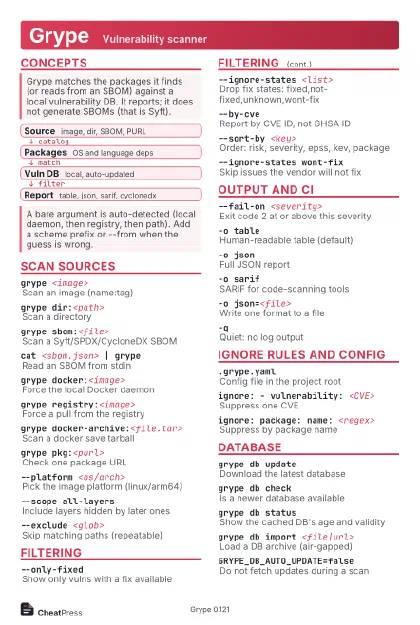 Light · Postcard
102 × 152 mm · PDF
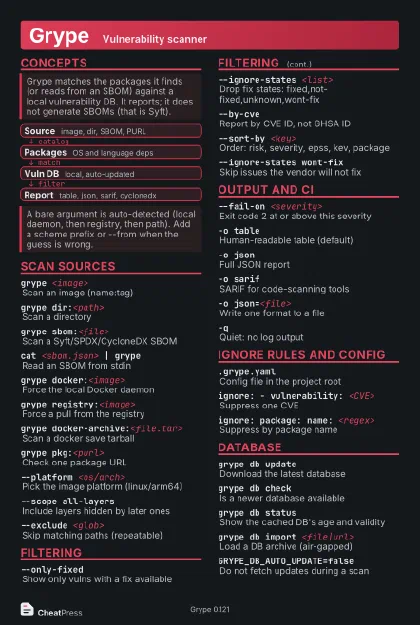 Dark · Postcard
102 × 152 mm · PDF
 Ink saver · Postcard
102 × 152 mm · PDF
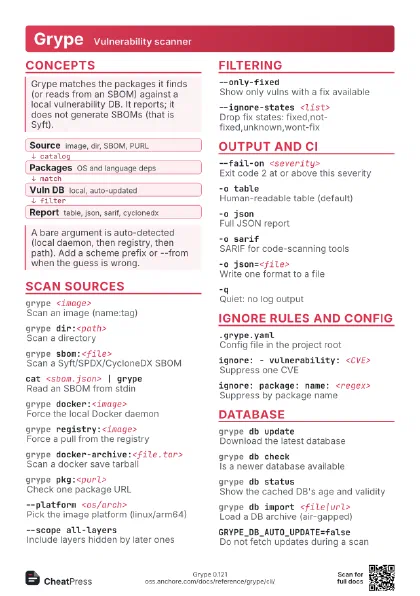
 Light · A4 landscape
297 × 210 mm · PDF
 Dark · A4 landscape
297 × 210 mm · PDF
 Ink saver · A4 landscape
297 × 210 mm · PDF
 Light · A3 landscape
420 × 297 mm · PDF
 Dark · A3 landscape
420 × 297 mm · PDF
 Ink saver · A3 landscape
420 × 297 mm · PDF
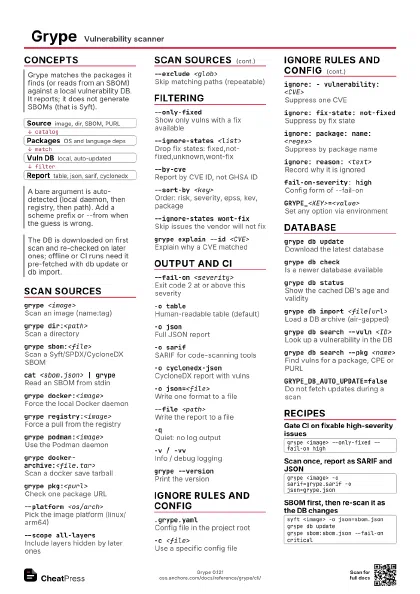
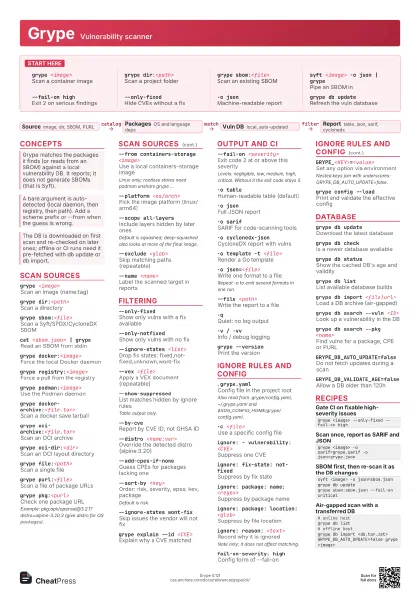
Start here
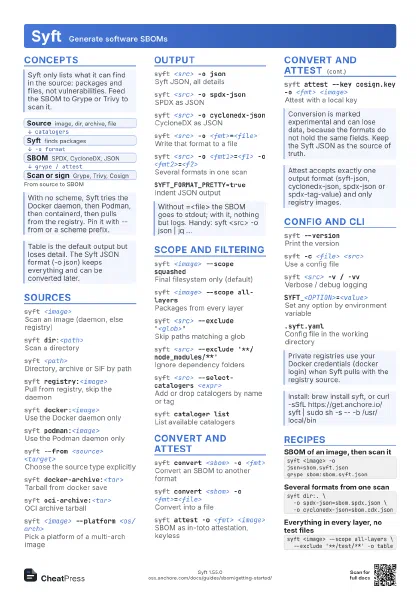
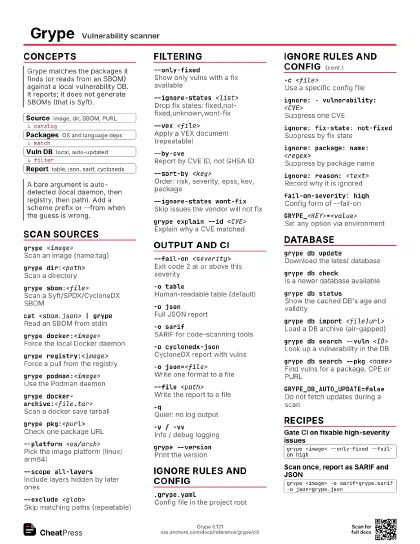
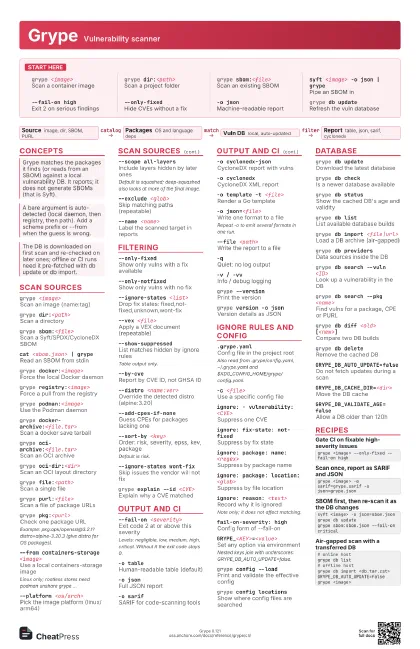
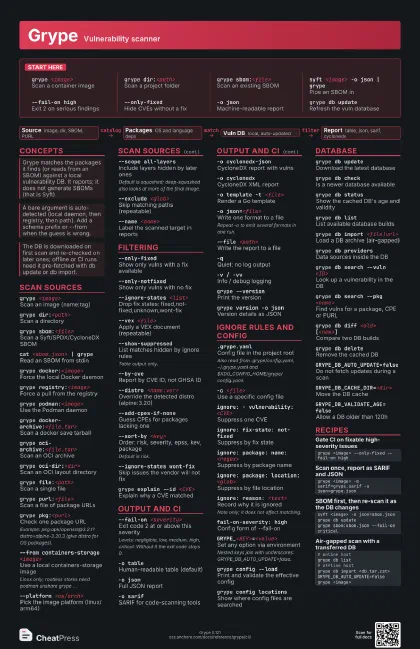
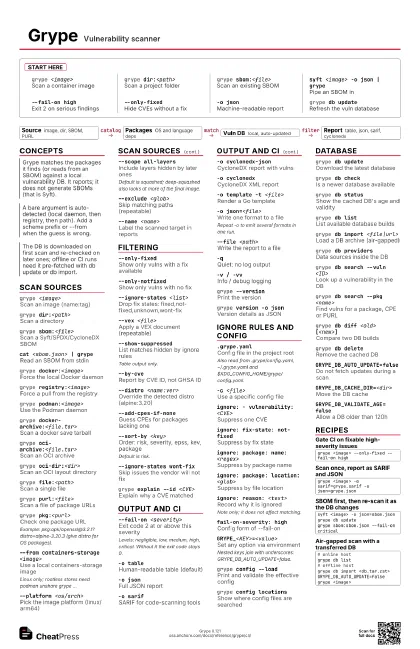
grype <image>
Scan a container image
grype dir:<path>
Scan a project folder
grype sbom:<file>
Scan an existing SBOM
syft <image> -o json | grype
Pipe an SBOM in
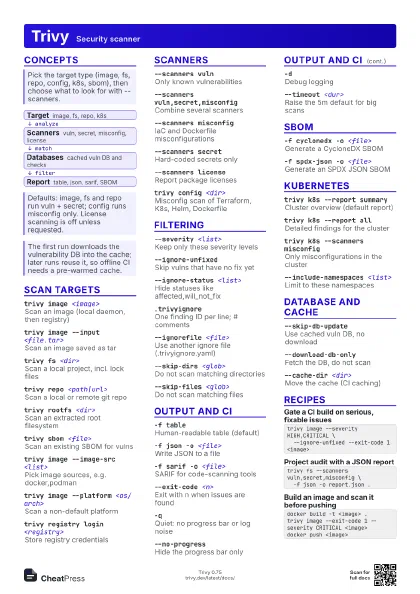
--fail-on highExit 2 on serious findings
--only-fixedHide CVEs without a fix
-o jsonMachine-readable report
grype db updateRefresh the vuln database
Concepts
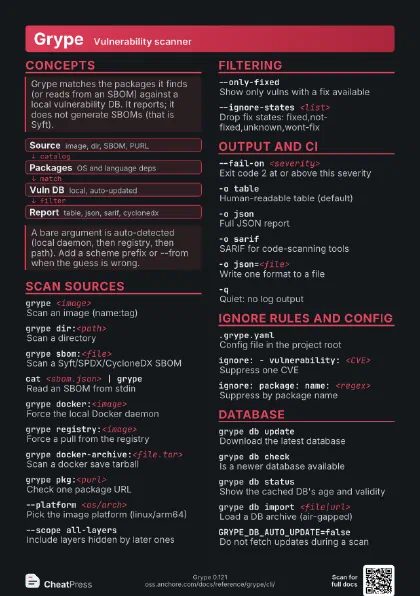
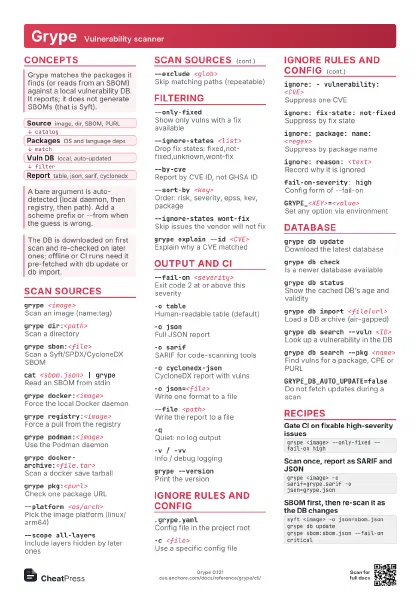
- Source image, dir, SBOM, PURL
- Packages OS and language deps
- Vuln DB local, auto-updated
- Report table, json, sarif, cyclonedx
Scan sources
grype <image>
Scan an image (name:tag)
grype dir:<path>
Scan a directory
grype sbom:<file>
Scan a Syft/SPDX/CycloneDX SBOM
cat <sbom.json> | grype
Read an SBOM from stdin
grype docker:<image>
Force the local Docker daemon
grype registry:<image>
Force a pull from the registry
grype podman:<image>
Use the Podman daemon
grype docker-archive:<file.tar>
Scan a docker save tarball
grype oci-archive:<file.tar>
Scan an OCI archive
grype oci-dir:<dir>
Scan an OCI layout directory
grype file:<path>
Scan a single file
grype purl:<file>
Scan a file of package URLs
grype pkg:<purl>
Check one package URL
Example: pkg:apk/openssl@3.2.1?distro=alpine-3.20.3 (give
distro for OS packages).
--from containers-storage <image>
Use a local containers-storage image
Linux only; rootless stores need podman unshare grype ...
--platform <os/arch>
Pick the image platform (linux/arm64)
--scope all-layers
Include layers hidden by later ones
Default is squashed; deep-squashed also looks at more of the
final image.
--exclude <glob>
Skip matching paths (repeatable)
--name <name>
Label the scanned target in reports
Filtering
--only-fixedShow only vulns with a fix available
--only-notfixedShow only vulns with no fix
--ignore-states <list>
Drop fix states: fixed,not-fixed,unknown,wont-fix
--vex <file>
Apply a VEX document (repeatable)
--show-suppressed
List matches hidden by ignore rules
Table output only.
--by-cveReport by CVE ID, not GHSA ID
--distro <name:ver>
Override the detected distro (alpine:3.20)
--add-cpes-if-none
Guess CPEs for packages lacking one
--sort-by <key>
Order: risk, severity, epss, kev, package
Default is risk.
--ignore-states wont-fix
Skip issues the vendor will not fix
grype explain --id <CVE>
Explain why a CVE matched
Output and CI
--fail-on <severity>
Exit code 2 at or above this severity
Levels: negligible, low, medium, high, critical. Without it
the exit code stays 0.
-o tableHuman-readable table (default)
-o jsonFull JSON report
-o sarifSARIF for code-scanning tools
-o cyclonedx-json
CycloneDX report with vulns
-o cyclonedxCycloneDX XML report
-o template -t <file>
Render a Go template
-o json=<file>
Write one format to a file
Repeat -o to emit several formats in one run.
--file <path>
Write the report to a file
-qQuiet: no log output
-v / -vvInfo / debug logging
grype --versionPrint the version
grype version -o json
Version details as JSON
Ignore rules and config
.grype.yamlConfig file in the project root
Also read from .grype/config.yaml, ~/.grype.yaml and
$XDG_CONFIG_HOME/grype/config.yaml.
-c <file>Use a specific config file
ignore: - vulnerability: <CVE>
Suppress one CVE
ignore: fix-state: not-fixed
Suppress by fix state
ignore: package: name: <regex>
Suppress by package name
ignore: package: location: <glob>
Suppress by file location
ignore: reason: <text>
Record why it is ignored
Note only; it does not affect matching.
fail-on-severity: high
Config form of --fail-on
GRYPE_<KEY>=<value>
Set any option via environment
Nested keys join with underscores: GRYPE_DB_AUTO_UPDATE=false.
grype config --load
Print and validate the effective config
grype config locations
Show where config files are searched
Database
grype db updateDownload the latest database
grype db checkIs a newer database available
grype db status
Show the cached DB's age and validity
grype db listList available database builds
grype db import <file|url>
Load a DB archive (air-gapped)
grype db providers
Data sources inside the DB
grype db search --vuln <ID>
Look up a vulnerability in the DB
grype db search --pkg <name>
Find vulns for a package, CPE or PURL
grype db diff <old> [<new>]
Compare two DB builds
grype db deleteRemove the cached DB
GRYPE_DB_AUTO_UPDATE=false
Do not fetch updates during a scan
GRYPE_DB_CACHE_DIR=<dir>
Move the DB cache
GRYPE_DB_VALIDATE_AGE=false
Allow a DB older than 120h
Recipes
grype <image> --only-fixed --fail-on highgrype <image> -o sarif=grype.sarif -o json=grype.jsonsyft <image> -o json=sbom.jsongrype db updategrype sbom:sbom.json --fail-on critical# online hostgrype db list# offline hostgrype db import <db.tar.zst>GRYPE_DB_AUTO_UPDATE=false grype <image>