Cheat
bc Precision calculator
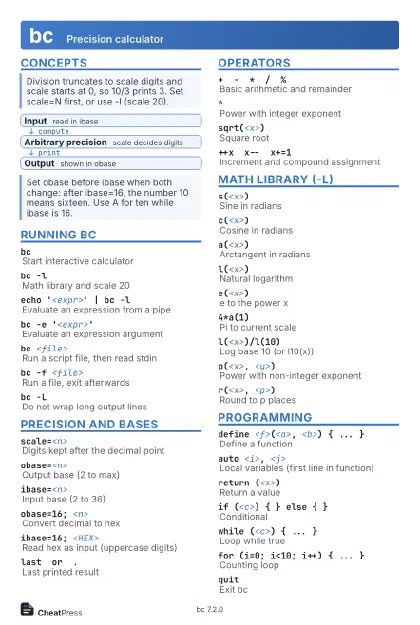 Light · Postcard
102 × 152 mm · PDF
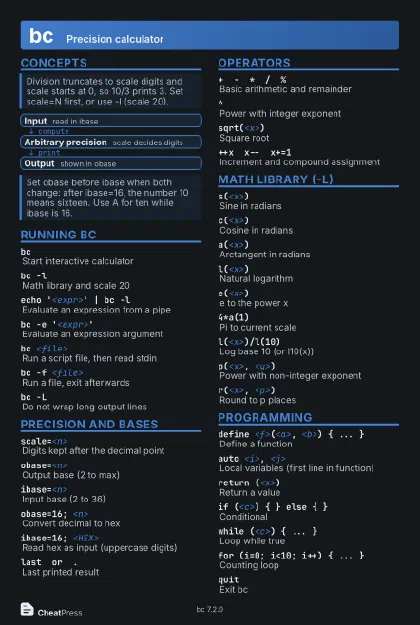 Dark · Postcard
102 × 152 mm · PDF
 Ink saver · Postcard
102 × 152 mm · PDF
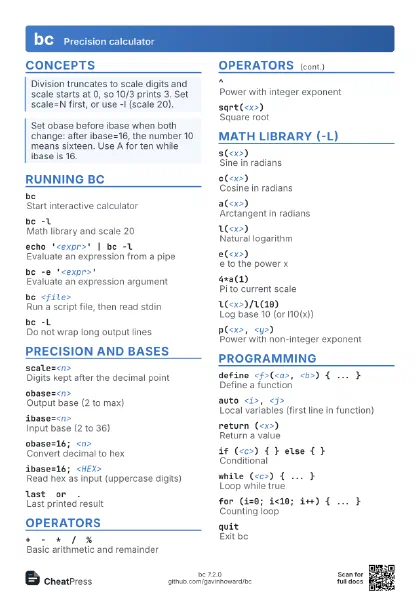
 Light · A4 landscape
297 × 210 mm · PDF
 Dark · A4 landscape
297 × 210 mm · PDF
 Ink saver · A4 landscape
297 × 210 mm · PDF
 Light · A3 landscape
420 × 297 mm · PDF
 Dark · A3 landscape
420 × 297 mm · PDF
 Ink saver · A3 landscape
420 × 297 mm · PDF
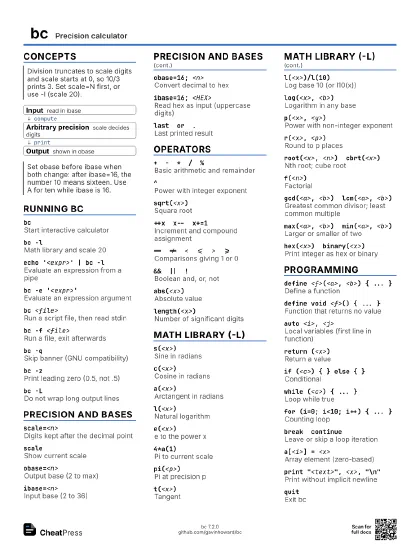
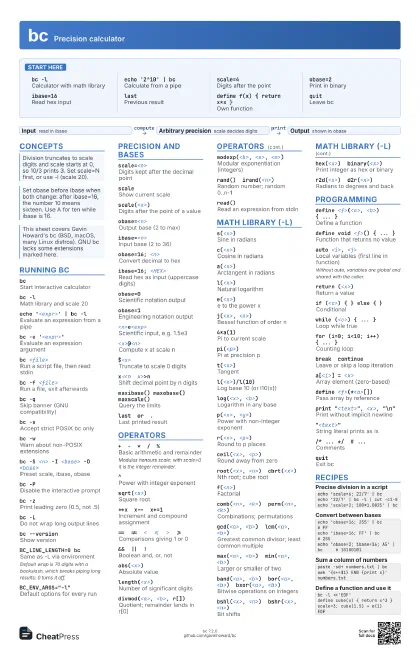
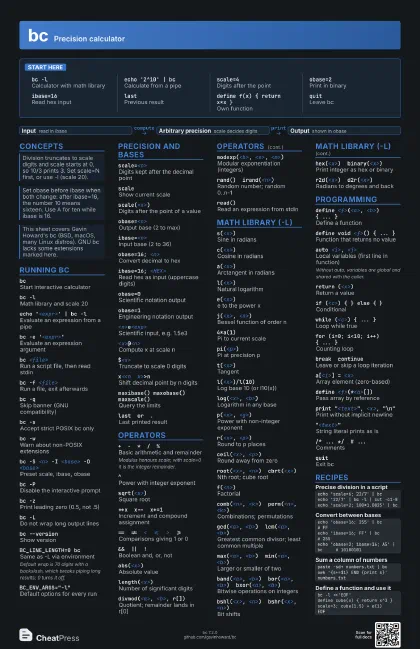
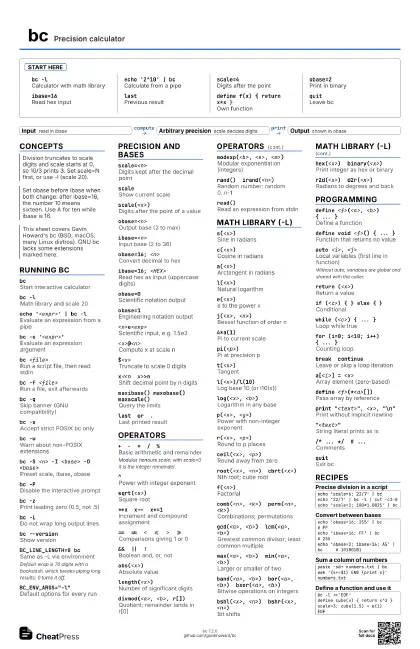
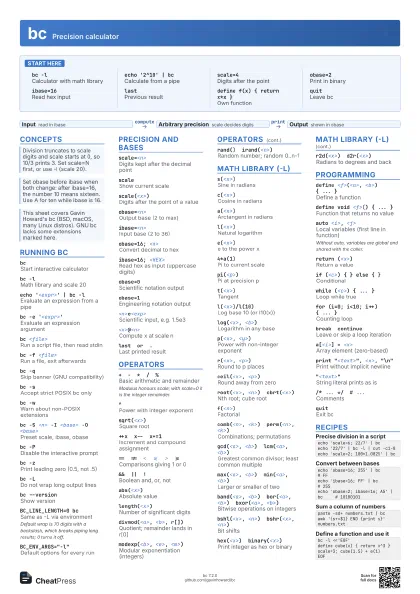
Start here
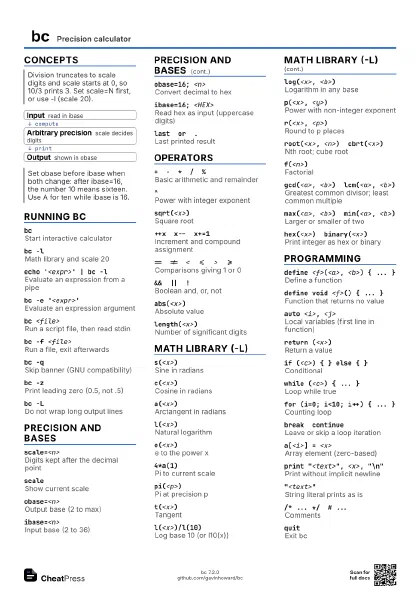
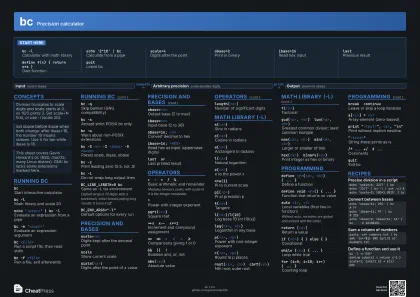
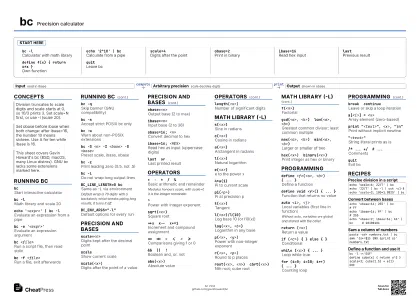
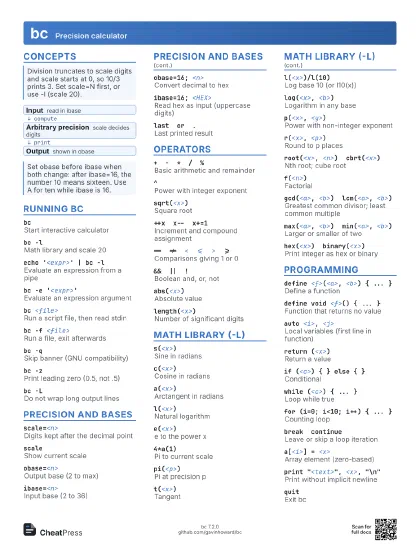
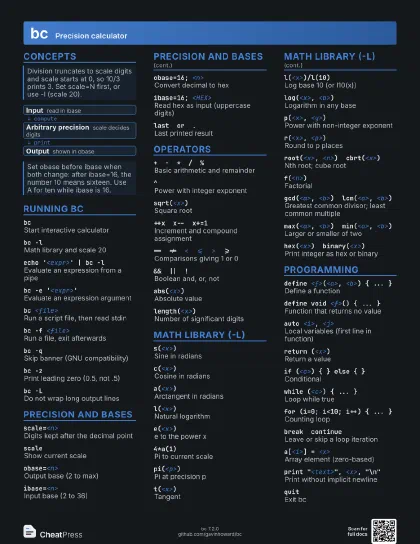
bc -lCalculator with math library
echo '2^10' | bc
Calculate from a pipe
scale=4Digits after the point
obase=2Print in binary
ibase=16Read hex input
lastPrevious result
define f(x) { return x*x }
Own function
quitLeave bc
Concepts
- Input read in ibase
- Arbitrary precision scale decides digits
- Output shown in obase
Running bc
bcStart interactive calculator
bc -lMath library and scale 20
echo '<expr>' | bc -l
Evaluate an expression from a pipe
bc -e '<expr>'
Evaluate an expression argument
bc <file>Run a script file, then read stdin
bc -f <file>
Run a file, exit afterwards
bc -qSkip banner (GNU compatibility)
bc -sAccept strict POSIX bc only
bc -wWarn about non-POSIX extensions
bc -S <n> -I <base> -O <base>
Preset scale, ibase, obase
bc -PDisable the interactive prompt
bc -zPrint leading zero (0.5, not .5)
bc -LDo not wrap long output lines
bc --versionShow version
BC_LINE_LENGTH=0 bc
Same as -L via environment
Default wrap is 70 digits with a backslash, which breaks
piping long results; 0 turns it off.
BC_ENV_ARGS="-l"
Default options for every run
Precision and bases
scale=<n>Digits kept after the decimal point
scaleShow current scale
scale(<x>)
Digits after the point of a value
obase=<n>Output base (2 to max)
ibase=<n>Input base (2 to 36)
obase=16; <n>
Convert decimal to hex
ibase=16; <HEX>
Read hex as input (uppercase digits)
obase=0Scientific notation output
obase=1Engineering notation output
<n>e<exp>
Scientific input, e.g. 1.5e3
<x>@<n>
Compute x at scale n
$<x>Truncate to scale 0 digits
x<<n x>>n
Shift decimal point by n digits
maxibase() maxobase() maxscale()
Query the limits
last or .Last printed result
Operators
+ - * / %Basic arithmetic and remainder
Modulus honours scale; with scale=0 it is the integer
remainder.
^Power with integer exponent
sqrt(<x>)Square root
++x x-- x+=1
Increment and compound assignment
== != < <= > >=
Comparisons giving 1 or 0
&& || !Boolean and, or, not
abs(<x>)Absolute value
length(<x>)
Number of significant digits
divmod(<a>, <b>, r[])
Quotient; remainder lands in r[0]
modexp(<b>, <e>, <m>)
Modular exponentiation (integers)
rand() irand(<n>)
Random number; random 0..n-1
read()Read an expression from stdin
Math library (-l)
s(<x>)Sine in radians
c(<x>)Cosine in radians
a(<x>)Arctangent in radians
l(<x>)Natural logarithm
e(<x>)e to the power x
j(<x>, <n>)
Bessel function of order n
4*a(1)Pi to current scale
pi(<p>)Pi at precision p
t(<x>)Tangent
l(<x>)/l(10)
Log base 10 (or l10(x))
log(<x>, <b>)
Logarithm in any base
p(<x>, <y>)
Power with non-integer exponent
r(<x>, <p>)
Round to p places
ceil(<x>, <p>)
Round away from zero
root(<x>, <n>) cbrt(<x>)
Nth root; cube root
f(<n>)Factorial
comb(<n>, <k>) perm(<n>, <k>)
Combinations; permutations
fib(<n>)Fibonacci number
gcd(<a>, <b>) lcm(<a>, <b>)
Greatest common divisor; least common multiple
max(<a>, <b>) min(<a>, <b>)
Larger or smaller of two
band(<a>, <b>) bor(<a>, <b>)
                    bxor(<a>, <b>)
Bitwise operations on integers
bshl(<x>, <n>) bshr(<x>, <n>)
Bit shifts
hex(<x>) binary(<x>)
Print integer as hex or binary
int8(<x>) uint32(<x>)
Print as signed or unsigned fixed width
r2d(<x>) d2r(<x>)
Radians to degrees and back
Programming
define <f>(<a>, <b>) { ... }
Define a function
define void <f>() { ... }
Function that returns no value
auto <i>, <j>
Local variables (first line in function)
Without auto, variables are global and shared with the caller.
return (<x>)
Return a value
if (<c>) { } else { }
Conditional
while (<c>) { ... }
Loop while true
for (i=0; i<10; i++) { ... }
Counting loop
break continueLeave or skip a loop iteration
a[<i>] = <x>
Array element (zero-based)
define <f>(*<a>[])
Pass array by reference
print "<text>", <x>, "\n"
Print without implicit newline
"<text>"
String literal prints as is
/* ... */ # ...Comments
haltStop at runtime
quitExit bc
limitsPrint implementation limits
Recipes
echo 'scale=6; 22/7' | bcecho '22/7' | bc -l | cut -c1-8echo 'scale=2; 100*1.0825' | bcecho 'obase=16; 255' | bc # FFecho 'ibase=16; FF' | bc # 255echo 'obase=2; ibase=16; A5' | bc # 10100101paste -sd+ numbers.txt | bcawk '{s+=$1} END {print s}' numbers.txtbc -l <<'EOF'define cube(x) { return x^3 }scale=3; cube(1.5) + e(1)EOF