Cheat
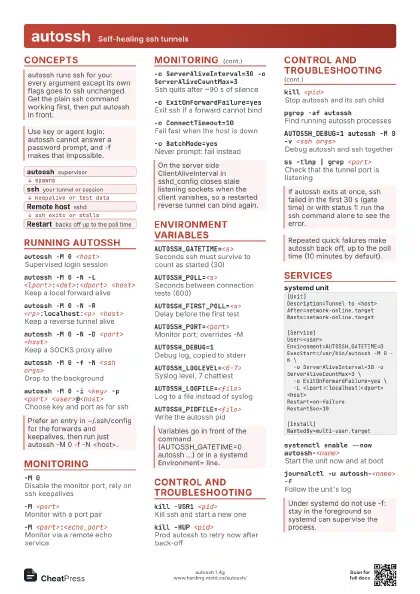
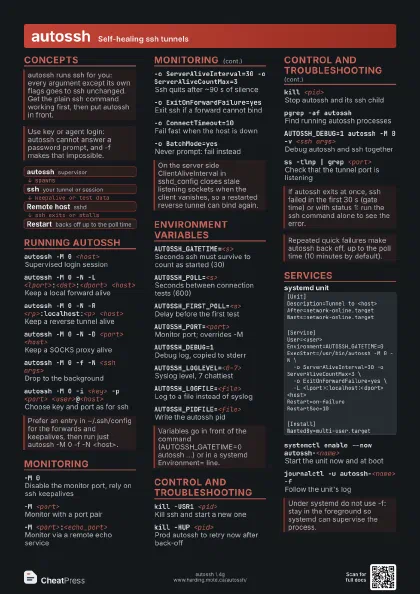
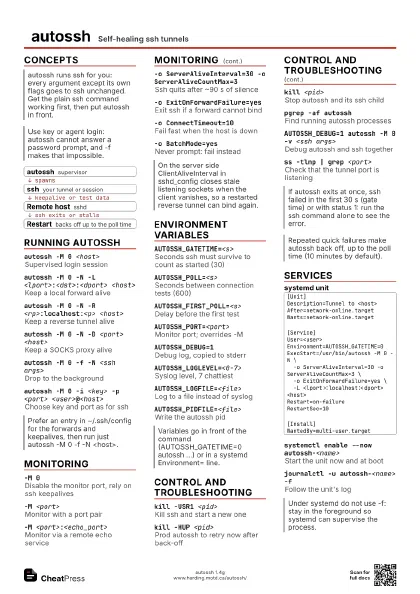
autossh Self-healing ssh tunnels
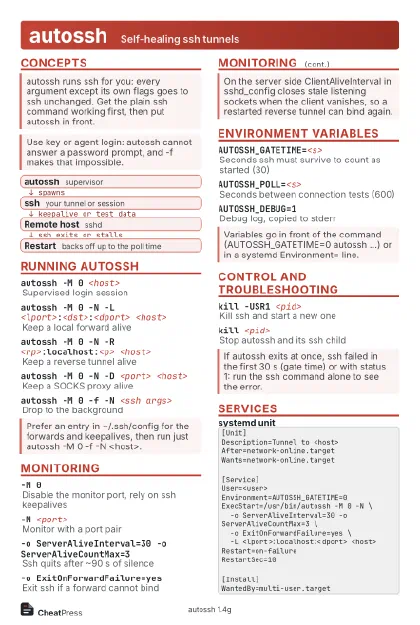 Light · Postcard
102 × 152 mm · PDF
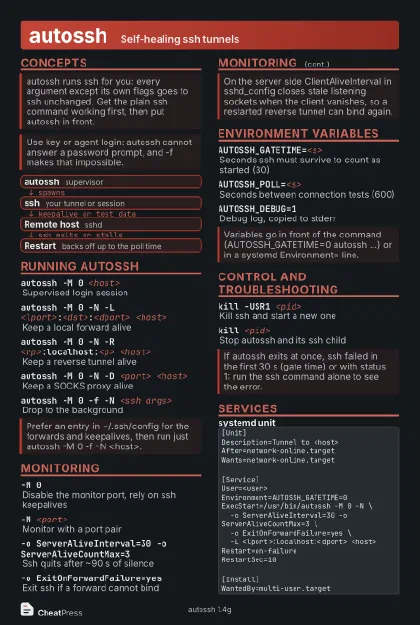 Dark · Postcard
102 × 152 mm · PDF
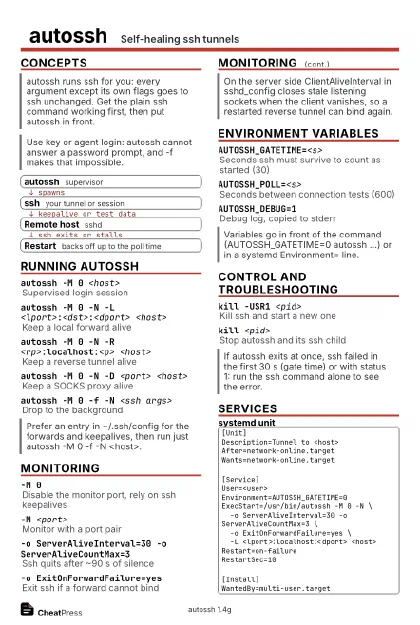 Ink saver · Postcard
102 × 152 mm · PDF
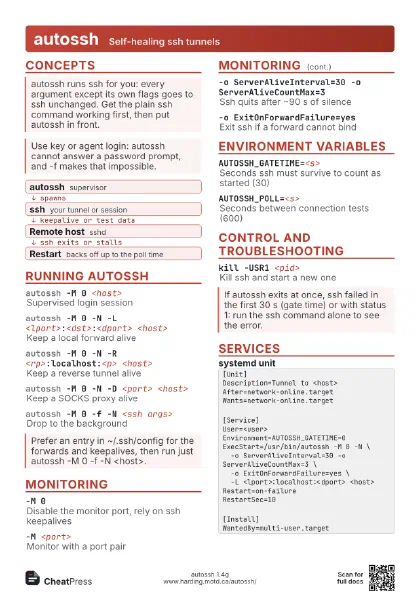
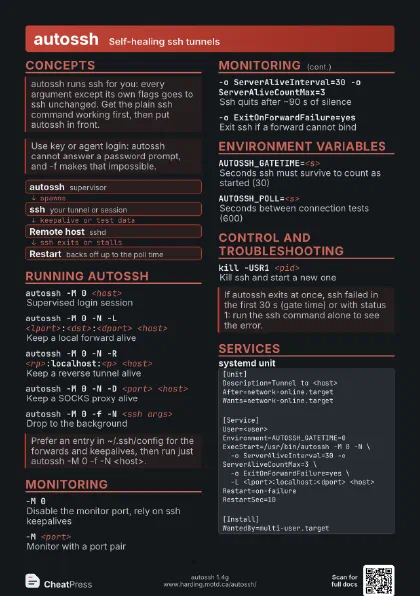
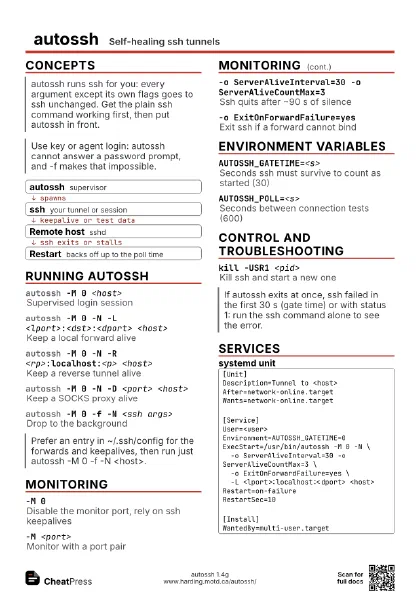
 Light · A4 landscape
297 × 210 mm · PDF
 Dark · A4 landscape
297 × 210 mm · PDF
 Ink saver · A4 landscape
297 × 210 mm · PDF

 Light · A3 landscape
420 × 297 mm · PDF
 Dark · A3 landscape
420 × 297 mm · PDF
 Ink saver · A3 landscape
420 × 297 mm · PDF
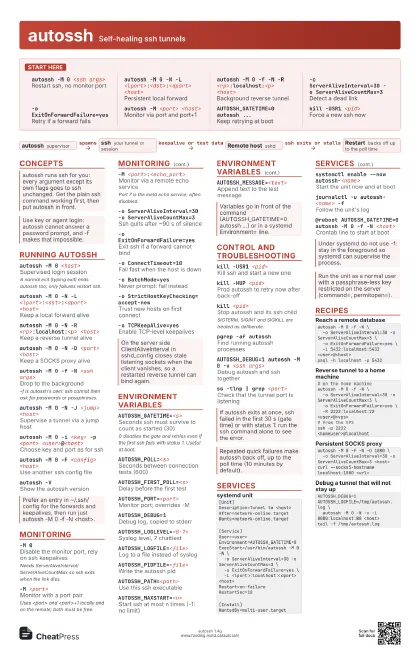

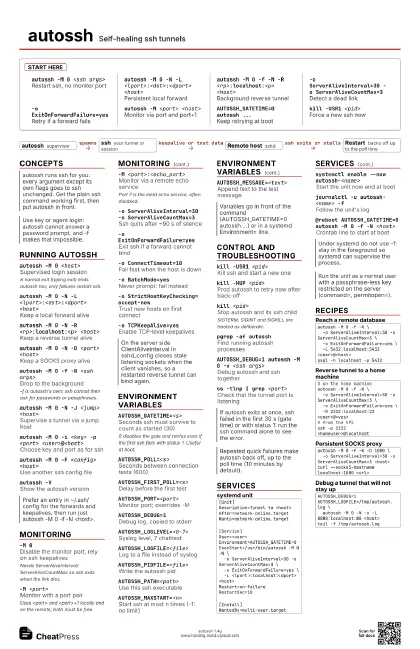
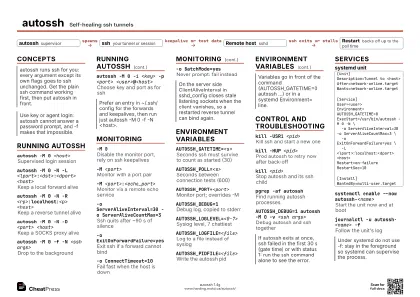
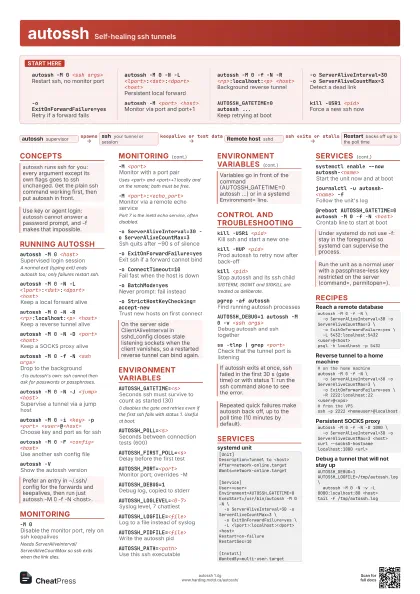
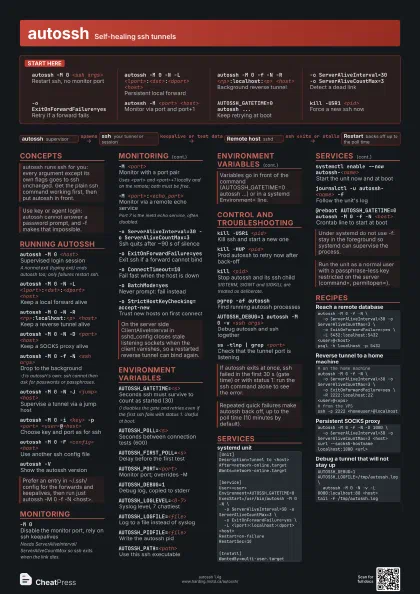
Start here
autossh -M 0 <ssh args>
Restart ssh, no monitor port
autossh -M 0 -N -L <lport>:<dst>:<dport>
                    <host>
Persistent local forward
autossh -M 0 -f -N -R <rp>:localhost:<p>
                    <host>
Background reverse tunnel
-o ServerAliveInterval=30 -o ServerAliveCountMax=3
Detect a dead link
-o ExitOnForwardFailure=yes
Retry if a forward fails
autossh -M <port> <host>
Monitor via port and port+1
AUTOSSH_GATETIME=0 autossh ...
Keep retrying at boot
kill -USR1 <pid>
Force a new ssh now
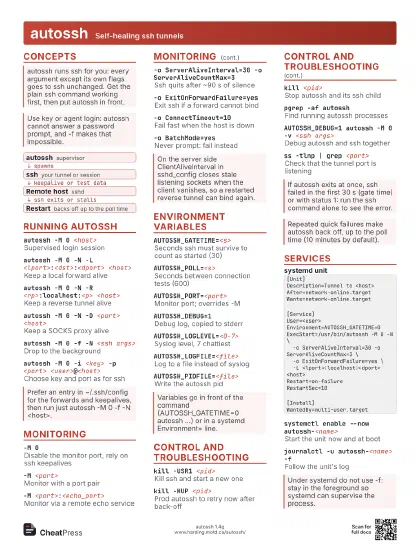
Concepts
- autossh supervisor
- ssh your tunnel or session
- Remote host sshd
- Restart backs off up to the poll time
Running autossh
autossh -M 0 <host>
Supervised login session
A normal exit (typing exit) ends autossh too; only failures
restart ssh.
autossh -M 0 -N -L <lport>:<dst>:<dport>
                    <host>
Keep a local forward alive
autossh -M 0 -N -R <rp>:localhost:<p>
                    <host>
Keep a reverse tunnel alive
autossh -M 0 -N -D <port> <host>
Keep a SOCKS proxy alive
autossh -M 0 -f -N <ssh args>
Drop to the background
-f is autossh's own: ssh cannot then ask for passwords or
passphrases.
autossh -M 0 -N -J <jump> <host>
Supervise a tunnel via a jump host
autossh -M 0 -i <key> -p <port>
                    <user>@<host>
Choose key and port as for ssh
autossh -M 0 -F <config> <host>
Use another ssh config file
autossh -VShow the autossh version
Monitoring
-M 0
Disable the monitor port, rely on ssh keepalives
Needs ServerAliveInterval/ServerAliveCountMax so ssh exits
when the link dies.
-M <port>Monitor with a port pair
Uses <port> and <port>+1 locally and on the
remote; both must be free.
-M <port>:<echo_port>
Monitor via a remote echo service
Port 7 is the inetd echo service, often disabled.
-o ServerAliveInterval=30 -o ServerAliveCountMax=3
Ssh quits after ~90 s of silence
-o ExitOnForwardFailure=yes
Exit ssh if a forward cannot bind
-o ConnectTimeout=10
Fail fast when the host is down
-o BatchMode=yes
Never prompt: fail instead
-o StrictHostKeyChecking=accept-new
Trust new hosts on first connect
-o TCPKeepAlive=yes
Enable TCP-level keepalives
Environment variables
AUTOSSH_GATETIME=<s>
Seconds ssh must survive to count as started (30)
0 disables the gate and retries even if the first ssh fails
with status 1. Useful at boot.
AUTOSSH_POLL=<s>
Seconds between connection tests (600)
AUTOSSH_FIRST_POLL=<s>
Delay before the first test
AUTOSSH_PORT=<port>
Monitor port; overrides -M
AUTOSSH_DEBUG=1Debug log, copied to stderr
AUTOSSH_LOGLEVEL=<0-7>
Syslog level, 7 chattiest
AUTOSSH_LOGFILE=<file>
Log to a file instead of syslog
AUTOSSH_PIDFILE=<file>
Write the autossh pid
AUTOSSH_PATH=<path>
Use this ssh executable
AUTOSSH_MAXSTART=<n>
Start ssh at most n times (-1: no limit)
AUTOSSH_MAXLIFETIME=<s>
Stop everything after this many seconds
AUTOSSH_MESSAGE=<text>
Append text to the test message
Control and troubleshooting
kill -USR1 <pid>
Kill ssh and start a new one
kill -HUP <pid>
Prod autossh to retry now after back-off
kill <pid>
Stop autossh and its ssh child
SIGTERM, SIGINT and SIGKILL are treated as deliberate.
pgrep -af autossh
Find running autossh processes
AUTOSSH_DEBUG=1 autossh -M 0 -v <ssh args>
Debug autossh and ssh together
ss -tlnp | grep <port>
Check that the tunnel port is listening
Services
[Unit]Description=Tunnel to <host>After=network-online.targetWants=network-online.target[Service]User=<user>Environment=AUTOSSH_GATETIME=0ExecStart=/usr/bin/autossh -M 0 -N \ -o ServerAliveInterval=30 -o ServerAliveCountMax=3 \ -o ExitOnForwardFailure=yes \ -L <lport>:localhost:<dport> <host>Restart=on-failureRestartSec=10[Install]WantedBy=multi-user.targetsystemctl enable --now autossh-<name>
Start the unit now and at boot
journalctl -u autossh-<name> -f
Follow the unit's log
@reboot AUTOSSH_GATETIME=0 autossh -M 0 -f -N
                    <host>
Crontab line to start at boot
Recipes
autossh -M 0 -f -N \ -o ServerAliveInterval=30 -o ServerAliveCountMax=3 \ -o ExitOnForwardFailure=yes \ -L 5432:localhost:5432 <user>@<host>psql -h localhost -p 5432# on the home machineautossh -M 0 -f -N \ -o ServerAliveInterval=30 -o ServerAliveCountMax=3 \ -o ExitOnForwardFailure=yes \ -R 2222:localhost:22 <user>@<vps># from the VPSssh -p 2222 <homeuser>@localhostautossh -M 0 -f -N -D 1080 \ -o ServerAliveInterval=30 -o ServerAliveCountMax=3 <host>curl --socks5-hostname localhost:1080 <url>AUTOSSH_DEBUG=1 AUTOSSH_LOGFILE=/tmp/autossh.log \ autossh -M 0 -N -v -L 8080:localhost:80 <host>tail -f /tmp/autossh.log