Cheat
Jest JavaScript test runner
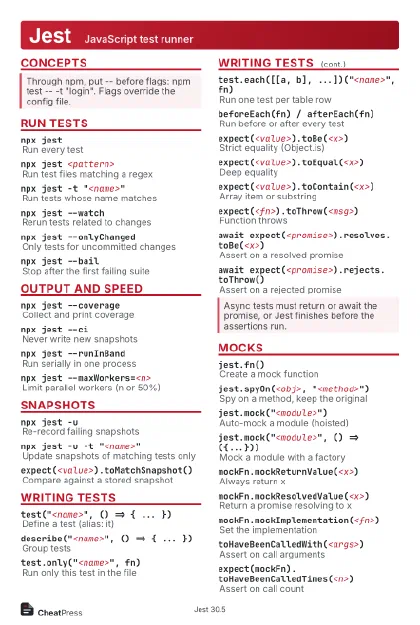 Light · Postcard
102 × 152 mm · PDF
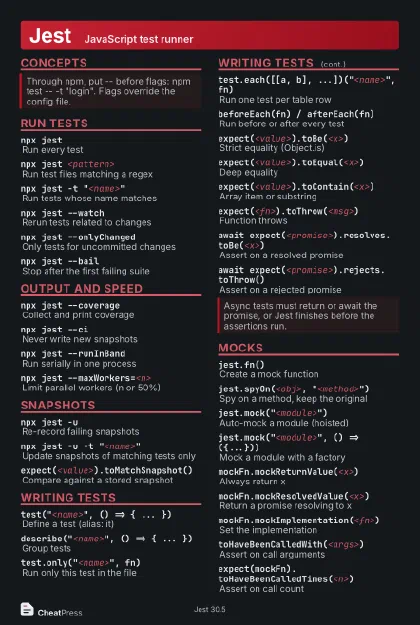 Dark · Postcard
102 × 152 mm · PDF
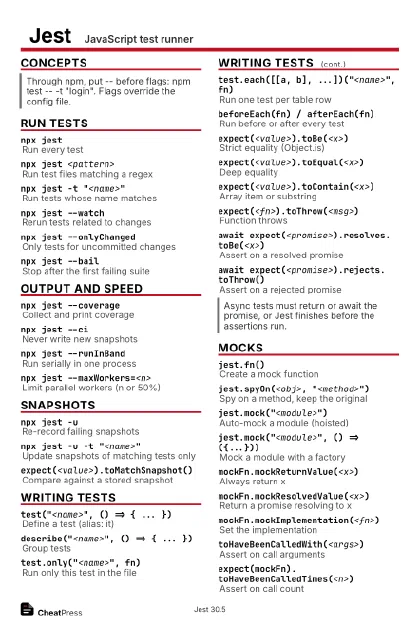 Ink saver · Postcard
102 × 152 mm · PDF
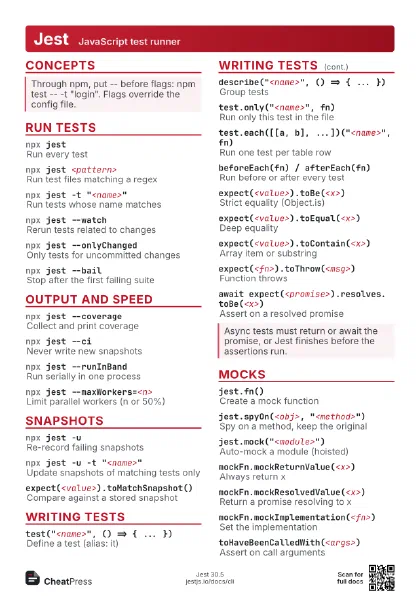
 Light · A4 landscape
297 × 210 mm · PDF
 Dark · A4 landscape
297 × 210 mm · PDF
 Ink saver · A4 landscape
297 × 210 mm · PDF
 Light · A3 landscape
420 × 297 mm · PDF
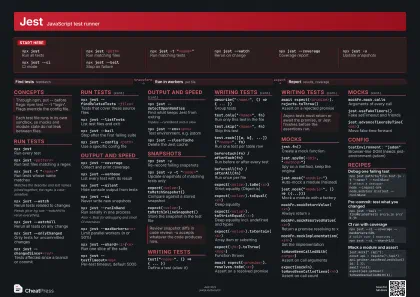 Dark · A3 landscape
420 × 297 mm · PDF
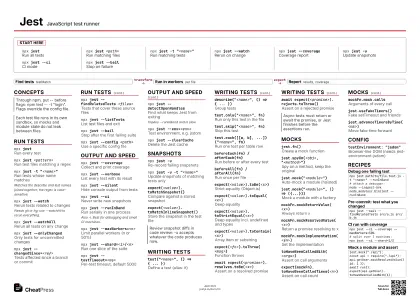 Ink saver · A3 landscape
420 × 297 mm · PDF
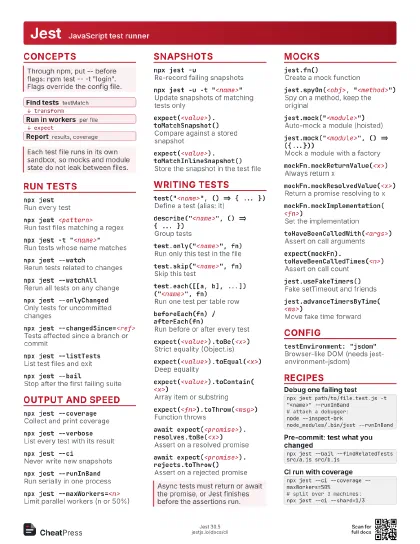
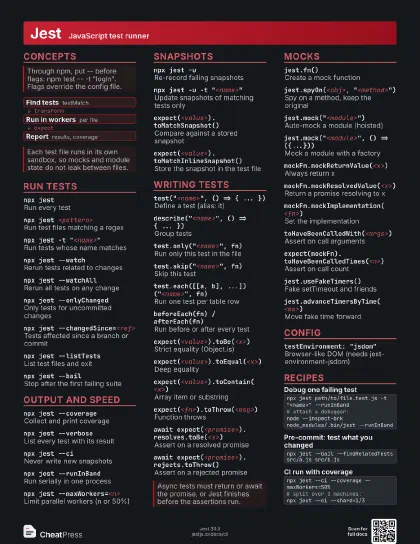
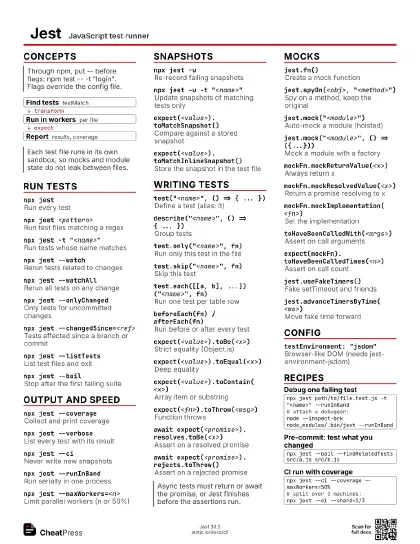
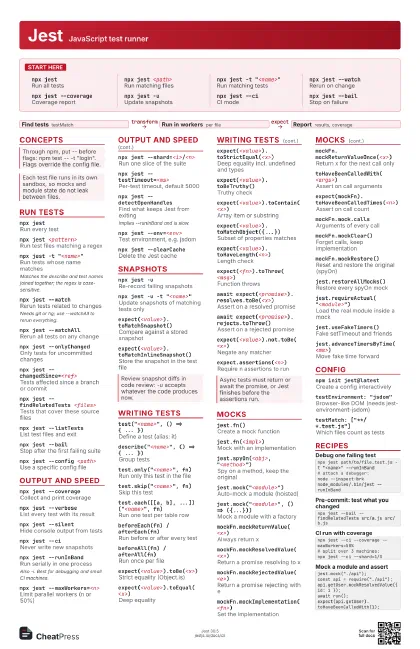
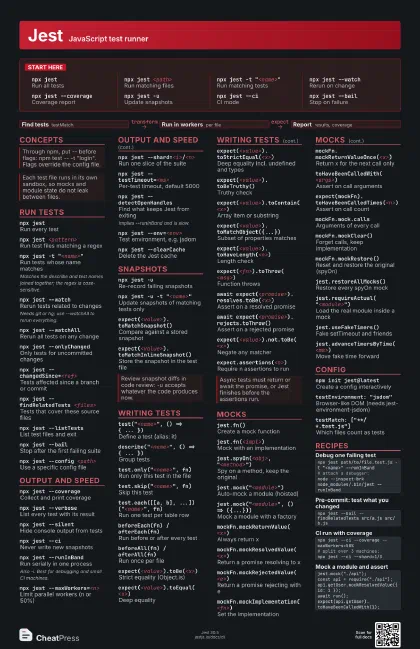
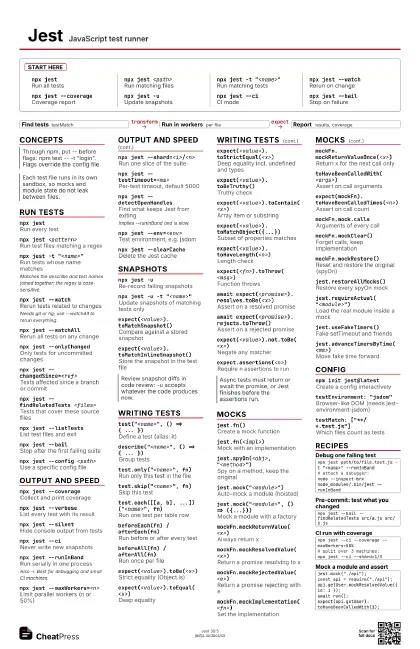
Start here
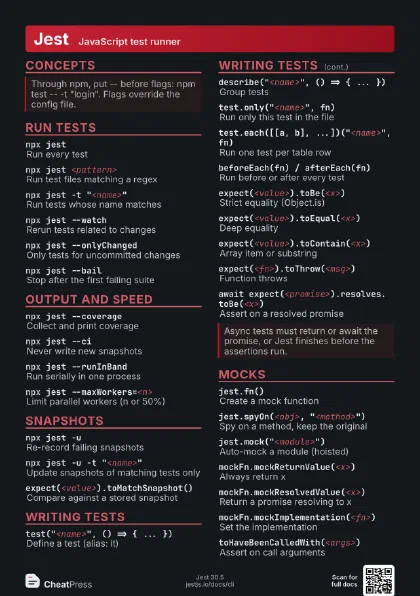
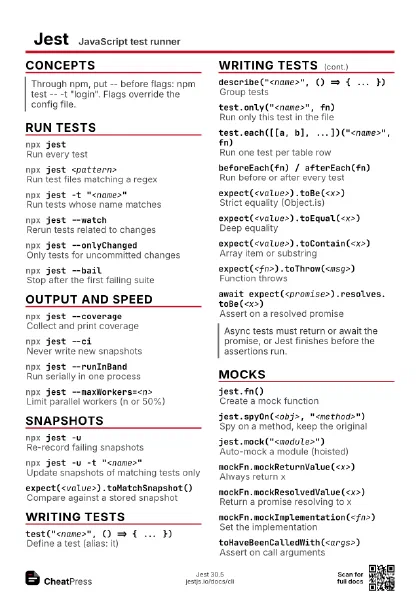
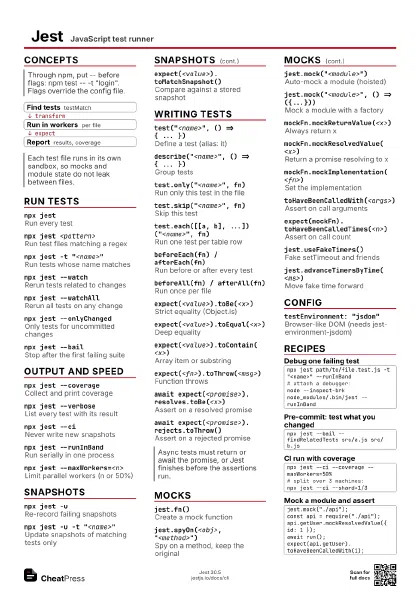
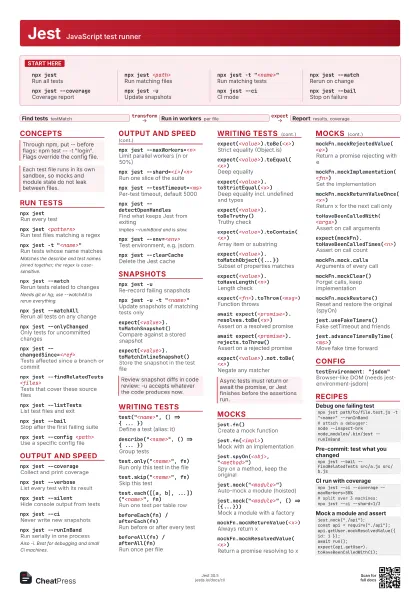
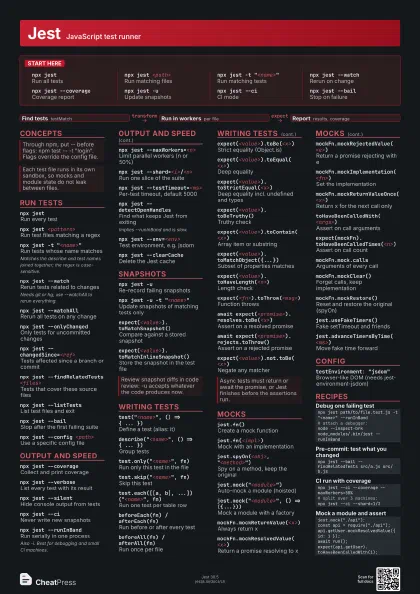
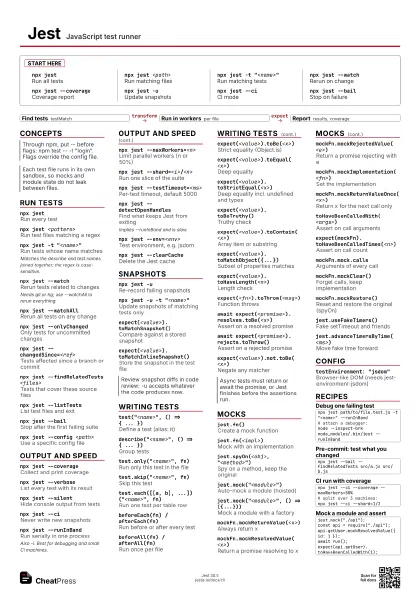
npx jestRun all tests
npx jest <path>
Run matching files
npx jest -t "<name>"
Run matching tests
npx jest --watch
Rerun on change
npx jest --coverage
Coverage report
npx jest -uUpdate snapshots
npx jest --ciCI mode
npx jest --bailStop on failure
Concepts
- Find tests testMatch
- Run in workers per file
- Report results, coverage
Run tests
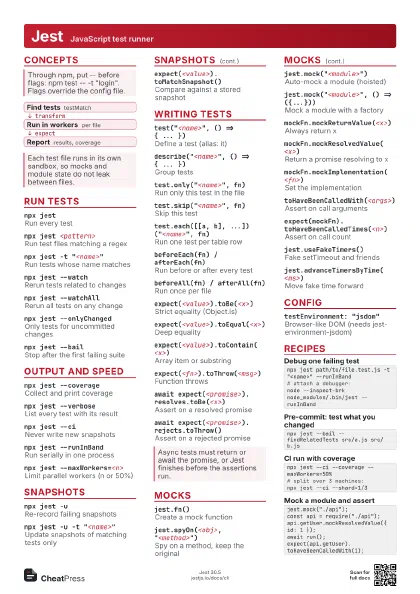
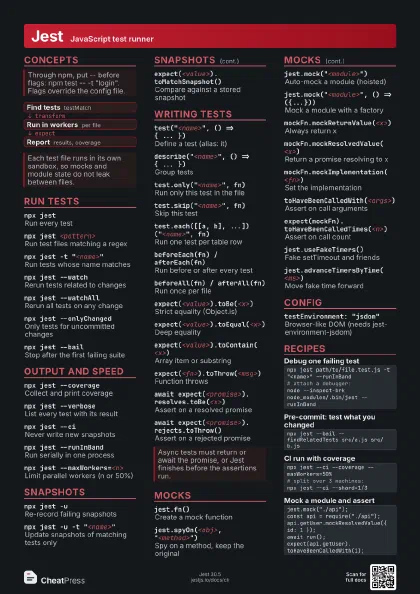
npx jestRun every test
npx jest <pattern>
Run test files matching a regex
npx jest -t "<name>"
Run tests whose name matches
Matches the describe and test names joined together; the regex
is case-sensitive.
npx jest --watch
Rerun tests related to changes
Needs git or hg; use --watchAll to rerun everything.
npx jest --watchAll
Rerun all tests on any change
npx jest --onlyChanged
Only tests for uncommitted changes
npx jest --changedSince=<ref>
Tests affected since a branch or commit
npx jest --findRelatedTests <files>
Tests that cover these source files
npx jest --lastCommit
Tests affected by the last commit
npx jest --listTests
List test files and exit
npx jest --bailStop after the first failing suite
npx jest --config <path>
Use a specific config file
npx jest --testPathPatterns <regex>
Filter files by path regex
Plural since Jest 30; older versions used --testPathPattern.
Output and speed
npx jest --coverage
Collect and print coverage
npx jest --verbose
List every test with its result
npx jest --silent
Hide console output from tests
npx jest --ciNever write new snapshots
npx jest --runInBand
Run serially in one process
Also -i. Best for debugging and small CI machines.
npx jest --maxWorkers=<n>
Limit parallel workers (n or 50%)
npx jest --shard=<i>/<n>
Run one slice of the suite
npx jest --json --outputFile=<file>
Write results as JSON
npx jest --testTimeout=<ms>
Per-test timeout, default 5000
npx jest --detectOpenHandles
Find what keeps Jest from exiting
Implies --runInBand and is slow.
npx jest --forceExit
Exit even with open handles
npx jest --env=<env>
Test environment, e.g. jsdom
npx jest --clearCache
Delete the Jest cache
npx jest --no-cache
Skip the cache for this run
Snapshots
npx jest -uRe-record failing snapshots
npx jest -u -t "<name>"
Update snapshots of matching tests only
expect(<value>).toMatchSnapshot()
Compare against a stored snapshot
expect(<value>).toMatchInlineSnapshot()
Store the snapshot in the test file
Writing tests
test("<name>", () => { ... })
Define a test (alias: it)
describe("<name>", () => { ... })
Group tests
test.only("<name>", fn)
Run only this test in the file
test.skip("<name>", fn)
Skip this test
test.each([[a, b], ...])("<name>", fn)
Run one test per table row
test.todo("<name>")
Note a test to write later
beforeEach(fn) / afterEach(fn)
Run before or after every test
beforeAll(fn) / afterAll(fn)
Run once per file
expect(<value>).toBe(<x>)
Strict equality (Object.is)
expect(<value>).toEqual(<x>)
Deep equality
expect(<value>).toStrictEqual(<x>)
Deep equality incl. undefined and types
expect(<value>).toBeTruthy()
Truthy check
expect(<value>).toContain(<x>)
Array item or substring
expect(<value>).toMatchObject({...})
Subset of properties matches
expect(<value>).toHaveLength(<n>)
Length check
expect(<fn>).toThrow(<msg>)
Function throws
await
                    expect(<promise>).resolves.toBe(<x>)
Assert on a resolved promise
await expect(<promise>).rejects.toThrow()
Assert on a rejected promise
expect(<value>).not.toBe(<x>)
Negate any matcher
expect.assertions(<n>)
Require n assertions to run
Mocks
jest.fn()Create a mock function
jest.fn(<impl>)
Mock with an implementation
jest.spyOn(<obj>, "<method>")
Spy on a method, keep the original
jest.mock("<module>")
Auto-mock a module (hoisted)
jest.mock("<module>", () => ({...}))
Mock a module with a factory
mockFn.mockReturnValue(<x>)
Always return x
mockFn.mockResolvedValue(<x>)
Return a promise resolving to x
mockFn.mockRejectedValue(<e>)
Return a promise rejecting with e
mockFn.mockImplementation(<fn>)
Set the implementation
mockFn.mockReturnValueOnce(<x>)
Return x for the next call only
toHaveBeenCalledWith(<args>)
Assert on call arguments
expect(mockFn).toHaveBeenCalledTimes(<n>)
Assert on call count
mockFn.mock.calls
Arguments of every call
mockFn.mockClear()
Forget calls, keep implementation
mockFn.mockReset()
Forget calls and implementation
mockFn.mockRestore()
Reset and restore the original (spyOn)
jest.resetAllMocks()
Reset every mock
jest.restoreAllMocks()
Restore every spyOn mock
jest.requireActual("<module>")
Load the real module inside a mock
jest.useFakeTimers()
Fake setTimeout and friends
jest.advanceTimersByTime(<ms>)
Move fake time forward
jest.runAllTimers()
Run all pending timers
jest.useRealTimers()
Switch back to real timers
Config
npm init jest@latest
Create a config interactively
testEnvironment: "jsdom"
Browser-like DOM (needs jest-environment-jsdom)
testMatch: ["**/*.test.js"]
Which files count as tests
transform: {...}
Compile files, e.g. babel-jest or ts-jest
moduleNameMapper: {...}
Map import aliases or stub assets
setupFilesAfterEnv: ["<file>"]
Run setup code before each test file
collectCoverageFrom: ["src/**"]
Files counted in coverage
coverageThreshold: {...}
Fail the run below a coverage floor
clearMocks: true
Clear mock calls before every test
testPathIgnorePatterns: [...]
Paths Jest never looks at
Recipes
npx jest path/to/file.test.js -t "<name>" --runInBand# attach a debugger:node --inspect-brk node_modules/.bin/jest --runInBandnpx jest --bail --findRelatedTests src/a.js src/b.jsnpx jest --ci --coverage --maxWorkers=50%# split over 3 machines:npx jest --ci --shard=1/3jest.mock("./api");const api = require("./api");api.getUser.mockResolvedValue({ id: 1 });await run();expect(api.getUser).toHaveBeenCalledWith(1);