Cheat
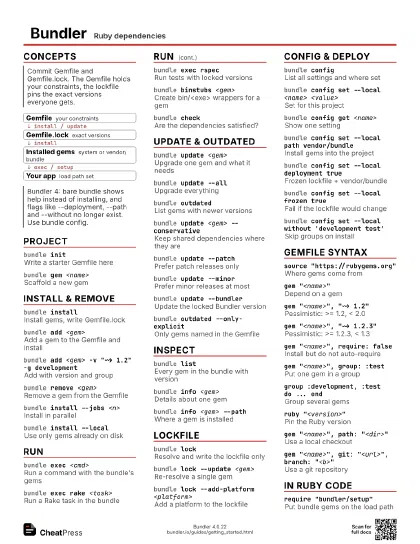
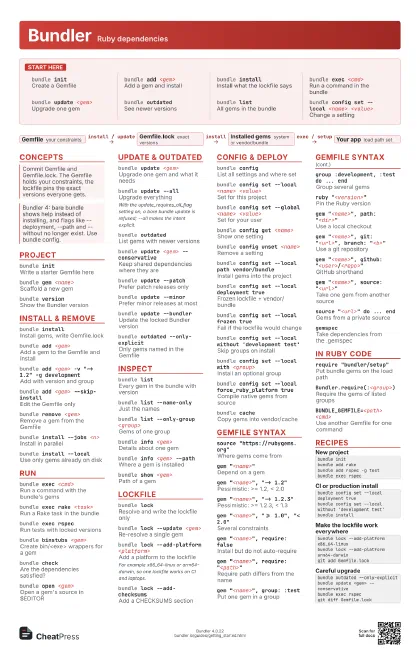
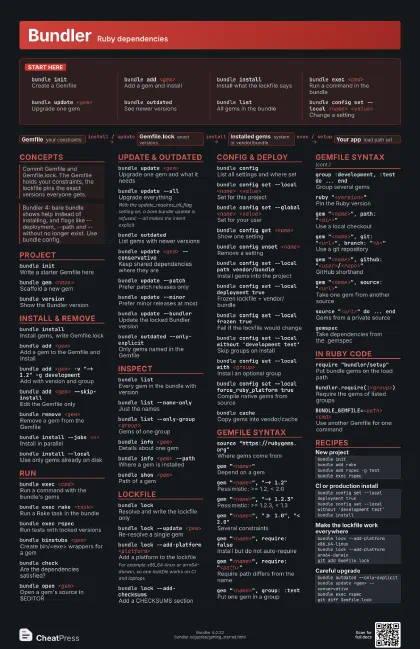
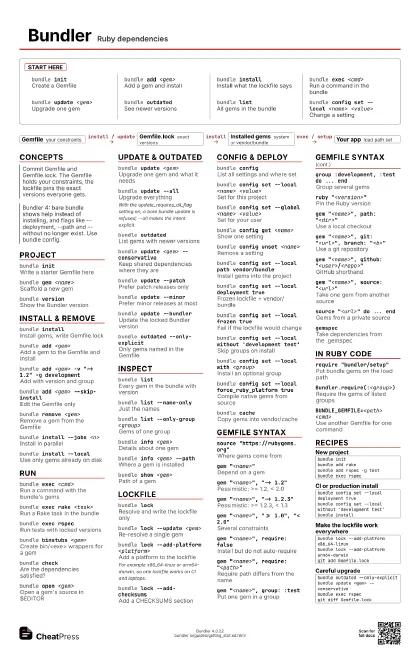
Bundler Ruby dependencies
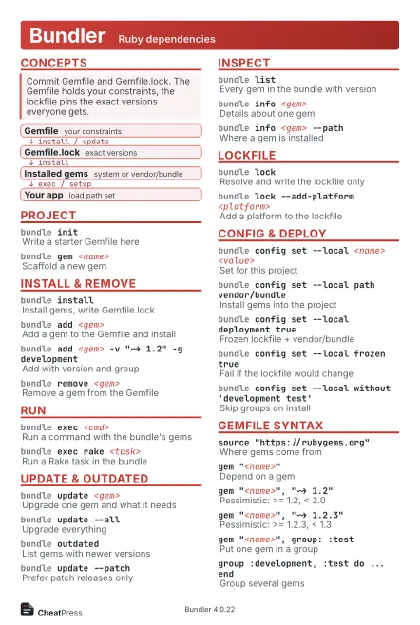 Light · Postcard
102 × 152 mm · PDF
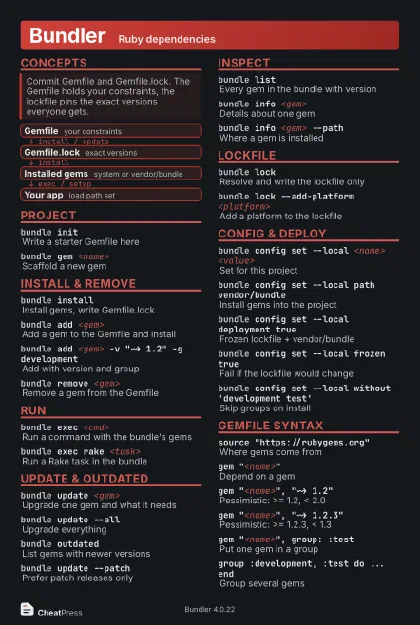 Dark · Postcard
102 × 152 mm · PDF
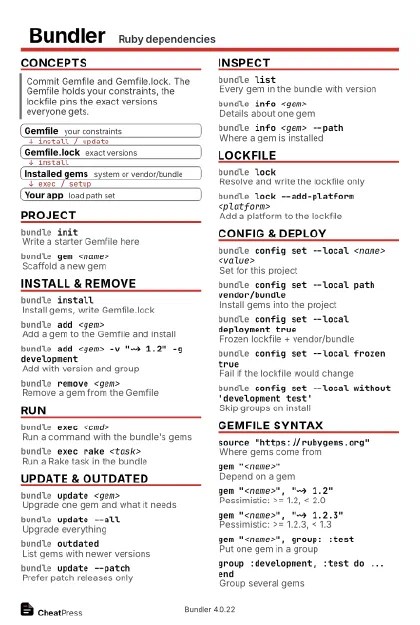 Ink saver · Postcard
102 × 152 mm · PDF
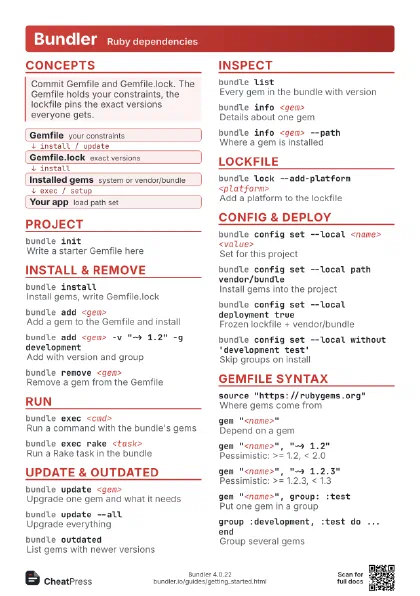
 Light · A4 landscape
297 × 210 mm · PDF
 Dark · A4 landscape
297 × 210 mm · PDF
 Ink saver · A4 landscape
297 × 210 mm · PDF
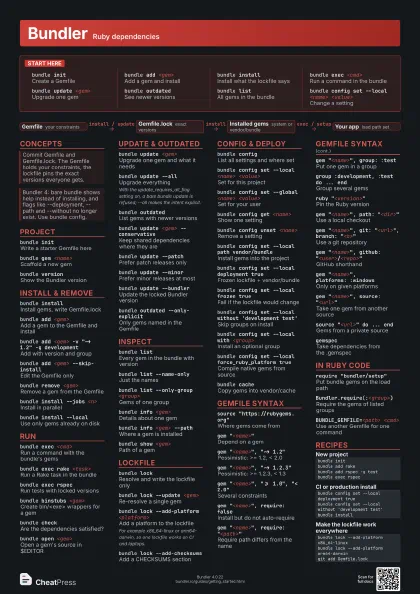
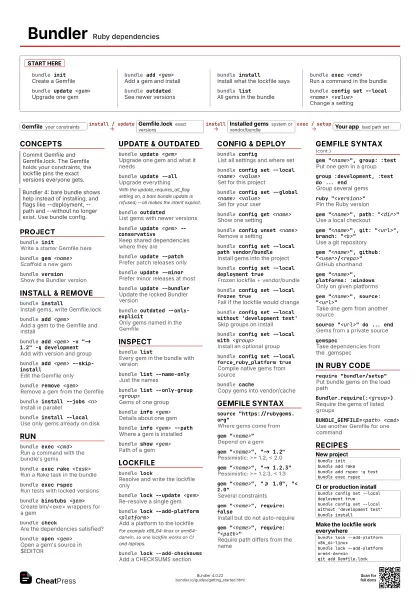
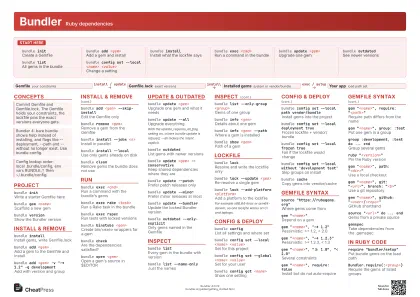 Light · A3 landscape
420 × 297 mm · PDF
 Dark · A3 landscape
420 × 297 mm · PDF
 Ink saver · A3 landscape
420 × 297 mm · PDF
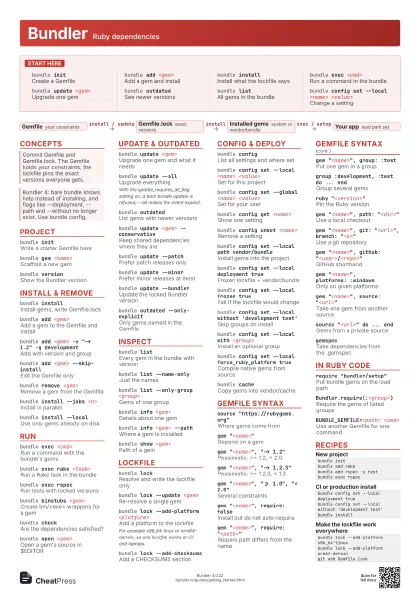
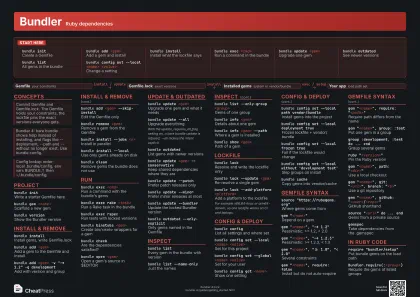
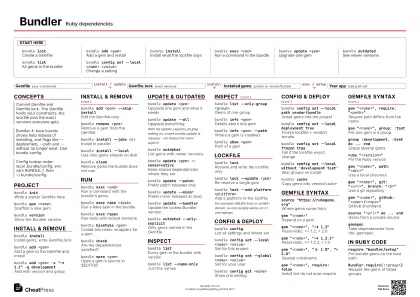
Start here
bundle initCreate a Gemfile
bundle add <gem>
Add a gem and install
bundle installInstall what the lockfile says
bundle exec <cmd>
Run a command in the bundle
bundle update <gem>
Upgrade one gem
bundle outdatedSee newer versions
bundle listAll gems in the bundle
bundle config set --local <name> <value>
Change a setting
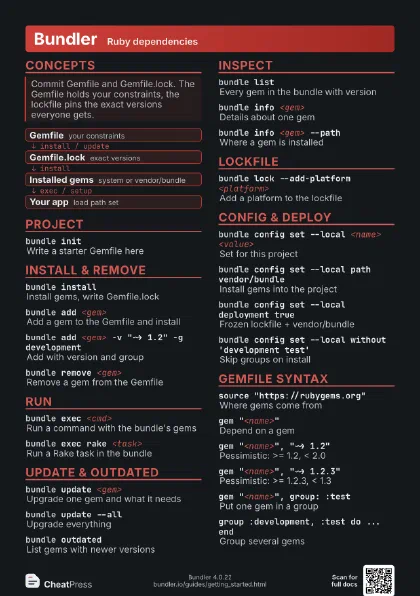
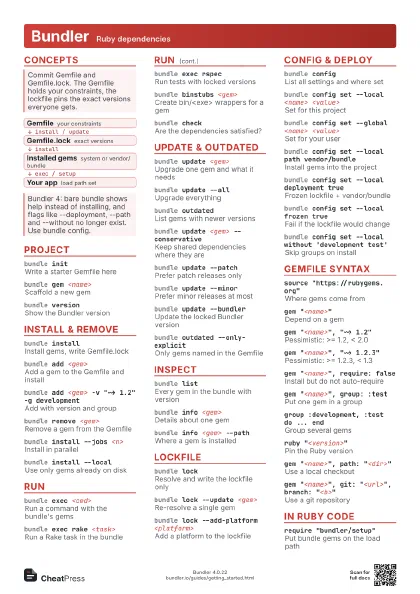
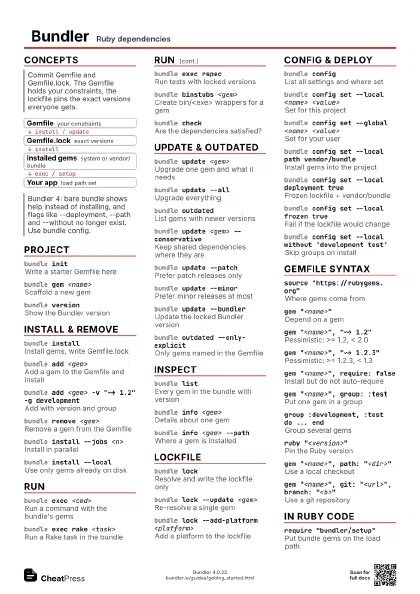
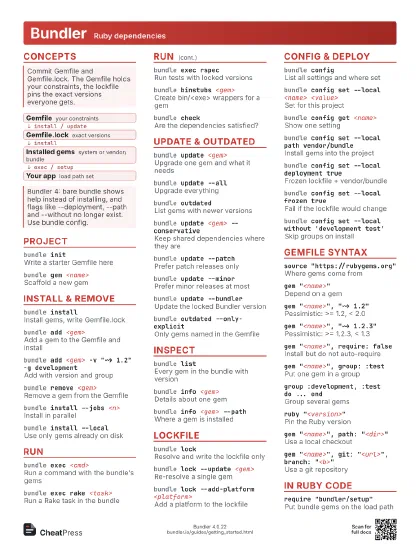
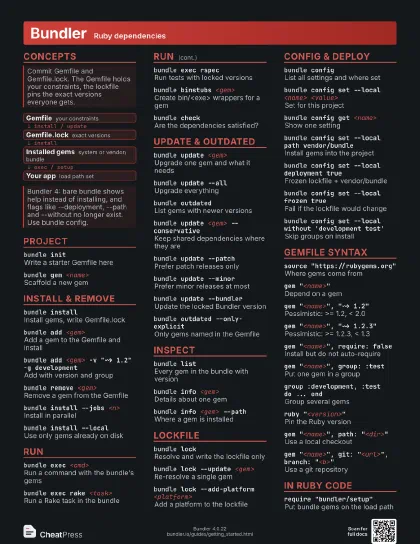
Concepts
- Gemfile your constraints
- Gemfile.lock exact versions
- Installed gems system or vendor/bundle
- Your app load path set
Project
bundle initWrite a starter Gemfile here
bundle gem <name>
Scaffold a new gem
bundle versionShow the Bundler version
Install & remove
bundle installInstall gems, write Gemfile.lock
bundle add <gem>
Add a gem to the Gemfile and install
bundle add <gem> -v "~> 1.2" -g
                    development
Add with version and group
bundle add <gem> --skip-install
Edit the Gemfile only
bundle remove <gem>
Remove a gem from the Gemfile
bundle install --jobs <n>
Install in parallel
bundle install --local
Use only gems already on disk
bundle cleanRemove gems the bundle does not use
Run
bundle exec <cmd>
Run a command with the bundle's gems
bundle exec rake <task>
Run a Rake task in the bundle
bundle exec rspec
Run tests with locked versions
bundle binstubs <gem>
Create bin/<exe> wrappers for a gem
bundle checkAre the dependencies satisfied?
bundle open <gem>
Open a gem's source in $EDITOR
Update & outdated
bundle update <gem>
Upgrade one gem and what it needs
bundle update --all
Upgrade everything
With the update_requires_all_flag setting on, a bare bundle
update is refused; --all makes the intent explicit.
bundle outdatedList gems with newer versions
bundle update <gem> --conservative
Keep shared dependencies where they are
bundle update --patch
Prefer patch releases only
bundle update --minor
Prefer minor releases at most
bundle update --bundler
Update the locked Bundler version
bundle outdated --only-explicit
Only gems named in the Gemfile
Inspect
bundle listEvery gem in the bundle with version
bundle list --name-only
Just the names
bundle list --only-group <group>
Gems of one group
bundle list --format=json
Machine-readable list
bundle info <gem>
Details about one gem
bundle info <gem> --path
Where a gem is installed
bundle show <gem>
Path of a gem
bundle platformRuby and platform compatibility
Lockfile
bundle lockResolve and write the lockfile only
bundle lock --update <gem>
Re-resolve a single gem
bundle lock --add-platform <platform>
Add a platform to the lockfile
For example x86_64-linux or arm64-darwin, so one lockfile
works on CI and laptops.
bundle lock --add-checksums
Add a CHECKSUMS section
Config & deploy
bundle configList all settings and where set
bundle config set --local <name> <value>
Set for this project
bundle config set --global <name> <value>
Set for your user
bundle config get <name>
Show one setting
bundle config unset <name>
Remove a setting
bundle config set --local path vendor/bundle
Install gems into the project
bundle config set --local deployment true
Frozen lockfile + vendor/bundle
bundle config set --local frozen true
Fail if the lockfile would change
bundle config set --local without 'development
                    test'
Skip groups on install
bundle config set --local with <group>
Install an optional group
bundle config set --local jobs <n>
Parallel installs by default
bundle config set --local force_ruby_platform true
Compile native gems from source
bundle cacheCopy gems into vendor/cache
Gemfile syntax
source "https://rubygems.org"
Where gems come from
gem "<name>"
Depend on a gem
gem "<name>", "~> 1.2"
Pessimistic: >= 1.2, < 2.0
gem "<name>", "~> 1.2.3"
Pessimistic: >= 1.2.3, < 1.3
gem "<name>", ">= 1.0", "<
                    2.0"
Several constraints
gem "<name>", require: false
Install but do not auto-require
gem "<name>", require:
                    "<path>"
Require path differs from the name
gem "<name>", group: :test
Put one gem in a group
group :development, :test do ... end
Group several gems
ruby "<version>"
Pin the Ruby version
gem "<name>", path:
                    "<dir>"
Use a local checkout
gem "<name>", git: "<url>",
                    branch: "<b>"
Use a git repository
gem "<name>", github:
                    "<user>/<repo>"
GitHub shorthand
gem "<name>", platforms: :windows
Only on given platforms
gem "<name>", source:
                    "<url>"
Take one gem from another source
source "<url>" do ... end
Gems from a private source
gemspecTake dependencies from the .gemspec
In Ruby code
require "bundler/setup"
Put bundle gems on the load path
Bundler.require(:<group>)
Require the gems of listed groups
BUNDLE_GEMFILE=<path> <cmd>
Use another Gemfile for one command
Recipes
bundle initbundle add rakebundle add rspec -g testbundle exec rspecbundle config set --local deployment truebundle config set --local without 'development test'bundle installbundle lock --add-platform x86_64-linuxbundle lock --add-platform arm64-darwingit add Gemfile.lockbundle outdated --only-explicitbundle update <gem> --conservativebundle exec rspecgit diff Gemfile.lock