Cheat
Swift Compiled language and SwiftPM
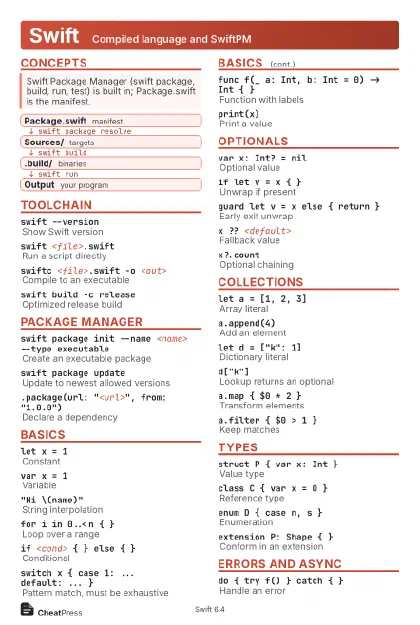 Light · Postcard
102 × 152 mm · PDF
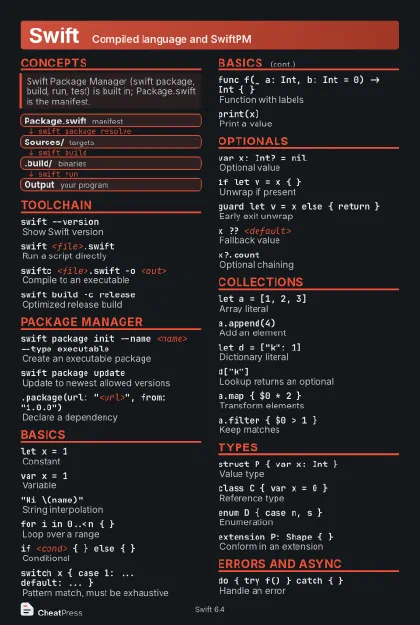 Dark · Postcard
102 × 152 mm · PDF
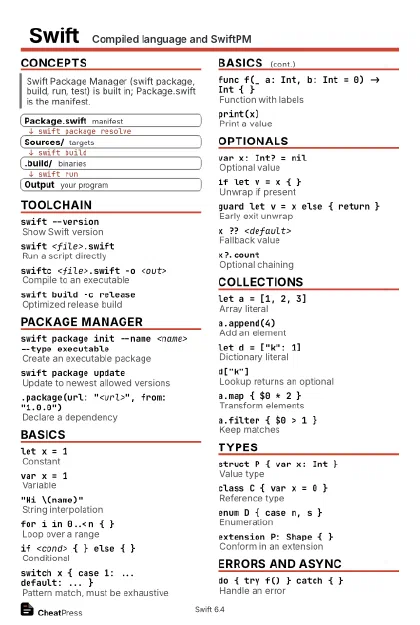 Ink saver · Postcard
102 × 152 mm · PDF
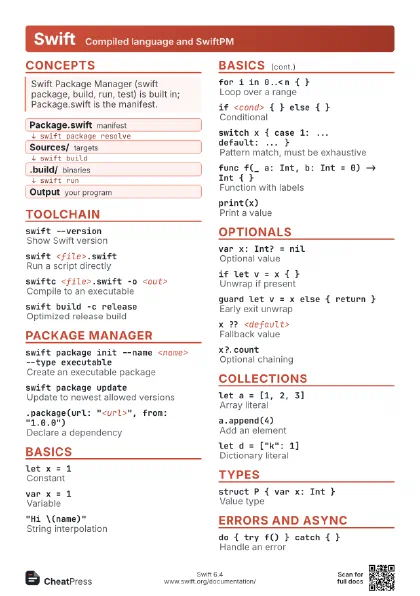
 Light · A4 landscape
297 × 210 mm · PDF
 Dark · A4 landscape
297 × 210 mm · PDF
 Ink saver · A4 landscape
297 × 210 mm · PDF
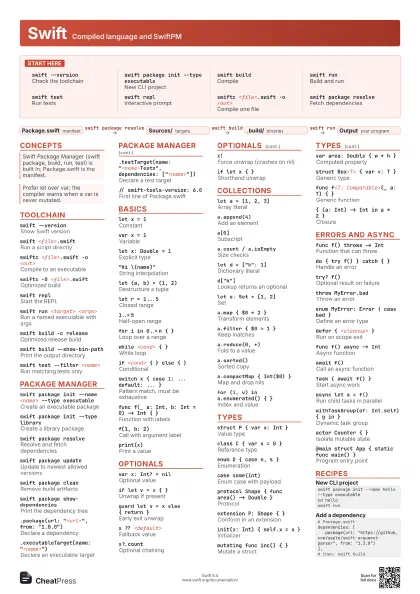
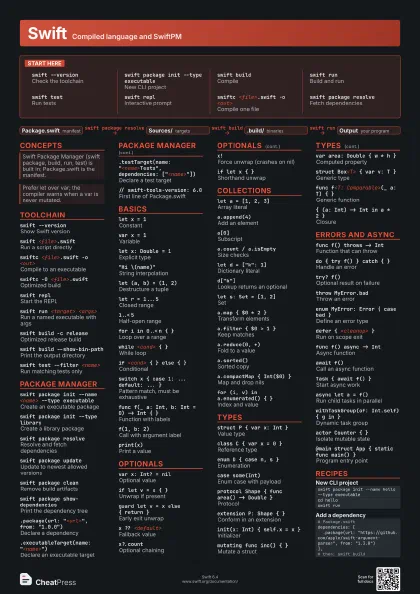
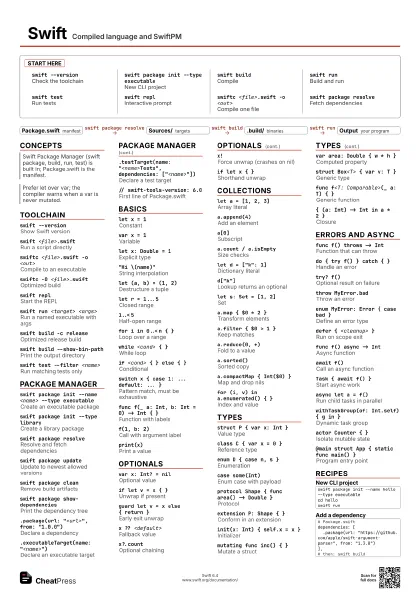
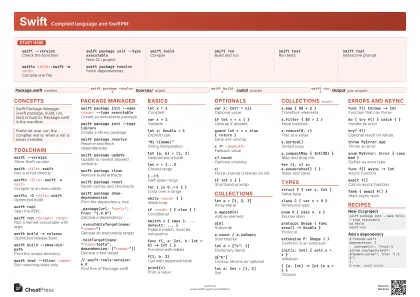 Light · A3 landscape
420 × 297 mm · PDF
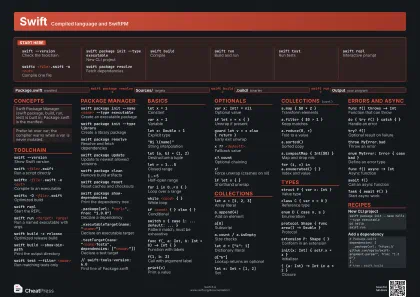 Dark · A3 landscape
420 × 297 mm · PDF
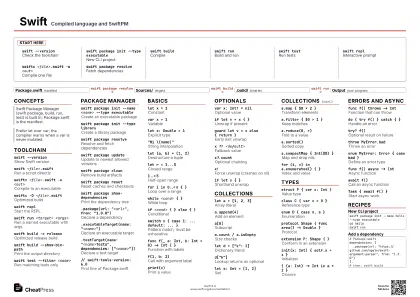 Ink saver · A3 landscape
420 × 297 mm · PDF
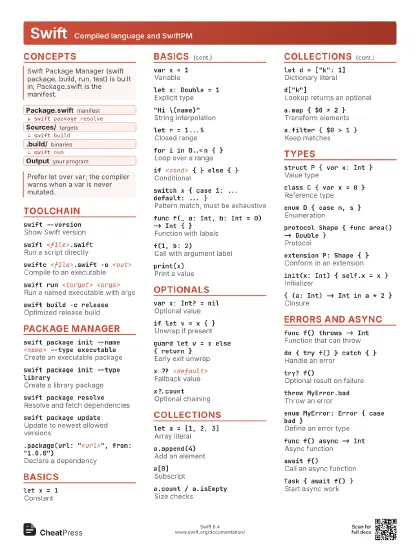
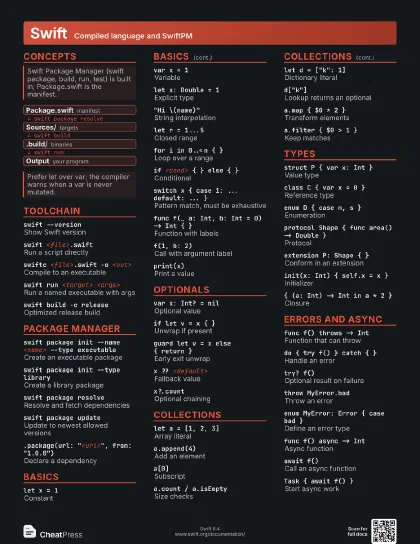
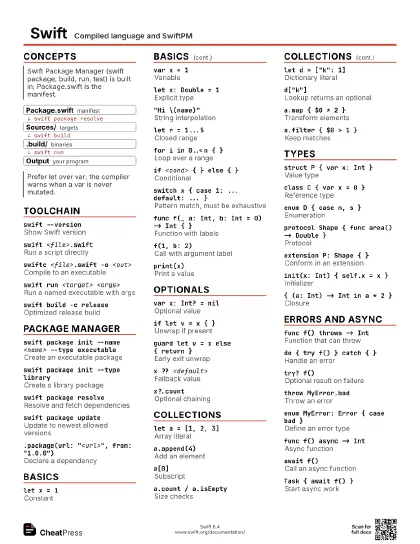
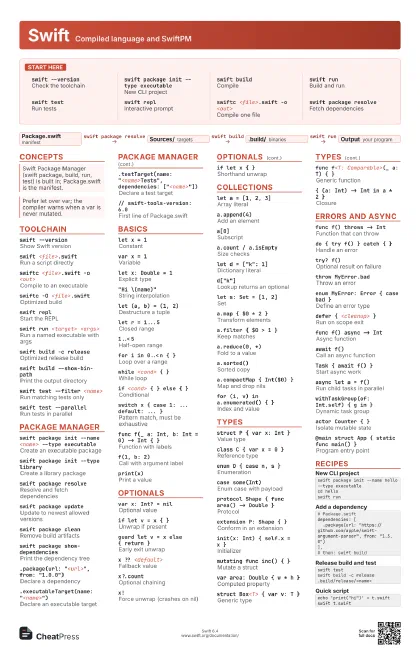
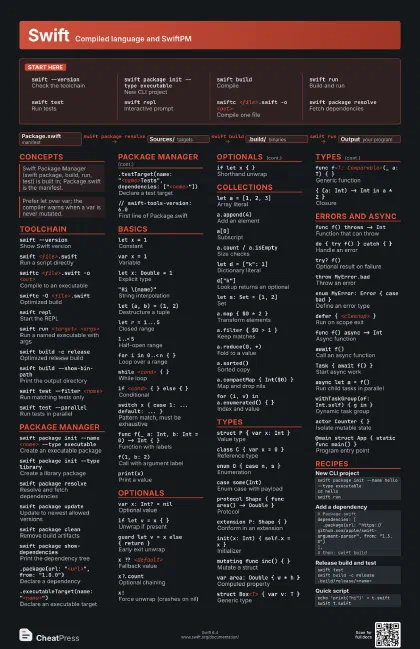
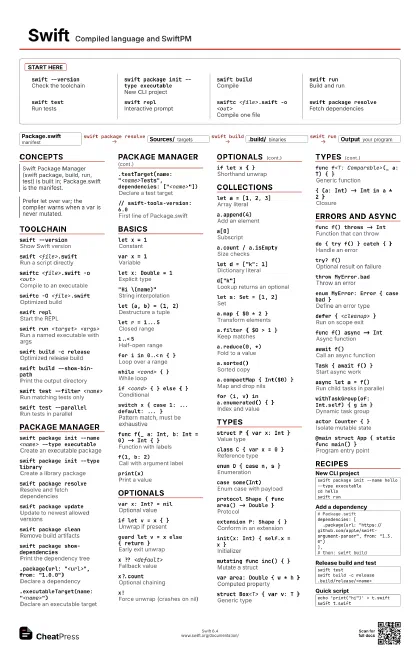
Start here
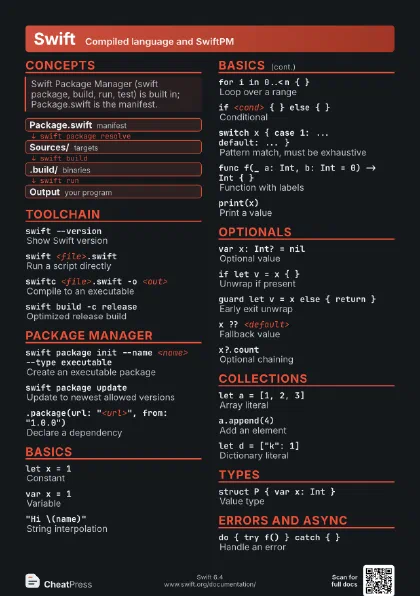
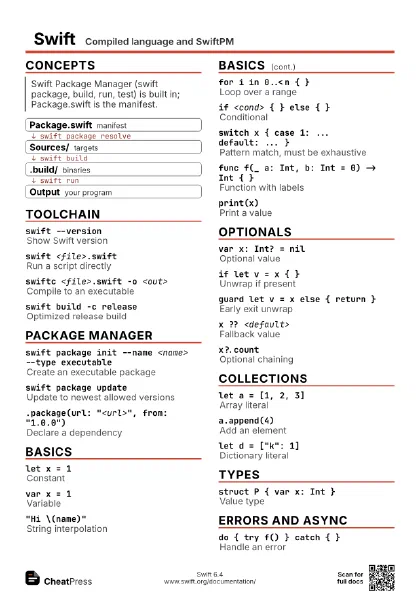
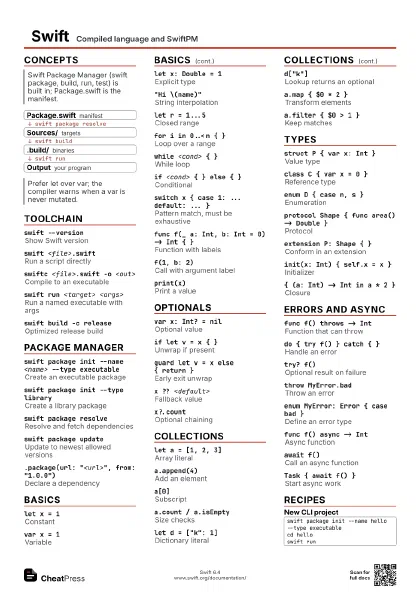
swift --versionCheck the toolchain
swift package init --type executable
New CLI project
swift buildCompile
swift runBuild and run
swift testRun tests
swift replInteractive prompt
swiftc <file>.swift -o <out>
Compile one file
swift package resolve
Fetch dependencies
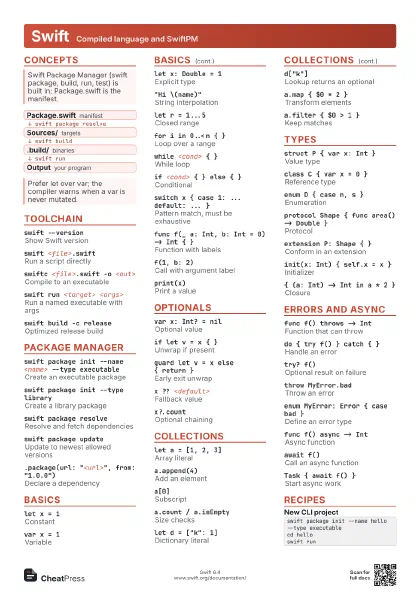
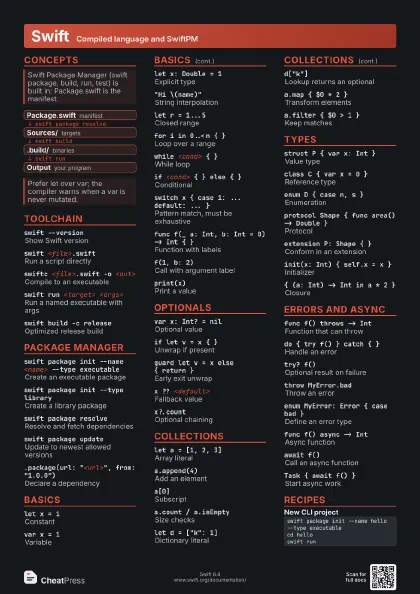
Concepts
- Package.swift manifest
- Sources/ targets
- .build/ binaries
- Output your program
Toolchain
swift --versionShow Swift version
swift <file>.swift
Run a script directly
swiftc <file>.swift -o <out>
Compile to an executable
swiftc -O <file>.swift
Optimized build
swift replStart the REPL
swift run <target> <args>
Run a named executable with args
swift build -c release
Optimized release build
swift build --show-bin-path
Print the output directory
swift test --filter <name>
Run matching tests only
swift test --parallel
Run tests in parallel
Package manager
swift package init --name <name> --type
                    executable
Create an executable package
swift package init --type library
Create a library package
swift package resolve
Resolve and fetch dependencies
swift package update
Update to newest allowed versions
swift package clean
Remove build artifacts
swift package reset
Reset caches and checkouts
swift package show-dependencies
Print the dependency tree
swift package describe
Describe the package
swift package edit <dep>
Work on a dependency locally
.package(url: "<url>", from:
                    "1.0.0")
Declare a dependency
.executableTarget(name: "<name>")
Declare an executable target
.testTarget(name: "<name>Tests",
                    dependencies: ["<name>"])
Declare a test target
// swift-tools-version: 6.0
First line of Package.swift
Basics
let x = 1Constant
var x = 1Variable
let x: Double = 1
Explicit type
"Hi \(name)"
String interpolation
let (a, b) = (1, 2)
Destructure a tuple
let r = 1...5Closed range
1..<5Half-open range
for i in 0..<n { }
Loop over a range
while <cond> { }
While loop
if <cond> { } else { }
Conditional
switch x { case 1: ... default: ... }
Pattern match, must be exhaustive
case 1...5, 10:Several patterns per case
func f(_ a: Int, b: Int = 0) -> Int { }
Function with labels
f(1, b: 2)Call with argument label
let s = """..."""
Multiline string
print(x)Print a value
Optionals
var x: Int? = nil
Optional value
if let v = x { }
Unwrap if present
guard let v = x else { return }
Early exit unwrap
x ?? <default>
Fallback value
x?.countOptional chaining
x!Force unwrap (crashes on nil)
if let x { }Shorthand unwrap
x.map { $0 + 1 }
Transform if present
Collections
let a = [1, 2, 3]
Array literal
a.append(4)Add an element
a[0]Subscript
a.count / a.isEmpty
Size checks
let d = ["k": 1]
Dictionary literal
d["k"]Lookup returns an optional
let s: Set = [1, 2]
Set
a.map { $0 * 2 }
Transform elements
a.filter { $0 > 1 }
Keep matches
a.reduce(0, +)
Fold to a value
a.sorted()Sorted copy
a.compactMap { Int($0) }
Map and drop nils
for (i, v) in a.enumerated() { }
Index and value
Types
struct P { var x: Int }
Value type
class C { var x = 0 }
Reference type
enum D { case n, s }
Enumeration
case some(Int)Enum case with payload
protocol Shape { func area() -> Double }
Protocol
extension P: Shape { }
Conform in an extension
init(x: Int) { self.x = x }
Initializer
mutating func inc() { }
Mutate a struct
var area: Double { w * h }
Computed property
final class C { }
Class that cannot be subclassed
struct Box<T> { var v: T }
Generic type
func f<T: Comparable>(_ a: T) { }
Generic function
{ (a: Int) -> Int in a * 2 }
Closure
@escapingClosure outlives the call
Errors and async
func f() throws -> Int
Function that can throw
do { try f() } catch { }
Handle an error
try? f()Optional result on failure
try! f()Crash on failure
throw MyError.bad
Throw an error
enum MyError: Error { case bad }
Define an error type
defer { <cleanup> }
Run on scope exit
func f() async -> Int
Async function
await f()Call an async function
Task { await f() }
Start async work
async let a = f()
Run child tasks in parallel
withTaskGroup(of: Int.self) { g in }
Dynamic task group
actor Counter { }
Isolate mutable state
@MainActorRun on the main actor
@main struct App { static func main() }
Program entry point
Recipes
swift package init --name hello --type executablecd helloswift run# Package.swiftdependencies: [ .package(url: "https://github.com/apple/swift-argument-parser", from: "1.3.0")],# then: swift buildswift testswift build -c release.build/release/<name>echo 'print("hi")' > t.swiftswift t.swift