Cheat
Gulp Streaming build tasks
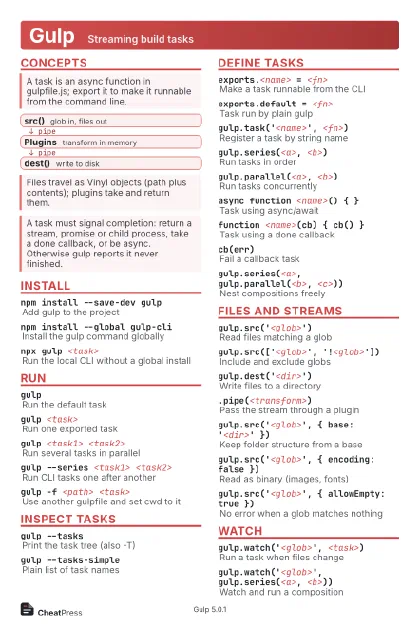 Light · Postcard
102 × 152 mm · PDF
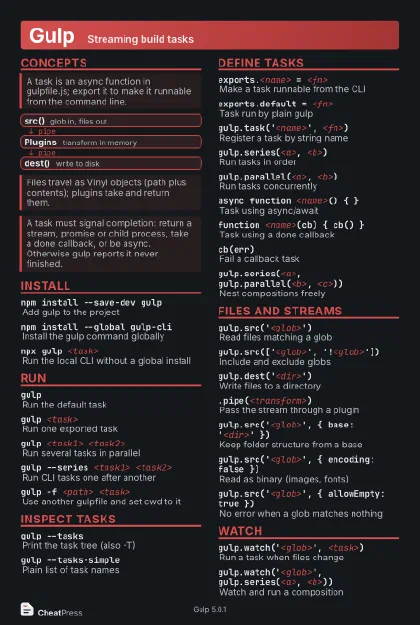 Dark · Postcard
102 × 152 mm · PDF
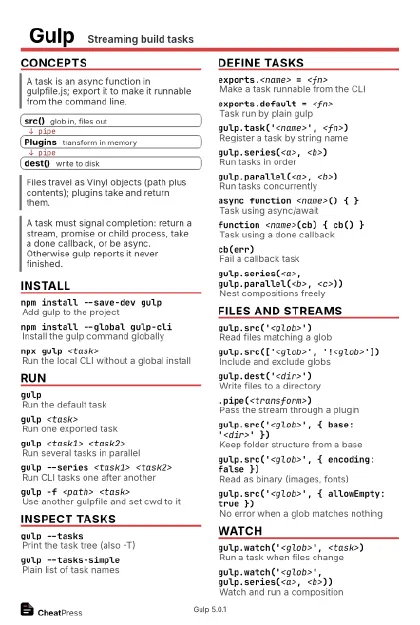 Ink saver · Postcard
102 × 152 mm · PDF
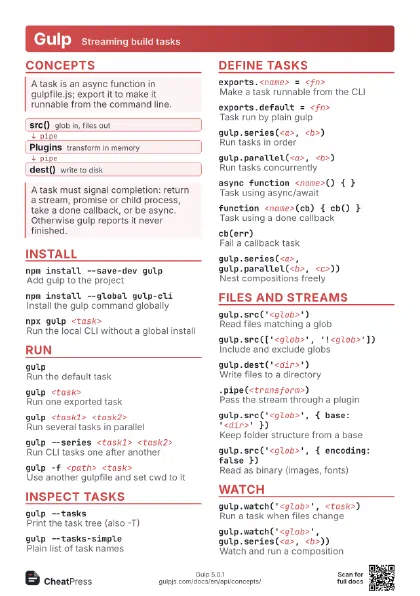
 Light · A4 landscape
297 × 210 mm · PDF
 Dark · A4 landscape
297 × 210 mm · PDF
 Ink saver · A4 landscape
297 × 210 mm · PDF
 Light · A3 landscape
420 × 297 mm · PDF
 Dark · A3 landscape
420 × 297 mm · PDF
 Ink saver · A3 landscape
420 × 297 mm · PDF
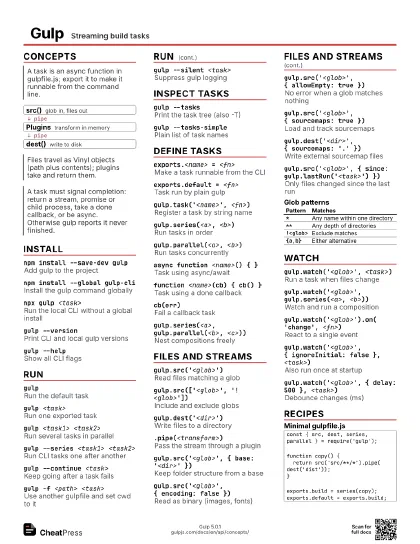
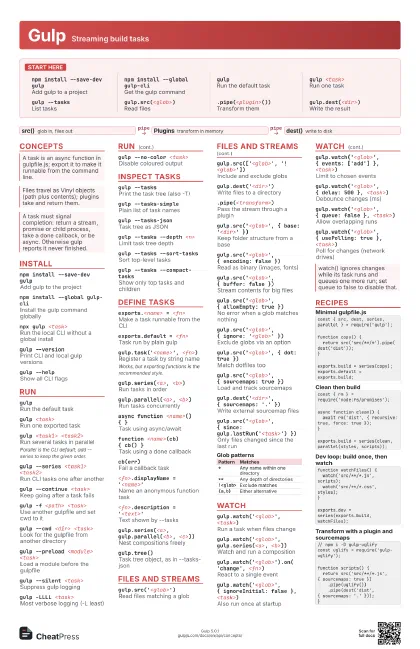
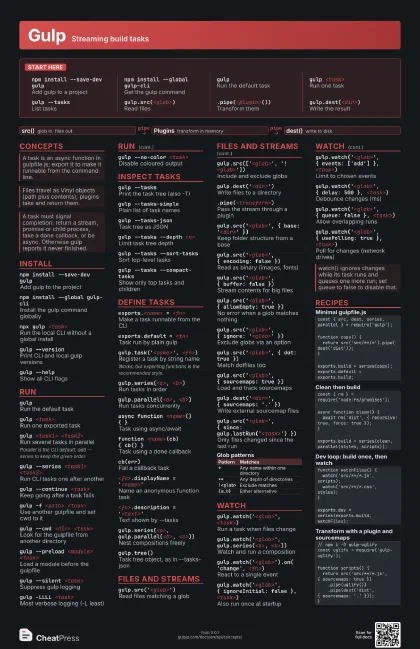
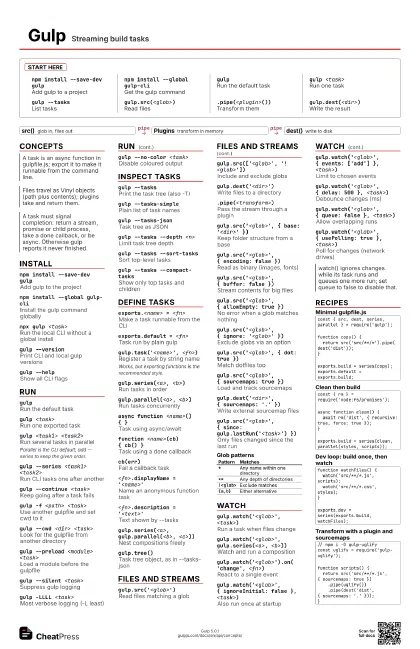
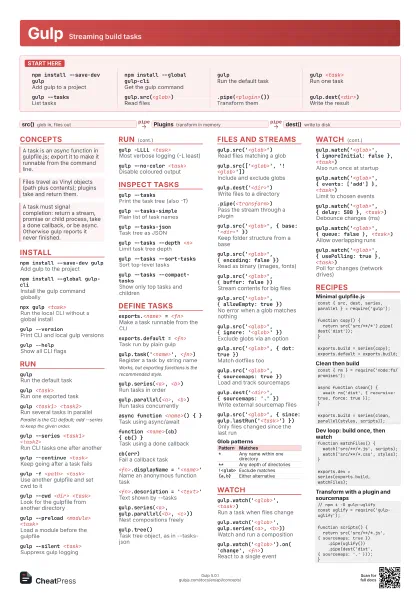
Start here
npm install --save-dev gulp
Add gulp to a project
npm install --global gulp-cli
Get the gulp command
gulpRun the default task
gulp <task>
Run one task
gulp --tasksList tasks
gulp.src(<glob>)
Read files
.pipe(<plugin>())
Transform them
gulp.dest(<dir>)
Write the result
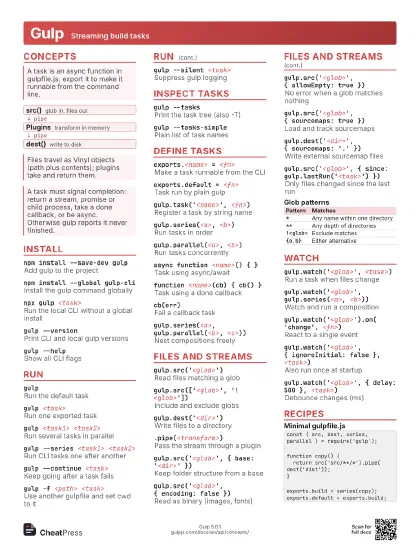
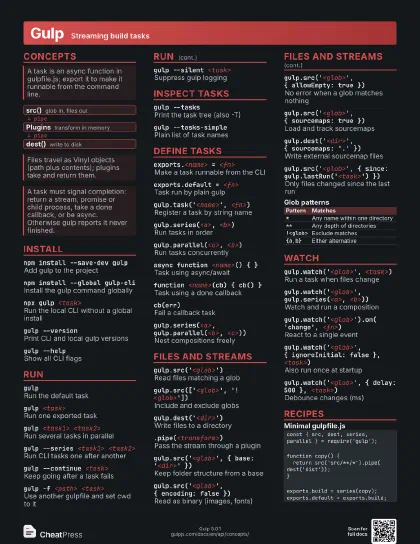
Concepts
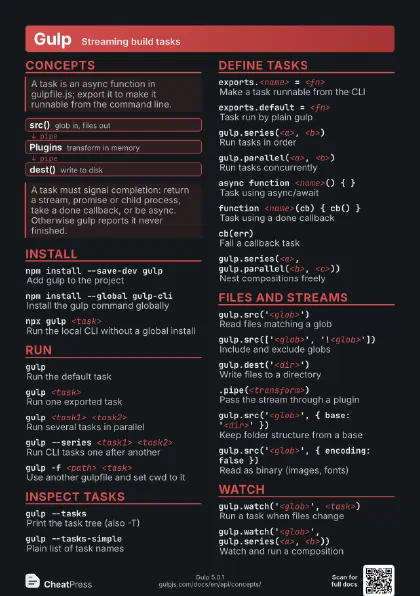
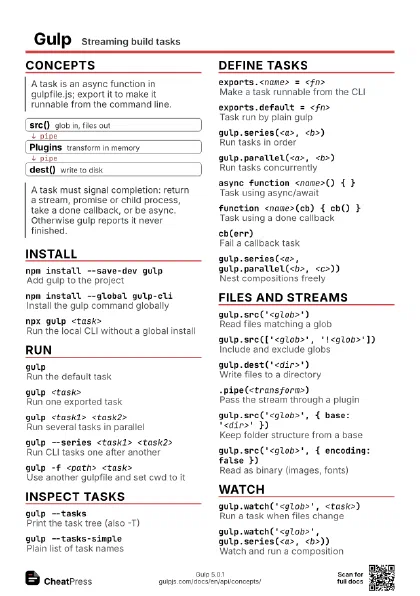
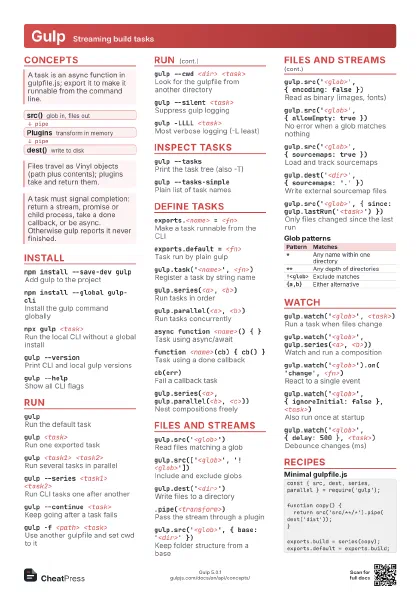
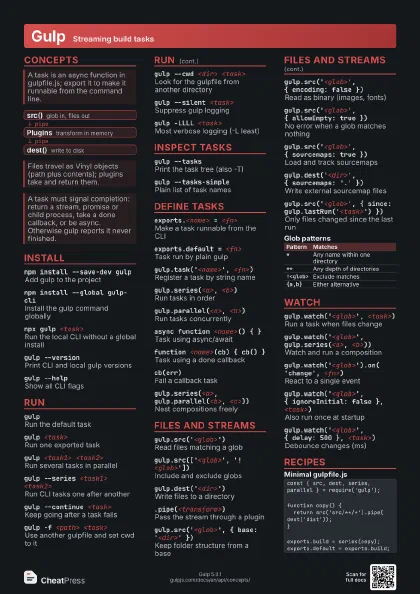
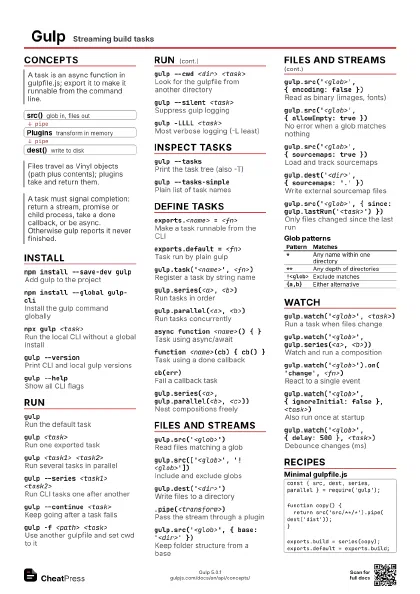
- src() glob in, files out
- Plugins transform in memory
- dest() write to disk
Install
npm install --save-dev gulp
Add gulp to the project
npm install --global gulp-cli
Install the gulp command globally
npx gulp <task>
Run the local CLI without a global install
gulp --versionPrint CLI and local gulp versions
gulp --helpShow all CLI flags
Run
gulpRun the default task
gulp <task>
Run one exported task
gulp <task1> <task2>
Run several tasks in parallel
Parallel is the CLI default; add --series to keep the given
order.
gulp --series <task1> <task2>
Run CLI tasks one after another
gulp --continue <task>
Keep going after a task fails
gulp -f <path> <task>
Use another gulpfile and set cwd to it
gulp --cwd <dir> <task>
Look for the gulpfile from another directory
gulp --preload <module> <task>
Load a module before the gulpfile
gulp --silent <task>
Suppress gulp logging
gulp -LLLL <task>
Most verbose logging (-L least)
gulp --no-color <task>
Disable coloured output
Inspect tasks
gulp --tasksPrint the task tree (also -T)
gulp --tasks-simple
Plain list of task names
gulp --tasks-json
Task tree as JSON
gulp --tasks --depth <n>
Limit task tree depth
gulp --tasks --sort-tasks
Sort top-level tasks
gulp --tasks --compact-tasks
Show only top tasks and children
Define tasks
exports.<name> = <fn>
Make a task runnable from the CLI
exports.default = <fn>
Task run by plain gulp
gulp.task('<name>', <fn>)
Register a task by string name
Works, but exporting functions is the recommended style.
gulp.series(<a>, <b>)
Run tasks in order
gulp.parallel(<a>, <b>)
Run tasks concurrently
async function <name>() { }
Task using async/await
function <name>(cb) { cb() }
Task using a done callback
cb(err)Fail a callback task
<fn>.displayName = '<name>'
Name an anonymous function task
<fn>.description = '<text>'
Text shown by --tasks
gulp.series(<a>, gulp.parallel(<b>,
                    <c>))
Nest compositions freely
gulp.tree()Task tree object, as in --tasks-json
Files and streams
gulp.src('<glob>')
Read files matching a glob
gulp.src(['<glob>',
                    '!<glob>'])
Include and exclude globs
gulp.dest('<dir>')
Write files to a directory
.pipe(<transform>)
Pass the stream through a plugin
gulp.src('<glob>', { base:
                    '<dir>' })
Keep folder structure from a base
gulp.src('<glob>', { encoding: false })
Read as binary (images, fonts)
gulp.src('<glob>', { buffer: false })
Stream contents for big files
gulp.src('<glob>', { allowEmpty: true
                    })
No error when a glob matches nothing
gulp.src('<glob>', { ignore:
                    '<glob>' })
Exclude globs via an option
gulp.src('<glob>', { dot: true })
Match dotfiles too
gulp.src('<glob>', { sourcemaps: true
                    })
Load and track sourcemaps
gulp.dest('<dir>', { sourcemaps: '.'
                    })
Write external sourcemap files
gulp.src('<glob>', { since:
                    gulp.lastRun('<task>') })
Only files changed since the last run
gulp.symlink('<dir>')
Symlink files instead of copying
| Pattern | Matches |
|---|---|
* |
Any name within one directory |
** |
Any depth of directories |
!<glob> |
Exclude matches |
{a,b} |
Either alternative |
Watch
gulp.watch('<glob>', <task>)
Run a task when files change
gulp.watch('<glob>', gulp.series(<a>,
                    <b>))
Watch and run a composition
gulp.watch('<glob>').on('change',
                    <fn>)
React to a single event
gulp.watch('<glob>', { ignoreInitial: false
                    }, <task>)
Also run once at startup
gulp.watch('<glob>', { events:
                    ['add'] }, <task>)
Limit to chosen events
gulp.watch('<glob>', { delay: 500 },
                    <task>)
Debounce changes (ms)
gulp.watch('<glob>', { queue: false },
                    <task>)
Allow overlapping runs
gulp.watch('<glob>', { usePolling: true },
                    <task>)
Poll for changes (network drives)
Recipes
const { src, dest, series, parallel } = require('gulp');function copy() { return src('src/**/*').pipe(dest('dist'));}exports.build = series(copy);exports.default = exports.build;const { rm } = require('node:fs/promises');async function clean() { await rm('dist', { recursive: true, force: true });}exports.build = series(clean, parallel(styles, scripts));function watchFiles() { watch('src/**/*.js', scripts); watch('src/**/*.css', styles);}exports.dev = series(exports.build, watchFiles);// npm i -D gulp-uglifyconst uglify = require('gulp-uglify');function scripts() { return src('src/**/*.js', { sourcemaps: true }) .pipe(uglify()) .pipe(dest('dist', { sourcemaps: '.' }));}