Cheat
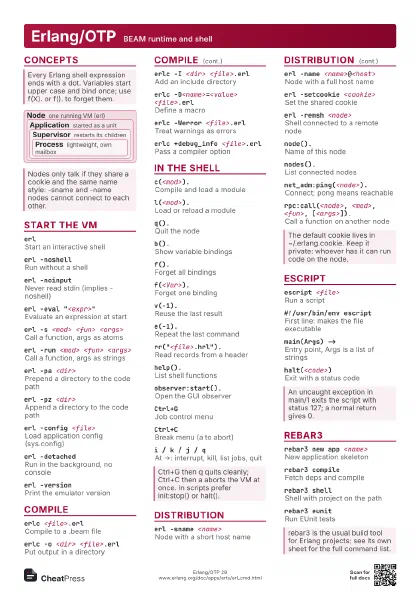
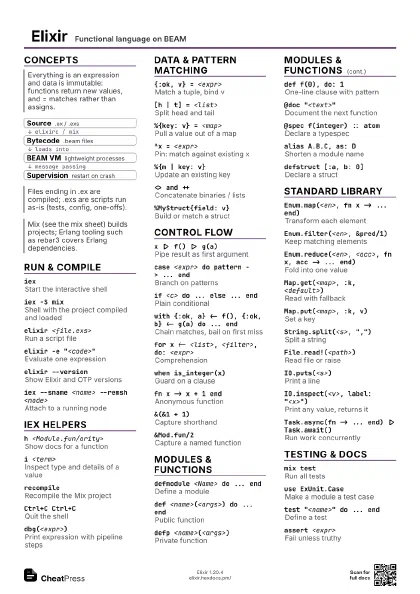
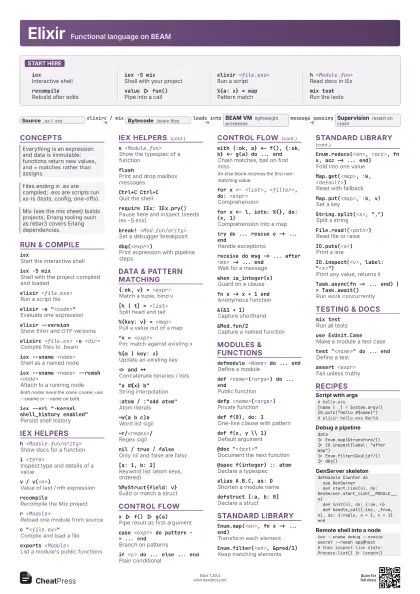
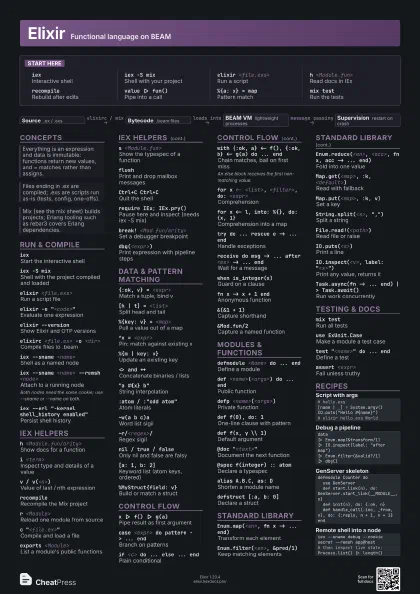
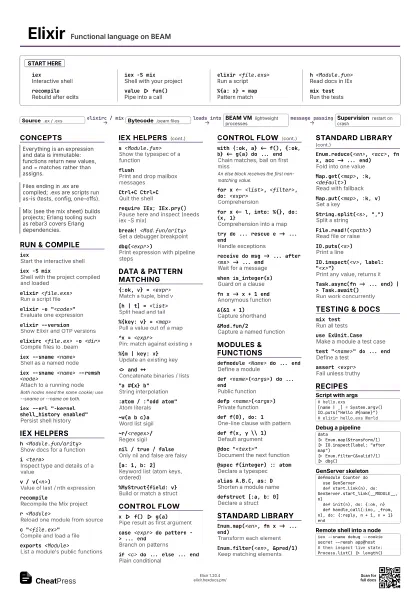
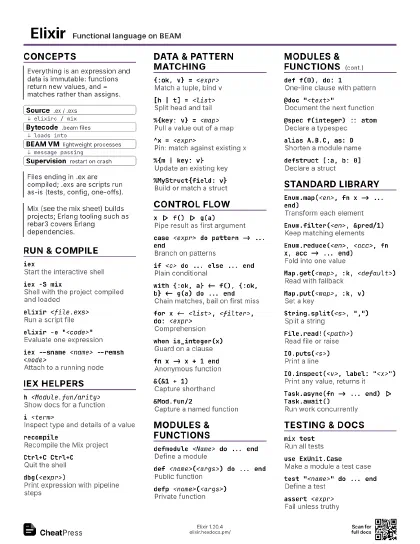
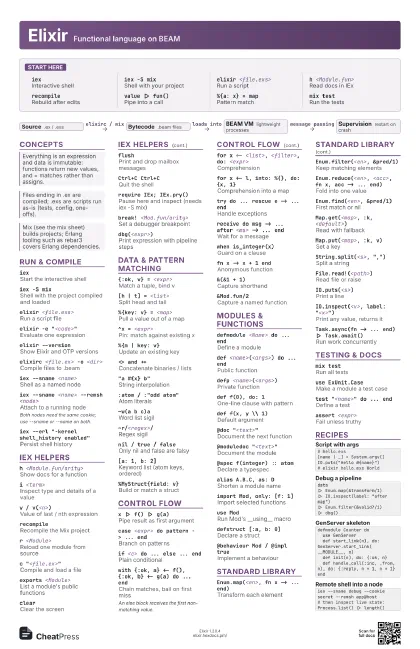
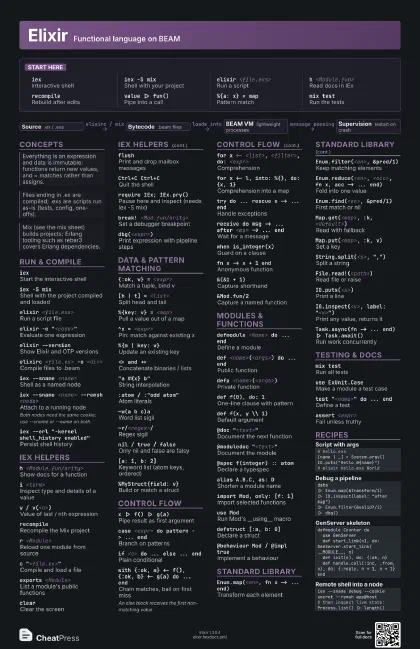
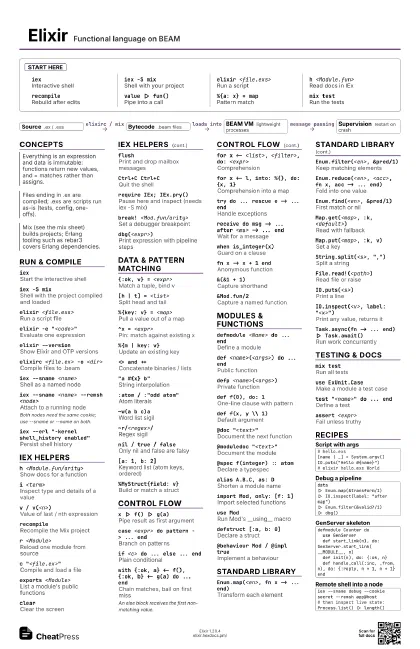
Elixir Functional language on BEAM
 Light · Postcard
102 × 152 mm · PDF
 Dark · Postcard
102 × 152 mm · PDF
 Ink saver · Postcard
102 × 152 mm · PDF
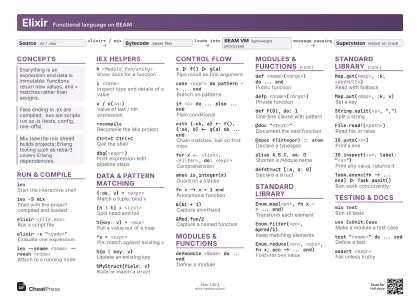 Light · A4 landscape
297 × 210 mm · PDF
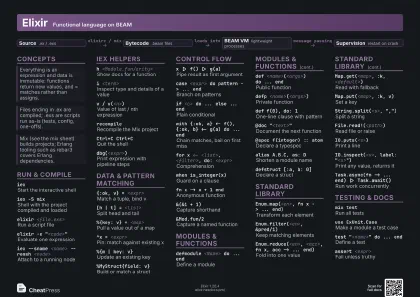 Dark · A4 landscape
297 × 210 mm · PDF
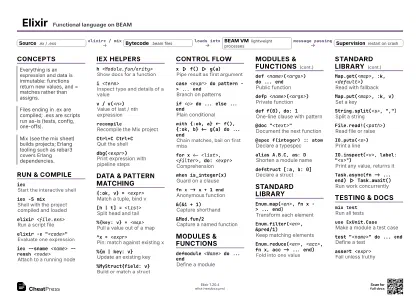 Ink saver · A4 landscape
297 × 210 mm · PDF
 Light · A3 landscape
420 × 297 mm · PDF
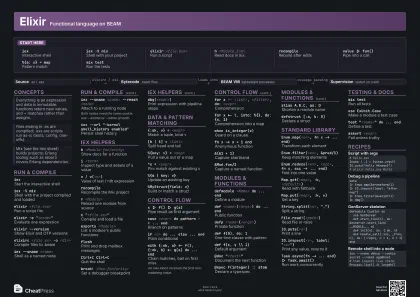 Dark · A3 landscape
420 × 297 mm · PDF
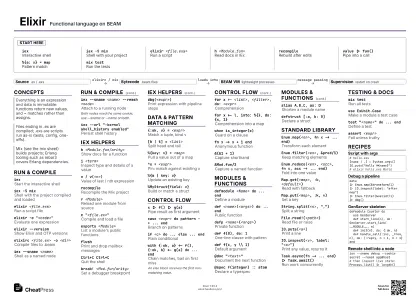 Ink saver · A3 landscape
420 × 297 mm · PDF
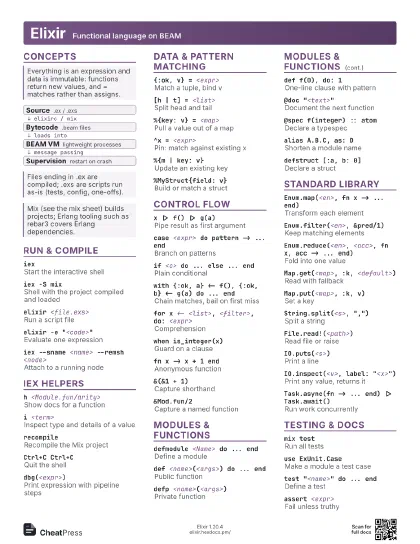
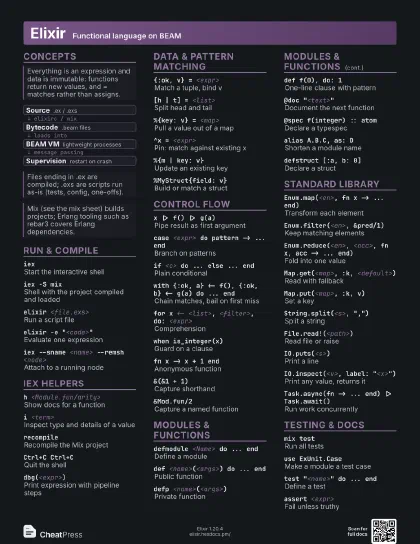
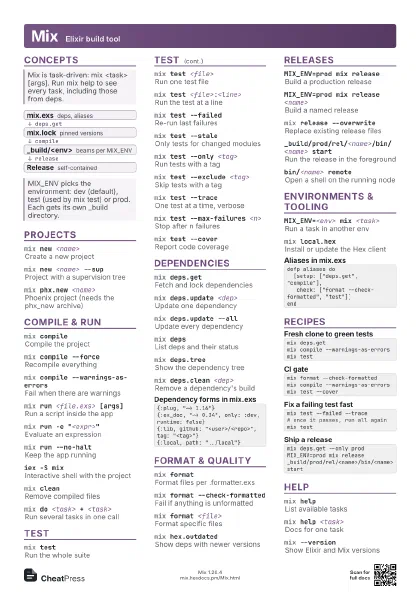
Start here
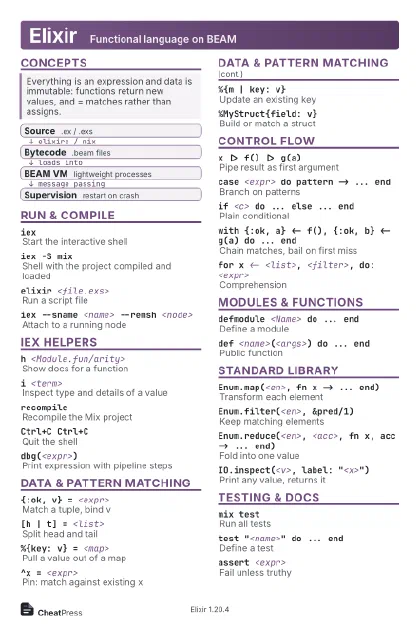
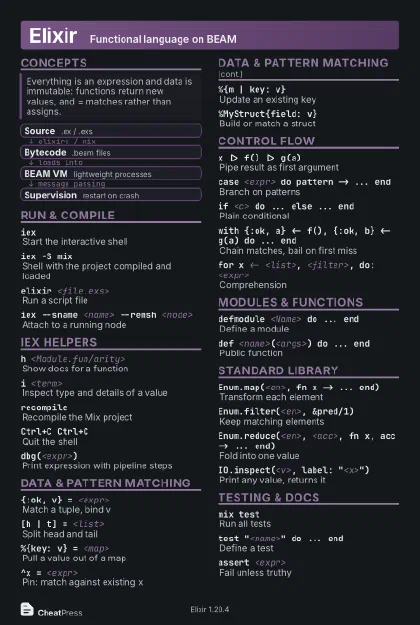
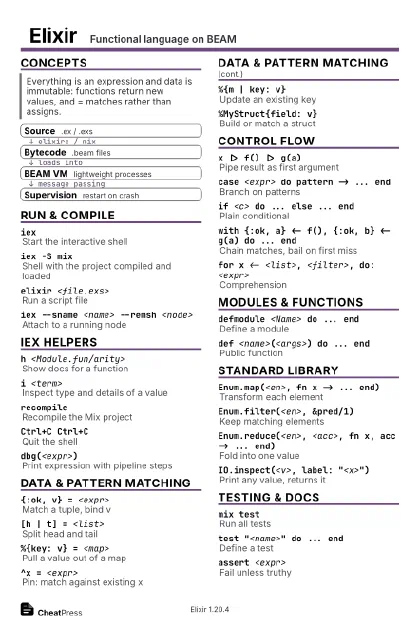
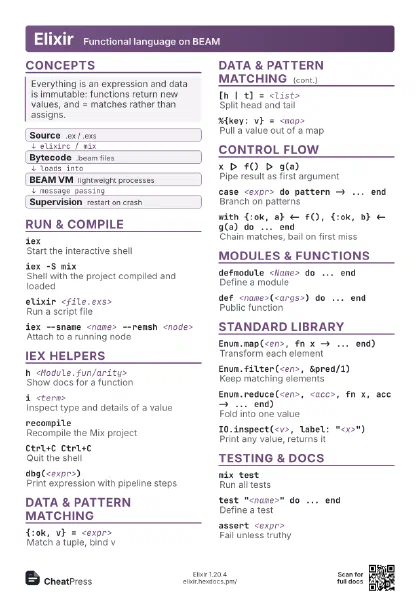
iexInteractive shell
iex -S mixShell with your project
elixir <file.exs>
Run a script
h <Module.fun>
Read docs in IEx
recompileRebuild after edits
value |> fun()
Pipe into a call
%{a: x} = mapPattern match
mix testRun the tests
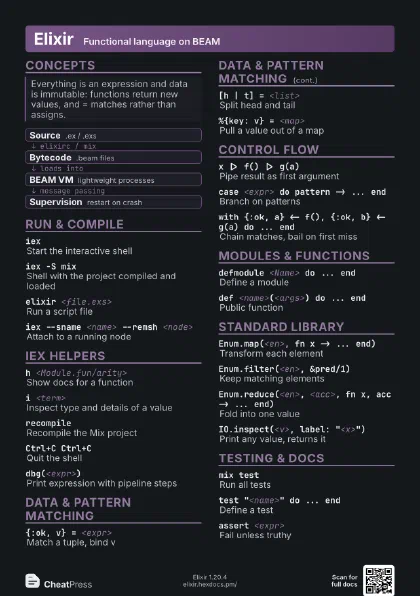
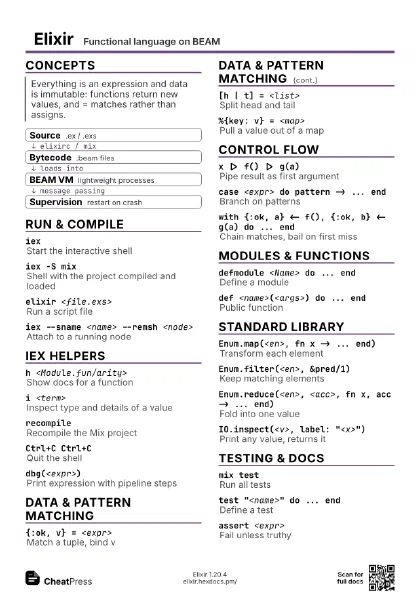
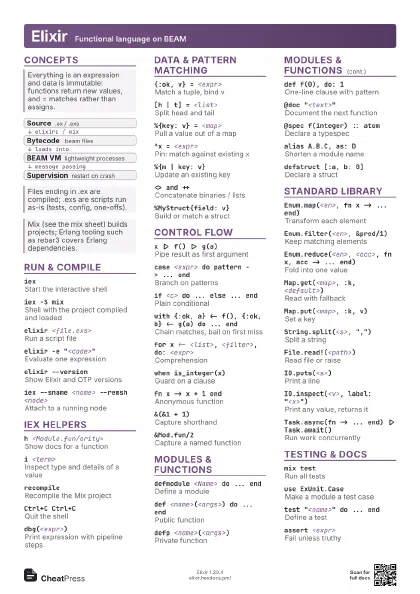
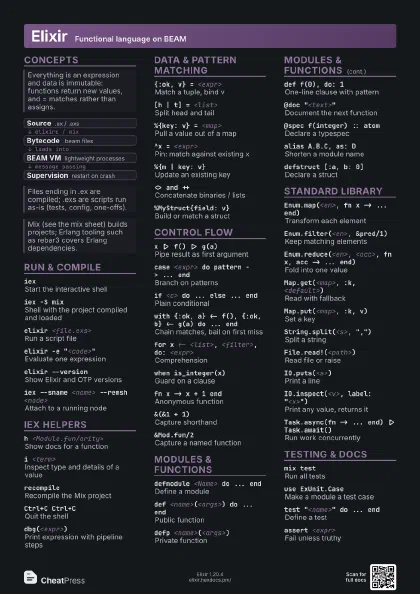
Concepts
- Source .ex / .exs
- Bytecode .beam files
- BEAM VM lightweight processes
- Supervision restart on crash
Run & compile
iexStart the interactive shell
iex -S mix
Shell with the project compiled and loaded
elixir <file.exs>
Run a script file
elixir -e "<code>"
Evaluate one expression
elixir --version
Show Elixir and OTP versions
elixirc <file.ex> -o <dir>
Compile files to .beam
iex --sname <name>
Shell as a named node
iex --sname <name> --remsh <node>
Attach to a running node
Both nodes need the same cookie; use --sname or --name on
both.
iex --erl "-kernel shell_history enabled"
Persist shell history
IEx helpers
h <Module.fun/arity>
Show docs for a function
i <term>Inspect type and details of a value
v / v(<n>)
Value of last / nth expression
recompileRecompile the Mix project
r <Module>
Reload one module from source
c "<file.ex>"
Compile and load a file
exports <Module>
List a module's public functions
s <Module.fun>
Show the typespec of a function
clearClear the screen
flushPrint and drop mailbox messages
Ctrl+C Ctrl+C
Quit the shell
require IEx; IEx.pry()
Pause here and inspect (needs iex -S mix)
break! <Mod.fun/arity>
Set a debugger breakpoint
dbg(<expr>)
Print expression with pipeline steps
Data & pattern matching
{:ok, v} = <expr>
Match a tuple, bind v
[h | t] = <list>
Split head and tail
%{key: v} = <map>
Pull a value out of a map
^x = <expr>
Pin: match against existing x
%{m | key: v}Update an existing key
<> and ++
Concatenate binaries / lists
"a #{x} b"
String interpolation
:atom / :"odd atom"
Atom literals
~w(a b c)aWord list sigil
~r/<regex>/
Regex sigil
nil / true / false
Only nil and false are falsy
[a: 1, b: 2]Keyword list (atom keys, ordered)
%MyStruct{field: v}
Build or match a struct
Control flow
x |> f() |> g(a)
Pipe result as first argument
case <expr> do pattern -> ... end
Branch on patterns
if <c> do ... else ... end
Plain conditional
with {:ok, a} <- f(), {:ok, b} <- g(a) do ...
                    end
Chain matches, bail on first miss
An else block receives the first non-matching value.
for x <- <list>, <filter>, do:
                    <expr>
Comprehension
for x <- l, into: %{}, do: {x, 1}
Comprehension into a map
try do ... rescue e -> ... end
Handle exceptions
receive do msg -> ... after <ms> -> ...
                    end
Wait for a message
when is_integer(x)
Guard on a clause
fn x -> x + 1 end
Anonymous function
&(&1 + 1)
Capture shorthand
&Mod.fun/2Capture a named function
Modules & functions
defmodule <Name> do ... end
Define a module
def <name>(<args>) do ... end
Public function
defp <name>(<args>)
Private function
def f(0), do: 1One-line clause with pattern
def f(x, y \\ 1)
Default argument
@doc "<text>"
Document the next function
@moduledoc "<text>"
Document the module
@spec f(integer) :: atom
Declare a typespec
alias A.B.C, as: D
Shorten a module name
import Mod, only: [f: 1]
Import selected functions
use ModRun Mod's __using__ macro
defstruct [:a, b: 0]
Declare a struct
@behaviour Mod / @impl true
Implement a behaviour
quote do ... end / unquote(x)
Build and inject AST
__MODULE__Name of the current module
Standard library
Enum.map(<en>, fn x -> ... end)
Transform each element
Enum.filter(<en>, &pred/1)
Keep matching elements
Enum.reduce(<en>, <acc>, fn x, acc -> ...
                    end)
Fold into one value
Enum.sort_by(<en>, & &1.key)
Sort by a derived key
Enum.group_by(<en>, &fun/1)
Group into a map
Enum.find(<en>, &pred/1)
First match or nil
Enum.each(<en>, &IO.inspect/1)
Run for side effects
Stream.map(<en>, f) |> Enum.take(<n>)
Lazy pipeline
Map.get(<map>, :k, <default>)
Read with fallback
Map.put(<map>, :k, v)
Set a key
String.split(<s>, ",")
Split a string
File.read!(<path>)
Read file or raise
IO.puts(<s>)
Print a line
IO.inspect(<v>, label: "<x>")
Print any value, returns it
Task.async(fn -> ... end) |> Task.await()
Run work concurrently
spawn(fn -> ... end)
Start a process
send(<pid>, <msg>)
Send a message
Testing & docs
mix testRun all tests
use ExUnit.CaseMake a module a test case
test "<name>" do ... end
Define a test
assert <expr>
Fail unless truthy
mix formatFormat the project
iex> 1 + 1 2
Doctest example in @doc
Recipes
# hello.exs[name | _] = System.argv()IO.puts("Hello #{name}")# elixir hello.exs Worlddata|> Enum.map(&transform/1)|> IO.inspect(label: "after map")|> Enum.filter(&valid?/1)|> dbg()defmodule Counter do use GenServer def start_link(n), do: GenServer.start_link(__MODULE__, n) def init(n), do: {:ok, n} def handle_call(:inc, _from, n), do: {:reply, n + 1, n + 1}endiex --sname debug --cookie secret --remsh app@host# then inspect live state:Process.list() |> length()